

2002-2003 Ford E-Series Fuel Pump: Decoding Production Dates and Failure Symptoms
This guide covers the common failure points, critical production date fitment, and replacement tips for the midship fuel pump in 2002-2003 Ford Econoline vans.
- Fitment is determined by a strict production date window: from June 4, 2002 for 2002 models, and on or before Oct 11, 2002 for 2003 models. Always verify your van's build date on the door jamb sticker.
- Replacement requires dropping the midship fuel tank, making it a moderately difficult job (4/5) for a DIYer.
- Common failure symptoms include engine hesitation, stalling, a long crank time, and a distinct whining noise from the tank area.
- A quality used OEM assembly is often a more reliable choice than a cheap new aftermarket pump due to better component quality and fuel gauge accuracy.
Symptoms of a Failing Fuel Pump

A failing fuel pump in the 2002-2003 Ford E-150, E-250, E-350, E-450, or E-550 can manifest in several ways. Often, the symptoms can be intermittent at first, becoming more consistent as the pump wears out. Recognizing these signs early can prevent you from being stranded.
- Engine Sputtering or Hesitation: The van may sputter or hesitate, especially under acceleration or when climbing a hill. This happens when the weak pump can't supply the extra fuel the engine demands.
- Difficulty Starting or Long Crank Time: The engine may take longer than usual to start because the pump isn't building up enough pressure in the fuel lines right away. In advanced cases, it may crank but fail to start at all.
- Sudden Stalling: The engine may stall unexpectedly, even while driving. This is a dangerous symptom caused by a complete, momentary interruption of fuel flow.
- Whining Noise from the Fuel Tank: A loud, high-pitched whining or buzzing sound from the mid-section of the van (where the tank is located) is a classic sign of a struggling fuel pump motor. You may hear it when you first turn the key to the 'on' position.
- Loss of Power: The vehicle may feel sluggish and lack its normal power, as the engine is being starved of fuel.
- Check Engine Light: Low fuel pressure can cause the engine to run lean (too much air, not enough fuel), which may trigger lean-related diagnostic trouble codes like P0171 and P0174. 🎬 Watch this diagnostic guide for fixing P0171 and P0174 lean codes.
Pro Tip: A quick diagnostic check is to listen for the pump to prime. When you turn the key to the 'on' position (without starting the engine), you should hear a faint 2-3 second hum from the fuel tank area. If you hear nothing, the pump may not be receiving power or may have failed completely. If you hear a loud whine, the pump is likely wearing out.
Critical Fitment Information: Production Dates

Compatibility for this fuel pump is extremely specific and depends on your van's production date, not just the model year. Ordering the wrong part will lead to wasted time and money. This 2-port fuel pump assembly is for the midship fuel tank only.
Warning: Before ordering, you MUST verify your vehicle's production date. This part fits:
- 2002 Models: Built from June 4, 2002, onward.
- 2003 Models: Built on or before October 11, 2002.
You can find the production date printed on the Safety Compliance Certification Label, which is located on the driver's side door jamb. It will be clearly labeled as "DATE" at the top of the sticker.
Buying a Used Fuel Pump: What to Check

For many owners, a quality used OEM fuel pump is a smart choice, offering factory reliability at a fraction of the cost of a new dealer part. However, you need to know what to look for.
- Verify Compatibility First: Double-check the production date of the donor vehicle against the fitment requirements. Do not buy a pump unless you can confirm it came from a van built within the specified date range.
- Physical Inspection: Examine the pump assembly closely. Look for any cracks or damage to the plastic housing. Ensure the electrical connector pins are clean, straight, and free of corrosion. The fuel line ports should be intact and not brittle.
- Check the Strainer: While the strainer (the 'sock' at the bottom) should always be replaced, its condition can tell you about the health of the tank it came from. A strainer that is black and clogged with debris suggests the pump may have been overworked.
- Mileage Considerations: While fuel pumps don't have a set lifespan, lower mileage is always better. A pump from a vehicle with under 150,000 miles is preferable. Ask the seller for the mileage of the donor vehicle if possible.
- Why Used OEM is Often Better Than New Aftermarket: Cheap, new aftermarket pumps are a gamble. They often use lower-quality internal components that can fail prematurely. More importantly, their fuel level sending units can be inaccurate, leading to a fuel gauge that is always wrong. A used OEM pump, like the one your van came with, has been tested for millions of miles and is more likely to have an accurate and reliable sending unit.
Replacement Overview
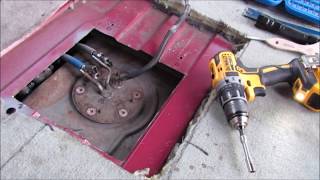
Replacing the fuel pump on these E-Series vans is a moderately difficult job because it requires dropping the fuel tank. There is no factory-installed access panel in the floor of the van. While some owners cut their own access hatch, 🎬 See how to replace the pump through a custom access hole. the standard procedure is to lower the tank from underneath the vehicle.
Difficulty: 4 out of 5 (for experienced DIYers)
Estimated Time: 3-5 hours
The basic steps involve:
- Relieving fuel system pressure and disconnecting the battery.
- Siphoning as much fuel as possible from the tank. A full tank is extremely heavy and dangerous to handle.
- Raising and supporting the vehicle safely.
- Disconnecting the fuel filler and vent hoses.
- Supporting the fuel tank with a transmission jack or floor jacks.
- Disconnecting the fuel lines and electrical connector from the top of the tank.
- Unbolting the two tank straps and carefully lowering the tank.
- Cleaning the top of the tank before removing the pump to prevent debris from falling in. 🎬 Watch a step-by-step walkthrough of the full fuel pump replacement.
- Removing the lock ring, pulling out the old pump assembly, and installing the new one.
- Re-installing the tank by reversing the steps.
Warning: Working with gasoline is extremely dangerous. Work in a well-ventilated area away from any open flames or sources of sparks. Have a fire extinguisher rated for gasoline fires (Class B) nearby.
Cost Comparison
Prices can vary based on location and supplier, but here is a general breakdown of what to expect.
| Part Type | Estimated Cost |
|---|---|
| New OEM (Dealer) | $250 - $410 |
| New Aftermarket | $60 - $260 |
| Used OEM | $75 - $150 |
| Shop Labor | $350 - $550 |
Known Issues, Recalls, and Technical Service Bulletins (TSBs)
As of early 2026, there are no specific safety recalls or widely published Technical Service Bulletins (TSBs) from Ford for fuel pump failures on the 2002-2003 E-Series vans. The fuel pump recalls that have been in the news are for much newer Ford models and do not apply to this generation. Failure is typically due to normal wear and tear over many years and miles.
OEM Part Numbers
This guide covers the fuel pump assembly which may be identified by the following Ford part numbers. Part numbers can supersede over time, but these are known references for this specific assembly.
- 2C249H307DA
- 2C24DA
- 2C2Z9H307AA
- 2C2Z9H307AB
- 2C2Z9H307DA
- 3C2Z9H307CA
- 3C2Z9H307CB
Frequently Asked Questions (FAQ)
Do I have to drop the fuel tank to replace the pump?
Yes. On the 2002-2003 Ford E-Series vans, there is no factory access panel in the floor. The only standard way to access the fuel pump is to lower the midship fuel tank from underneath the vehicle.
My van cranks but won't start. Could it be the fuel pump?
Yes, a failed fuel pump is a very common cause of a crank/no-start condition. The engine is turning over, but it's not receiving the fuel it needs to fire. Other potential causes include a bad fuel pump relay, a tripped inertia switch, or a clogged fuel filter, so a full diagnosis is recommended.
How do I find my van's production date?
The production date is printed on the white and black sticker on the driver's side door jamb (the B-pillar). It will be listed at the top of the sticker, usually in a MM/YY format.
Can I just replace the pump motor instead of the whole assembly?
While it is sometimes possible to buy just the internal pump motor, it is not recommended. The fuel level sending unit and the internal wiring are also common failure points. Replacing the entire module ensures all components are new (or in good working order, for a used OEM part) and reduces the chance you'll have to do the job again soon for a different failed component within the same assembly.
Helpful Videos
Technical Specifications
OEM Part Numbers: 2C249H307DA 2C24DA 2C2Z9H307AA 2C2Z9H307AB 2C2Z9H307DA 3C2Z9H307CA 3C2Z9H307CB
2-port fuel pump assembly for midship fuel tank.
We Have This Part in Stock



The information in this article is provided for general reference and educational purposes only. Vehicle specifications, procedures, and part compatibility can vary by production date, trim level, and region. Always consult your vehicle's factory service manual and verify part numbers before purchasing or performing repairs. Safety-critical components such as airbags, seat belts, and braking systems should be installed by a qualified professional.
- Ford E-150:
- Ford E-250:
- Ford E-350 Super Duty:
- Ford E-450 Super Duty:
- Ford E-550 Super Duty:
- 🎬 Helpful Videos
- 🛍️ Shop This Part
- Symptoms of a Failing Fuel Pump
- Critical Fitment Information: Production Dates
- Buying a Used Fuel Pump: What to Check
- Replacement Overview
- Cost Comparison
- Known Issues, Recalls, and Technical Service Bulletins (TSBs)
- OEM Part Numbers
- Frequently Asked Questions (FAQ)
- 🎟️ Get 5% Off