

2018-2023 Kia Stinger Fuel Pump Control Module: Diagnosis, Location, and Replacement
This guide clarifies the role of the Fuel Pump Control Module, its failure symptoms, and how it differs from the Stinger's recalled high-pressure fuel pump.
- This module is NOT the same as the High-Pressure Fuel Pump (HPFP) that was recalled on 2.0L Stinger models.
- A replacement Fuel Pump Control Module does NOT require special programming; it is a plug-and-play part, though clearing codes is recommended.
- Symptoms of failure include stalling, no-start, and hesitation, often with codes P025C or P0087.
- The module is located in the trunk behind the right-side trim panel, making it relatively easy to access and replace.
Symptoms of a Failing Fuel Pump Control Module
When the FPCM begins to fail, it can starve the engine of fuel intermittently or completely. The symptoms can sometimes be mistaken for a bad fuel pump. Look for these specific warning signs:
- Engine Stalling: The engine may stall unexpectedly while driving or when stopped at idle. It might restart after a few minutes as if nothing happened, only to stall again later. This happens when the module overheats or has an internal fault, cutting power to the fuel pump.
- Hard Start or No-Start: You may find the engine cranks but refuses to start, or takes much longer than usual to fire up. A faulty FPCM may not be sending the signal to the fuel pump to 'prime' the system when you turn the key. You might notice the faint humming sound from the fuel pump is absent when you first turn the ignition on.
- Hesitation and Power Loss: During acceleration, the vehicle may hesitate, jerk, or feel sluggish. This indicates the module isn't commanding the fuel pump to increase its speed to meet the engine's demand for more fuel.
- Check Engine Light: A failing FPCM will often trigger a Check Engine Light.
Common OBD-II Trouble Codes
If you have a Check Engine Light, scanning for codes is the first step. Codes related to an FPCM issue include:
- P025C - Fuel Pump Module Control Circuit Low: This code points directly to a problem with the FPCM or its wiring, indicating the control circuit is reading a lower-than-expected voltage.
- P0087 - Fuel Rail/System Pressure - Too Low: While this can have several causes, a faulty FPCM is a primary suspect because it directly controls the low-pressure fuel supply. If the module doesn't run the pump correctly, pressure will drop.
Important: Related Fuel System Recalls & TSBs
It is critical to distinguish a Fuel Pump Control Module failure from other known fuel system issues on the Kia Stinger. The symptoms can be very similar. Before replacing any parts, check if your vehicle has had these free recall services performed by a Kia dealer.
Confusion Alert: The most common fuel-related issue on the Stinger is not the Fuel Pump Control Module. It is the High-Pressure Fuel Pump (HPFP), which is a completely different part located on the engine.
- NHTSA Recall 23V-634 (Kia Campaign SC281): This major safety recall affects 2018-2021 Kia Stingers with the 2.0L Turbo engine. The internal plunger in the High-Pressure Fuel Pump (HPFP) can stick, causing fuel over-pressurization and a sudden loss of driving power. The fix involves a dealer inspection, replacement of the HPFP if needed, and an essential Engine Control Unit (ECU) software update.
- Kia Campaign SC198: This recall affects a smaller number of 2020-2021 Stinger models. A plastic burr from manufacturing could block the fuel pump's jet nozzle, leading to insufficient fuel supply and potential loss of power. The fix is an inspection and, if needed, replacement of the jet nozzle housing assembly.
Because symptoms like stalling and power loss overlap, always verify these recalls have been addressed before diagnosing the FPCM.
Buying a Used Fuel Pump Control Module
If you've ruled out other issues and identified the FPCM as the problem, a used OEM module is an excellent, cost-effective option. The FPCM on the Stinger appears to be a reliable part, so a low-mileage used unit should have plenty of life left.
What to Look For:
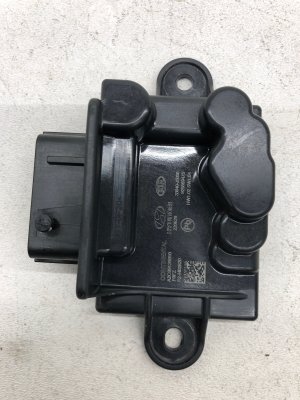
- Match the Part Number: The only way to guarantee compatibility is to match the OEM part number. The correct number for all 2018-2023 Kia Stingers is 33040-J5000 (or 33040J5000).
- Inspect the Pins: Check the electrical connector pins on the used module. They should be straight, clean, and free of any green or white corrosion.
- Check the Casing: The black plastic housing should be free of cracks, heat damage, or signs of water intrusion. Since this module is located inside the trunk, it is well-protected from the elements, so any damage is a red flag.
- Why Used OEM is a Good Choice: For an electronic controller like this, a used OEM part is often superior to a new, cheap aftermarket alternative. The OEM unit was designed and validated by Kia for the vehicle's specific systems. Aftermarket modules can sometimes have software or firmware quirks that cause unpredictable behavior.
Programming, Installation, and Location
Does the module need to be programmed?
No, programming does not appear to be required. Official Kia service documents for the 2018-2023 Stinger do not list programming or VIN-linking as a step for replacing the FPCM. The procedure is to install the new module, connect it, and then use a diagnostic tool to check for and clear any stored trouble codes. While some sellers add a generic "programming required" disclaimer to all electronics, the factory procedure suggests this part is plug-and-play.
Location on Vehicle
The Fuel Pump Control Module is located inside the trunk. You will find it mounted behind the luggage side trim on the right-hand (passenger) side of the vehicle, near the fuel tank area.
Installation Overview
Replacing the module is a straightforward job suitable for a DIYer with basic tools.
- Disconnect the negative battery terminal.
- Access the trunk and remove the rear transverse trim and the right-hand side luggage trim panel to expose the module.
- Disconnect the single electrical connector from the FPCM.
- Remove the mounting nuts that secure the module to the vehicle body.
- Install the new module and tighten the nuts.
- Reconnect the electrical connector and reinstall the trunk trim panels.
- Reconnect the battery, start the vehicle to verify the repair, and clear any lingering DTCs with a scan tool.
Cost to Replace a Kia Stinger FPCM
The cost for this repair is relatively low, especially if you use a recycled OEM part.
| Part Type | Estimated Cost |
|---|---|
| New OEM (Kia) | $110 - $165 |
| Used OEM (Recycled) | $35 - $80 |
| New Aftermarket | Not commonly available as a separate module. |
| Shop Labor | $100 - $200 (approx. 1 hour) |
Frequently Asked Questions (FAQ)
Where is the fuel pump control module on a 2019 Kia Stinger?
It is located in the trunk, behind the right-hand (passenger side) interior trim panel.
Do I need to program a replacement fuel pump control module for my Stinger?
No, specific programming is not required according to Kia's service manual. The replacement procedure involves physically swapping the part and then clearing any diagnostic trouble codes with a scan tool.
Is the Fuel Pump Control Module the same as the High-Pressure Fuel Pump that was recalled?
No, they are two completely separate parts. The FPCM (this article's topic) is an electronic module in the trunk that controls the low-pressure pump in the gas tank. The recalled part (on 2.0L models) is the High-Pressure Fuel Pump (HPFP), which is a mechanical pump mounted directly on the engine.
Can a bad fuel pump control module cause my car not to start?
Yes, absolutely. A complete failure of the FPCM will prevent it from powering the fuel pump, meaning no fuel gets to the engine. The engine will crank but will not start.
Technical Specifications
OEM Part Numbers: 33040-J5000 33040J5000
Controls the low-pressure in-tank fuel pump via CAN bus signals from the ECM. Located in the right rear of the trunk.
We Have This Part in Stock




The information in this article is provided for general reference and educational purposes only. Vehicle specifications, procedures, and part compatibility can vary by production date, trim level, and region. Always consult your vehicle's factory service manual and verify part numbers before purchasing or performing repairs. Safety-critical components such as airbags, seat belts, and braking systems should be installed by a qualified professional.
- Kia Stinger:
- 🛍️ Shop This Part
- Symptoms of a Failing Fuel Pump Control Module
- Common OBD-II Trouble Codes
- Important: Related Fuel System Recalls & TSBs
- Buying a Used Fuel Pump Control Module
- What to Look For:
- Programming, Installation, and Location
- Does the module need to be programmed?
- Location on Vehicle
- Installation Overview
- Cost to Replace a Kia Stinger FPCM
- Frequently Asked Questions (FAQ)
- 🎟️ Get 5% Off