

1998 Kia Sephia Front Knee Assembly: Diagnosing Grinding Noises and Bearing Failure
This guide covers the common failure symptoms, replacement costs, and critical inspection points for the front steering knuckle and bearing assembly on the 1998 Kia Sephia.
- The primary failure is the wheel bearing inside the knuckle, which typically causes a humming or grinding noise that gets louder with speed.
- When buying a used part, you must verify if your car has ABS, as the knuckles are different. Test the used part for smooth rotation and zero play before buying.
- A wheel alignment is mandatory after replacing the knuckle to prevent unsafe handling and rapid tire wear.
- Key torque specs are critical for safety: the axle nut requires 155-206 ft-lbs, and the wheel lugs need 76 ft-lbs.
Symptoms of a Failing Front Knee Assembly
Failure in the front knee assembly almost always refers to the wheel bearing housed inside it. The cast-iron knuckle itself is extremely durable and typically only gets damaged from a collision or severe pothole impact. When the wheel bearing wears out, it will produce several distinct warning signs.
1. Humming, Grinding, or Growling Noises
The most common symptom of a bad wheel bearing is a noise that changes with vehicle speed. It often starts as a faint hum and progresses to a louder grinding or growling sound as the bearing deteriorates. This noise is typically loudest when driving straight and may change in pitch or disappear when turning. For example, a failing front right bearing might get louder when you steer left, as more weight is transferred to the right side of the car.
2. Clicking or Popping Sounds
If the bearing is severely worn, you may hear clicking or popping noises, especially during turns. This indicates significant internal damage and means the bearing is close to complete failure.
3. Steering Wheel Vibration
A worn bearing allows for excessive play in the wheel hub, which can translate into a vibration you feel in the steering wheel. This vibration will typically get worse as your speed increases. This should not be confused with the shaking caused by unbalanced tires, which often occurs only within a specific speed range.
4. Loose or Vague Steering
As the bearing wears, it can create looseness in the wheel assembly, making the steering feel less precise or responsive. Your car might feel like it's wandering or pulling to one side, requiring constant small corrections to keep it driving straight.
5. ABS Warning Light
On models equipped with an Anti-lock Braking System (ABS), the wheel speed sensor is mounted near the knuckle. A failing wheel bearing can create a wobble that damages the sensor or the tone ring it reads, triggering the ABS warning light on your dashboard.
Warning: While a noisy wheel bearing can often be driven on for a short period, ignoring it is dangerous. A complete failure can cause the wheel to seize or, in extreme cases, detach from the vehicle, leading to a total loss of control.
Known Issues, Recalls, and Service Bulletins
As of mid-2026, there are no specific recalls or Technical Service Bulletins (TSBs) from the NHTSA or Kia directly related to the front knee assembly or wheel bearings on the 1998 Kia Sephia. However, several recalls were issued for other issues on this model, including problems with the fuel pump, seat belts, and turn signals.
Owners have reported various suspension noises. Diagnostic reports suggest that rattling or clunking sounds from the front end are often caused by worn sway bar links, struts, or lower ball joints. If you are diagnosing a noise, it's important to inspect these related components as well.
Buying a Used Front Knee Assembly: What to Look For
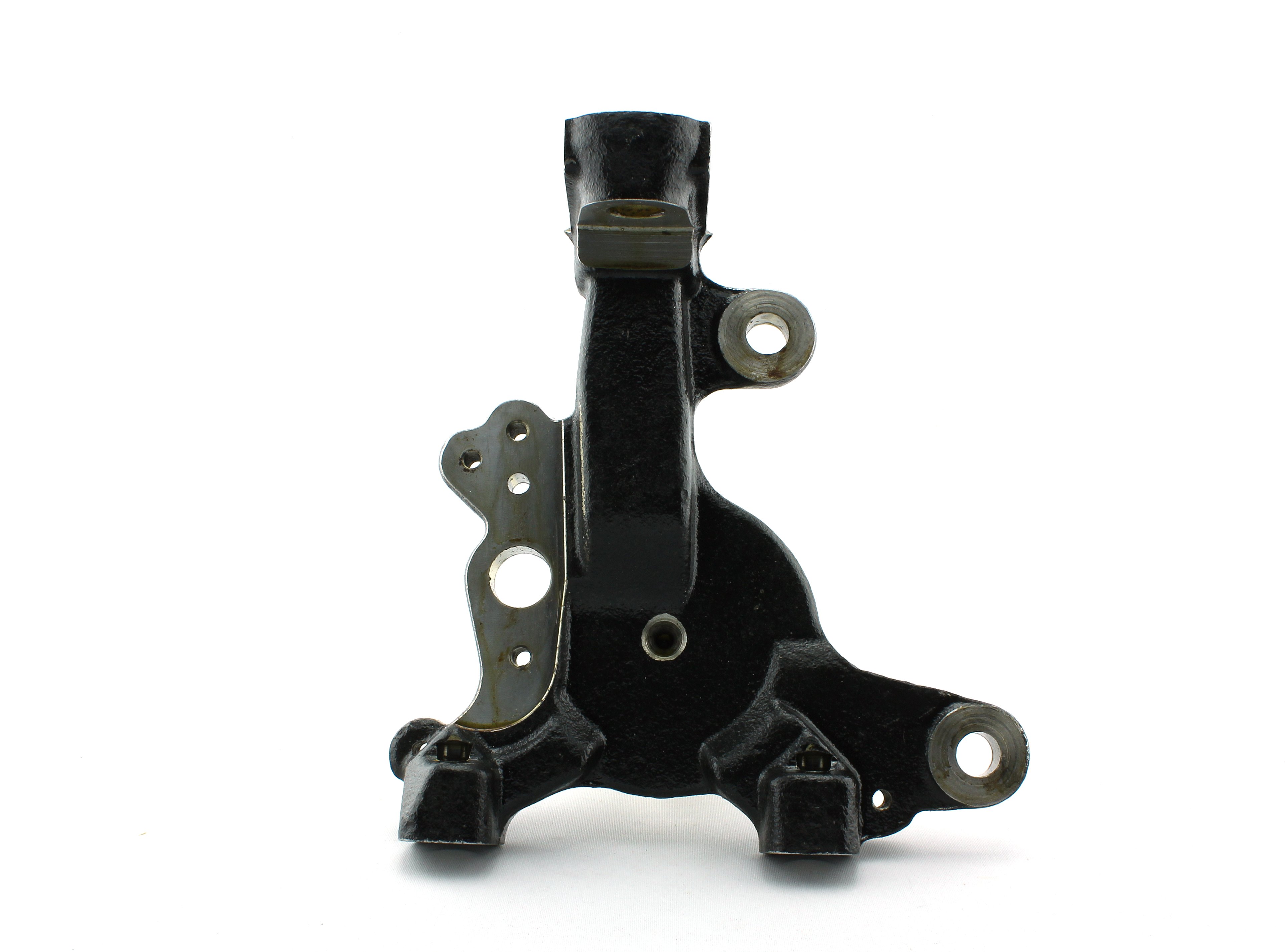
A used OEM knee assembly can be a reliable and cost-effective alternative to expensive new parts, especially since the knuckle itself rarely fails. However, careful inspection is key, as the integrated wheel bearing is a wear item.
- Verify ABS Compatibility: This is the most critical step. The 1998 Sephia was available with and without an Anti-lock Braking System (ABS). A knuckle for a car with ABS will have a mounting point for the wheel speed sensor and a tone ring on the axle or hub. A non-ABS knuckle will not. You must match the part to your vehicle's system.
- Check for Physical Damage: Inspect the cast iron knuckle for any cracks, bends, or signs of heavy impact. Pay close attention to the mounting ears where the strut and brake caliper bolt on. Damaged threads can make the part unusable.
- Test the Wheel Bearing: This is the most important check. Hold the knuckle firmly and try to spin the wheel hub flange. It should rotate smoothly and silently. If you feel any grinding, roughness, or hear any noise, the bearing is bad and will need to be pressed out and replaced—an added cost.
- Check for Play: Grip the wheel hub flange and try to wiggle it from side to side and top to bottom. There should be absolutely no looseness or play. Any movement indicates a worn-out bearing.
- Mileage Considerations: Wheel bearings typically last between 75,000 and 150,000 miles. A used assembly from a low-mileage vehicle is a great value. Be cautious with parts from high-mileage cars, as the bearing may be near the end of its service life.
Pro Tip: An original equipment (OEM) used knuckle is often superior to a cheap, new aftermarket part. OEM knuckles are manufactured to precise geometric specifications. Poorly made aftermarket knuckles can cause persistent alignment issues and premature failure of other suspension components.
Cost Comparison for Front Knee Assembly Replacement
The cost to replace a front knee assembly can vary widely based on the parts you choose and local labor rates. A wheel alignment is also required after the job is complete, adding to the total cost.
| Part/Service | Estimated Cost |
|---|---|
| New OEM Assembly | $200 - $350+ (if available) |
| New Aftermarket Assembly | $80 - $180 |
| Used OEM Assembly | $75 - $150 |
| Shop Labor | $200 - $450 (2-4 hours) |
| Wheel Alignment | $100 - $200 |
| Total Estimated Cost | $375 - $1000+ |
Related Parts to Consider Replacing
Since replacing the knuckle requires significant disassembly of the front suspension, it's an ideal time to inspect and replace other nearby wear items. The labor cost overlaps, saving you money in the long run.
- Lower Ball Joint: The knuckle connects directly to the lower ball joint. If it's original or shows signs of wear (like a torn boot or looseness), replace it.
- Outer Tie Rod End: This must be disconnected from the knuckle for removal. Inspect it for play and replace if necessary to ensure proper steering response.
- CV Axle Nut: This is a one-time-use nut and should always be replaced with a new one during reassembly.
- Front Strut Assembly: The knuckle bolts directly to the strut. If your struts are old or leaking, replacing them at the same time is highly efficient.
Replacement Procedures and Torque Specs
Replacing the front knee assembly is a job for an experienced DIYer or a professional mechanic. It involves safety-critical steering and suspension components. The general process involves lifting and supporting the vehicle, then removing the wheel, brake caliper, brake rotor, and axle nut. The tie rod end and lower ball joint are then separated from the knuckle, and the two large bolts connecting the knuckle to the strut are removed.
Crucial Torque Specs: Using a torque wrench is mandatory for safety. Overtightening or undertightening these bolts can lead to component failure.
| Component | Torque Specification | Source |
|---|---|---|
| CV Axle Shaft Nut | 155 - 206 ft-lbs (214 - 279 Nm) | |
| Lower Ball Joint to Steering Knuckle Nut | 32 - 40 ft-lbs (43 - 54 Nm) | |
| Outer Tie Rod End Nut | 22 - 33 ft-lbs (29 - 44 Nm) | |
| Wheel Lug Nuts | 76 ft-lbs (103 Nm) |
Important: After replacing the steering knuckle, a full four-wheel alignment is not optional—it is required. Skipping the alignment will result in poor handling, unsafe driving characteristics, and rapid, uneven tire wear.
Frequently Asked Questions (FAQ)
Can I just replace the wheel bearing instead of the whole knuckle assembly?
Yes, the wheel bearing can be replaced independently. However, it requires a hydraulic press to remove the old bearing and press in the new one. Most DIY mechanics do not have this tool. For many, replacing the entire knuckle assembly (especially with a good used part) is faster and easier.
What is the difference between a knee assembly, a steering knuckle, and a spindle?
The terms are often used interchangeably. "Steering knuckle" is the most technically correct term for this part on a front-wheel-drive car like the Sephia. A "spindle" typically refers to a similar part on a rear-wheel-drive vehicle where the hub and bearing assembly ride on a solid, non-rotating shaft. "Knee assembly" is a common slang term for the entire knuckle/hub unit.
Will a bad knee assembly cause my tires to wear out?
Yes. A worn wheel bearing creates play in the wheel, which directly affects the vehicle's alignment angles. This can cause rapid and uneven tire wear, often appearing as scalloped or cupped patterns on the tread.
How do I know if the noise is from my bearing or my tire?
Tire noise is usually consistent and directly related to road surface texture. A bad wheel bearing noise often changes when you turn the steering wheel. If the humming or grinding gets noticeably louder when you swerve to one side, it's very likely a wheel bearing.
Technical Specifications
OEM Part Numbers: 0K2A3-33021A 0K2A133021A
Side: Front Passenger (RH). Axle Nut Torque: 155-206 ft-lbs. Lower Ball Joint Nut Torque: 32-40 ft-lbs. Tie Rod End Nut Torque: 22-33 ft-lbs. Wheel Lug Nut Torque: 76 ft-lbs.
We Have This Part in Stock

The information in this article is provided for general reference and educational purposes only. Vehicle specifications, procedures, and part compatibility can vary by production date, trim level, and region. Always consult your vehicle's factory service manual and verify part numbers before purchasing or performing repairs. Safety-critical components such as airbags, seat belts, and braking systems should be installed by a qualified professional.
- Kia Sephia:
- 🛍️ Shop This Part
- Symptoms of a Failing Front Knee Assembly
- 1. Humming, Grinding, or Growling Noises
- 2. Clicking or Popping Sounds
- 3. Steering Wheel Vibration
- 4. Loose or Vague Steering
- 5. ABS Warning Light
- Known Issues, Recalls, and Service Bulletins
- Buying a Used Front Knee Assembly: What to Look For
- Cost Comparison for Front Knee Assembly Replacement
- Related Parts to Consider Replacing
- Replacement Procedures and Torque Specs
- Frequently Asked Questions (FAQ)
- 🎟️ Get 5% Off