

2012-2019 VW Tiguan Front End Assembly: A Tale of Two Tiguans
This guide clarifies the critical differences between the first and second generation Tiguan front ends to ensure you buy the right parts after a collision.
- The 2012-2019 period covers two different Tiguan generations; parts are NOT interchangeable. Verify if you have a Gen 1 (2012-2018 Limited) or Gen 2 (2018-2019).
- When buying used, you must match the generation, trim (R-Line vs. Standard), and lighting type (Halogen vs. Xenon/LED).
- On 2018+ models, replacing front-end components often requires expensive recalibration of driver-assist safety systems.
- Always inspect a used assembly for cracks in the main radiator support structure and broken mounting tabs on the bumper and headlights.
Understanding the Two Generations of Tiguan (2012-2019)

The most critical factor when replacing a front end assembly on a Volkswagen Tiguan from this period is identifying the correct generation. The 2012-2019 timeframe covers two completely different vehicles that do not share front-end parts.
- First Generation (Body Style 5N): This applies to model years 2012-2017 and the 2018 Tiguan Limited. The "Tiguan Limited" was the leftover first-generation body style sold alongside the new model for one year. These vehicles are smaller and have a distinct, more rounded front-end design.
- Second Generation (Body Style AD/BW): This applies to model years 2018-2019 (excluding the "Limited" model). This is a larger, more angular SUV built on VW's newer MQB platform. Its front-end components are completely different from the first generation.
Warning: Parts are NOT interchangeable between generations. A front end assembly from a 2017 Tiguan will not fit a 2018 Tiguan (non-Limited), and vice-versa. Always verify the specific model year and whether you have a standard 2018 or the 2018 "Tiguan Limited".
Symptoms of a Damaged Front End Assembly

Unlike mechanical parts that wear out, a front end assembly typically only needs replacement due to collision damage. The symptoms are usually obvious and visible.
- Visible Cosmetic Damage: Cracked or torn bumper cover, broken grille, scuffed or scraped paint.
- Broken or Misaligned Headlights: Headlight housings that are cracked, full of condensation, or pointing in the wrong direction.
- Poor Panel Gaps: Uneven gaps between the bumper, fenders, and hood indicate the underlying support structure is bent.
- Fluid Leaks: Coolant (green, pink, or purple) or A/C refrigerant leaks from the radiator or condenser, which are often damaged in a front-end impact.
- Warning Lights: Faults for airbags, parking sensors, or Adaptive Cruise Control (ACC) can trigger if sensors housed in the bumper or grille are damaged or disconnected.
Known Issues, TSBs, and Recalls

While the assembly itself isn't recalled, components within it or related systems have been subject to recalls and Technical Service Bulletins (TSBs).
- Airbag Clock Spring Recall (Gen 1): On 2010-2014 Tiguans, debris could contaminate the clock spring, potentially disabling the driver's front airbag. This is a critical safety repair.
- Autonomous Emergency Braking (AEB) TSB (Gen 2): TSB 2062957/5 addresses unwarranted emergency braking events. The service procedure involves checking for front-end damage or misalignment of the bumper, grille, and emblem where the radar sensor is located. This highlights the importance of correct assembly alignment.
- Rearview Camera Recalls (Gen 2): Multiple recalls were issued for the rearview camera failing to display an image, a crucial safety issue.
- Incorrect Tire Label Recall (2019): Recall 19V241 was issued for some 2019 Tiguans having incorrect tire pressure information on the door jamb label.
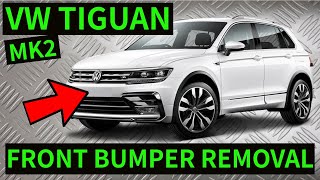
Pro Tip: For second-generation Tiguans (2018+), any work on the front end, including bumper removal or even a wheel alignment 🎬 Watch this step-by-step VW Tiguan front bumper removal guide, may require recalibration of the Advanced Driver-Assistance Systems (ADAS) like Adaptive Cruise Control. This can significantly add to the repair cost.
Buying a Used Front End Assembly: What to Check

A used, recycled OEM front end assembly can be a great value, offering factory fit and quality at a lower price. However, careful inspection is key.
1. Verify the Generation and Trim Level
- Generation: Confirm if the donor car is a Gen 1 (2012-2018 Limited) or Gen 2 (2018-2019). Look at photos of the headlights and grille shape.
- Trim Package (R-Line vs. Standard): The R-Line trim has a more aggressive and completely different bumper and grille design. They are not interchangeable with standard trims.
- Lighting Type: Did the donor car have Halogen, Xenon (Gen 1), or LED (Gen 2) headlights? The wiring and modules are different. Ensure the assembly's headlights match your vehicle's original specification.
- Sensors: Check for the presence or absence of cutouts for parking sensors and headlight washers. Match these to your vehicle's options.
2. Physical Inspection Checklist
- Radiator Support (Core Support): This is the main structural frame. Look for any cracks, especially around mounting points for the radiator and headlights. Even small cracks can compromise the integrity of the entire assembly. Part numbers often start with 5N0 for Gen 1 and 5NA for Gen 2.
- Bumper Cover: Check all mounting tabs on the top and sides. These are often broken during removal or in minor impacts and are critical for proper alignment. Look for deep scratches that have gone through the plastic, not just the paint.
- Headlights: Inspect for hazy or yellowed lenses, internal moisture, and broken mounting tabs. Ensure all bulbs and ballasts (for Xenon/LED) are included if promised.
- Grilles and Trim: Make sure no clips are broken and that chrome or black trim pieces are not peeling or deeply scratched.
- Included Components: Clarify exactly what is included. Does it come with the radiator, A/C condenser, fans, and wiring harness? Test these components if possible.
Cost Comparison for Tiguan Front End Components
Prices vary significantly based on generation, trim, and included components. A full "assembly" is typically only sold used. The table below breaks down costs for major individual components.
| Part | New OEM | New Aftermarket | Used OEM |
|---|---|---|---|
| Front Bumper Cover (Primed) | $450 - $700 | $180 - $350 | $200 - $400 |
| Radiator Support | $350 - $550 | $120 - $200 | $150 - $300 |
| Headlight Assembly (Halogen, each) | $300 - $500 | $150 - $250 | $100 - $200 |
| Headlight Assembly (Xenon/LED, each) | $800 - $1,500+ | $400 - $700 | $350 - $600+ |
| Complete Used Assembly | N/A | N/A | $800 - $2,500+ |
Note: Prices are estimates and do not include painting the bumper cover ($300-$600) or labor.
Installation Details
- Difficulty: 4 out of 5. This is a complex job.
- Time: 4-8 hours for a professional.
- Feasibility: While possible for an experienced DIYer, it is not recommended for beginners. The process involves removing wheels and fender liners, disconnecting numerous electrical connectors and sensors, and potentially draining and refilling the cooling system and A/C. Proper panel alignment requires patience and skill.
- Shop Labor Cost: Expect to pay between $500 and $1,200 for labor, plus extra for ADAS recalibration on newer models.
Frequently Asked Questions
Do I need to paint a replacement bumper cover?
Yes. New OEM and aftermarket bumper covers typically come in a black or gray primer. They must be professionally painted to match your vehicle's color. Used bumpers will come in the donor car's color, which may or may not match yours perfectly due to fading and paint batch differences.
Will a front-end replacement affect my car's safety systems?
Yes, especially on the 2018-2019 models. The front bumper and grille often house radar sensors for adaptive cruise control and forward collision warning. If these are not installed and calibrated correctly, the systems will malfunction. Even on older models, airbag sensors are located in the front of the vehicle and must be handled with care.
What's the difference between a radiator support and a reinforcement bar?
The radiator support (or core support) is the large plastic or composite frame that holds the headlights, radiator, and condenser. The reinforcement bar is a heavy steel or aluminum beam that bolts to the frame rails behind the plastic bumper cover, providing the primary impact protection.
Can I just replace the bumper cover if the damage is minor?
Yes. If the damage is limited to the plastic bumper cover and there is no damage to the underlying reinforcement bar, radiator support, or lights, you can replace just the cover. However, even a minor impact can crack hidden tabs or brackets, so a thorough inspection is necessary once the cover is removed.
Helpful Videos
Technical Specifications
OEM Part Numbers: 5N0807217DAGRU 5N0807221T 5N0805588F 5N0807109J 5NN807217GRU 5NA805588L 5NA805588J 5NA805588K
Key components include the bumper cover, upper and lower grilles, radiator support (core support), reinforcement bar, energy absorber, headlights, and fog lights. Materials are typically polypropylene for the bumper cover and a steel/composite mix for the support structures.
We Have This Part in Stock


The information in this article is provided for general reference and educational purposes only. Vehicle specifications, procedures, and part compatibility can vary by production date, trim level, and region. Always consult your vehicle's factory service manual and verify part numbers before purchasing or performing repairs. Safety-critical components such as airbags, seat belts, and braking systems should be installed by a qualified professional.
- Volkswagen Tiguan:
- 🎬 Helpful Videos
- 🛍️ Shop This Part
- Understanding the Two Generations of Tiguan (2012-2019)
- Symptoms of a Damaged Front End Assembly
- Known Issues, TSBs, and Recalls
- Buying a Used Front End Assembly: What to Check
- 1. Verify the Generation and Trim Level
- 2. Physical Inspection Checklist
- Cost Comparison for Tiguan Front End Components
- Installation Details
- Frequently Asked Questions
- 🎟️ Get 5% Off