

2024-2025 Hyundai Elantra Front End Assembly: Navigating Trim and Sensor Complexities
This guide details the critical differences in front end assemblies across Elantra trims and why matching sensor options is essential for a successful repair.
- Compatibility is extremely complex; you must match the assembly to your Elantra's specific trim (SE, SEL, Limited, N-Line, Hybrid) and options (with or without adaptive cruise).
- N-Line and N model front end assemblies are NOT interchangeable with standard models due to unique styling and components.
- Replacement is not DIY-friendly because vehicles with adaptive cruise control require mandatory radar sensor calibration with specialized tools after installation.
- When buying used, get the donor car's VIN to verify its trim and features to ensure you are purchasing the correct part.
Understanding the 2024 Facelift

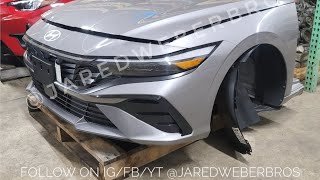
The 2024 model year marked a significant mid-generation refresh for the Hyundai Elantra, featuring a completely redesigned front end. This update introduced a new 'shark-nose' front, thinner LED daytime running lights, and a new grille and bumper design. Consequently, front end assembly components are not interchangeable with the earlier 2021-2023 models. This guide focuses exclusively on the facelifted 2024 and 2025 model years.
Variant Differences: A Critical First Step 🎬 Watch: Breakdown of 2024 Elantra trim levels and features

The biggest challenge when replacing a 2024-2025 Elantra front end assembly is navigating the variations between trim levels and optional equipment. An incorrect assembly will lead to misaligned panels, non-functional features, and warning lights. The primary differences are in the bumper beam and radiator support, which are designed to accommodate specific grilles, bumper covers, and sensors.
SE, SEL, and Limited Trims (2.0L Gas)
These are the mainstream trims powered by a 2.0L engine. Their front end assemblies are generally similar but vary based on optional packages. The key differentiator is the presence of the front radar sensor for Smart Cruise Control (Adaptive Cruise). Assemblies for cars without adaptive cruise will lack the specific mounting bracket for the radar module. The Limited trim, being the highest non-performance trim, often includes these features as standard.
Hybrid Trims (Blue, Limited)
Hybrid models share much of their body structure with the standard gas models but may have unique considerations for cooling systems related to the hybrid powertrain. Compatibility largely follows the same rules as the gas models: the presence or absence of adaptive cruise control and parking sensors is the main determining factor.
N-Line and N Models
The N-Line and the high-performance Elantra N have unique and more aggressive front-end styling. This includes a different front bumper, grille, and potentially different cooling requirements for the turbocharged engines. Front end assemblies for N-Line or N models are not interchangeable with SE, SEL, Limited, or Hybrid models. The part numbers and physical design are distinct.
Warning: The mounting points for sensors related to Adaptive Cruise Control and Park Assist are often integrated into the radiator support. Attempting to use an assembly from a base model on a vehicle equipped with these features will result in the inability to properly mount and calibrate these critical safety systems.
Symptoms of a Damaged Front End Assembly

Unlike mechanical parts that wear out over time, the front end assembly is typically only damaged by a front-end collision. Symptoms are almost always visual or structural.
- Poor Panel Gaps: The most common symptom is inconsistent or wide gaps between the bumper cover, fenders, and hood. This indicates the underlying structure is bent or broken.
- Headlight Misalignment: If the headlights point too high, too low, or to the side and cannot be adjusted correctly, it's often because their mounting points on the radiator support are damaged.
- Hood Latch Problems: Difficulty latching or unlatching the hood can occur if the core support is shifted, misaligning the latch with the striker on the hood.
- Overheating: A severely damaged assembly can push the condenser into the radiator, causing leaks or blocking airflow, which can lead to engine overheating.
- ADAS Warning Lights: Following an impact, warning lights for Forward Collision-Avoidance Assist, Smart Cruise Control, or parking sensors may illuminate. This can be caused by a damaged sensor or a sensor that has been knocked out of alignment due to a bent mounting bracket on the core support.
Buying a Used 2024-2025 Elantra Front End Assembly: What to Inspect 🎬 See an example of a 2024 Elantra front end assembly

Purchasing a used OEM assembly is a cost-effective way to ensure factory fit and quality. However, careful inspection is crucial.
- Verify Trim and Options: This is the most important step. Get the VIN of the donor vehicle and confirm its trim level (SE, SEL, N-Line, etc.) and whether it was equipped with adaptive cruise control and parking sensors. Do not purchase the part if this information cannot be verified.
- Inspect for Hidden Damage: Look for hairline cracks in the plastic or composite material, especially around headlight mounting points, fender bolt holes, and the lower radiator mounts. Even a small crack can compromise the structural integrity.
- Check All Mounting Points: Carefully examine the brackets for the headlights, bumper bar, and especially the ADAS sensors. Ensure they are not bent, broken, or repaired. A damaged radar sensor bracket can make calibration impossible.
- Look for Warping: Lay the assembly on a flat floor to check for any twisting or warping. A warped support will make it impossible to achieve correct panel gaps.
- Why Used OEM is a Smart Choice: For a modern vehicle like the 2024-2025 Elantra, fitment is precise. Aftermarket radiator supports often have slight variations in mounting hole locations that can cause significant issues with panel alignment. Given the integrated sensor mounts, a used OEM part that matches your vehicle's exact specification is far more likely to result in a successful and trouble-free repair.
Known Issues, Recalls, and Technical Service Bulletins (TSBs)
As of mid-2026, the following issues have been noted for the 2024-2025 Elantra platform:
- Recall 24V-359 (NHTSA): Affecting 2024-2026 Elantra Hybrid models, this recall addresses an issue where the Hybrid Power Control Unit (HPCU) can overheat, potentially leading to a loss of power or, in rare cases, a fire. The fix is a software update performed by a dealer. This does not directly involve the front end assembly but is a critical safety issue for Hybrid owners.
- Recall (Safety Recall 260): Some 2024 Elantra models were recalled for a faulty Exhaust Gas Recirculation (EGR) valve sensor that could cause an electrical short, leading to a sudden loss of power. The remedy is a replacement of the EGR valve assembly.
- TSB 25-EE-001H: For some 2025 Elantra models with the 2.0L engine, a TSB was issued to address steering wheel vibration when the engine cooling fan operates at high speed. The procedure involves inspecting and potentially replacing the cooling fan assembly.
- TSB 25-EM-007H: This bulletin addresses a P218100 trouble code (Cooling System Performance) on some 2021-2025 models by installing a spring on the thermostat and updating the ECU software.
- Warranty Extension (TSB 25-BE-005H-1): Hyundai extended the warranty for an inoperable horn on 2021-2025 Elantra models to 10 years/120,000 miles.
Replacement Overview and Difficulty
- Difficulty Rating: 4 out of 5 (Professional Recommended)
- Process: Replacement is a labor-intensive process that involves removing the front bumper cover, headlights, and undertray; disconnecting sensors and the hood latch cable; evacuating the A/C system; draining the engine coolant; and removing the radiator, condenser, and fan assembly. The core support itself is then unbolted from the vehicle's frame rails.
- Calibration Required: This is the most critical part of the job. After the new assembly is installed, any vehicle equipped with Smart Cruise Control must have the front radar sensor recalibrated. This procedure requires specialized targets and diagnostic software that is typically only available at dealerships or high-end collision repair centers. Failure to calibrate the sensor will result in a non-functional system and persistent warning lights.
Pro Tip: Before beginning disassembly, take detailed photos of the original panel gaps around the hood, fenders, and headlights. Also, measure the diagonal distance between fixed points on the frame rails to ensure the chassis itself is not bent. This will save significant time during reassembly.
Cost of Replacement
| Part/Service | Estimated Cost |
|---|---|
| New OEM Radiator Support | $560 - $940 |
| New OEM Bumper Impact Bar | $370 - $590 |
| New Aftermarket Radiator Support | $150 - $570 |
| Used OEM Assembly (Varies) | $400 - $1,000+ |
| Shop Labor (Replacement) | $800 - $1,500+ (Does not include A/C service or calibration) |
| ADAS Calibration | $250 - $600 |
Note: Costs are estimates and will vary based on location, supplier, and the specific parts included. Labor for a full front-end repair after a collision can be significantly higher.
Frequently Asked Questions (FAQ)
What parts are included in a 'front end assembly'?
Typically, a complete used front end assembly includes the main radiator core support, the front bumper reinforcement bar (impact bar), and sometimes the upper plastic sight shield. It does not usually include the radiator, condenser, fans, headlights, or the painted bumper cover, which are separate components that bolt to the assembly.
Will a front end assembly from an Elantra N-Line fit my SEL?
No. The N-Line and N models have unique front bumpers, grilles, and underlying support structures. The parts are not interchangeable with standard SE, SEL, or Limited models.
Do I have to get my car's sensors recalibrated after replacing the front end assembly?
Yes, if your vehicle is equipped with adaptive cruise control (Smart Cruise Control). The front-facing radar sensor is mounted to the core support or bumper beam, and replacing this structure requires a precise calibration to ensure the system functions safely and accurately. This is not an optional step.
Can I install a front end assembly myself?
While mechanically possible for an experienced DIYer, it is not recommended for most people. The job requires draining coolant, evacuating the A/C system (which requires special equipment), and extensive disassembly. Most importantly, the mandatory ADAS sensor calibration requires dealer-level tools, making a trip to a professional shop necessary to complete the job correctly.
Helpful Videos

Technical Specifications
OEM Part Numbers: 64101-AA500 64101-IB500 64900-AA700 64900-AA701 64900-AA710 64900-AA900 64900-AA911 64900-BY600 64900-BY610 64900-BY611 66310-AA500 66320-AA500 86511AAAA0
The primary component is the radiator core support, typically made of a composite plastic and metal structure. It serves as the mounting frame for the entire front of the vehicle, including cooling systems, lighting, and ADAS sensors.

The information in this article is provided for general reference and educational purposes only. Vehicle specifications, procedures, and part compatibility can vary by production date, trim level, and region. Always consult your vehicle's factory service manual and verify part numbers before purchasing or performing repairs. Safety-critical components such as airbags, seat belts, and braking systems should be installed by a qualified professional.
- Hyundai Elantra:
- 🎬 Helpful Videos
- Understanding the 2024 Facelift
- Variant Differences: A Critical First Step
- SE, SEL, and Limited Trims (2.0L Gas)
- Hybrid Trims (Blue, Limited)
- N-Line and N Models
- Symptoms of a Damaged Front End Assembly
- Buying a Used 2024-2025 Elantra Front End Assembly: What to Inspect
- Known Issues, Recalls, and Technical Service Bulletins (TSBs)
- Replacement Overview and Difficulty
- Cost of Replacement
- Frequently Asked Questions (FAQ)
- 🎟️ Get 5% Off