

Audi & Porsche 2.9L/3.0T V6 Water Pump & Pulley Failure (2018-2024)
This guide details the common water pump failures on EA839 engines, focusing on the critical internal leak that can contaminate the engine's vacuum system.
- The most critical failure is an internal leak that allows coolant to enter the engine's vacuum system, causing widespread and costly collateral damage.
- This water pump is a known high-failure item; it is a matter of 'when' it will fail, not 'if'.
- Audi released an updated water pump with a 6-bolt pulley design that is more reliable than the original 4-bolt version; always choose the 6-bolt version when replacing.
- Replacement is a complex, high-labor job (4/5 difficulty) as it requires removing the intake manifold to access the pump in the engine valley.
The Critical Failure: Internal Leaks and Vacuum System Contamination

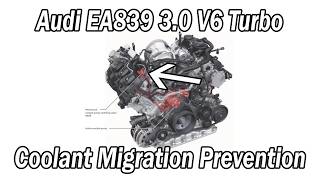
Warning: The most significant issue with the EA839 water pump is not a simple external leak. A design flaw in the original pump's seals allows coolant to leak internally, where it is then drawn into the engine's vacuum system. 🎬 See how to prevent coolant from migrating into your vacuum lines. This can cause widespread and expensive damage to other vacuum-operated components, such as the turbocharger wastegate solenoid and various coolant control valves. This is why a seemingly minor coolant loss can trigger a "Drivetrain Malfunction" warning and must be addressed immediately.
Symptoms of a Failing Water Pump

A failing water pump on these engines can present several distinct symptoms. Because of the internal leak issue, some signs are more urgent than others.
Low Coolant Warning Light
This is often the first and most obvious sign. You may find yourself needing to top off the pink or purple G12/G13 coolant in the reservoir more frequently than usual. This indicates a leak somewhere in the system, and the water pump is a primary suspect on these engines.
"Drivetrain Malfunction" Message
If coolant contaminates the vacuum lines, it can cause other systems to malfunction. This often triggers a general drivetrain malfunction warning on the dashboard. It may be accompanied by a P0299 (Turbocharger/Supercharger Underboost) fault code if the vacuum-actuated turbo wastegate is affected.
Engine Overheating
If the pump bearing seizes or the impeller fails, it can no longer circulate coolant. You will see the engine temperature gauge rise rapidly into the red zone, often accompanied by a high engine temperature warning. 🎬 Watch: What happens when a B9 Audi water pump fails completely. If you see steam coming from under the hood, pull over and shut off the engine immediately to prevent catastrophic damage like a warped cylinder head or cracked block.
Whining or Grinding Noises
A high-pitched whining or a low-pitched grinding sound from the front of the engine that changes with RPM is a classic sign of a failing bearing inside the water pump. This indicates the mechanical parts of the pump are wearing out and failure is imminent.
Visible Coolant Leaks or Residue
While the internal leak is most dangerous, external leaks also occur. You may see pink or purple dried, crusty coolant residue on the front of the engine block, near the water pump pulley. You might also notice drips on the ground under the front of the engine.
Vehicles Affected

This water pump and its related issues are common to Audi and Porsche models equipped with the turbocharged 2.9L V6 or 3.0L V6 (EA839) engines. The list includes, but is not limited to:
- 2019-2024 Audi A6
- 2019-2024 Audi A7
- 2019-2024 Audi A8
- 2018-2025 Audi RS5
- 2018-2024 Audi S4
- 2018-2024 Audi S5
- 2020-2024 Audi Q7
- 2019-2024 Audi Q8
- 2018-2024 Audi SQ5
- 2019-2024 Porsche Cayenne (Base, S, E-Hybrid) 🎬 Watch: A complete guide to the EA839 engine and its components.
Buying a Used Water Pump Assembly

Given the high failure rate, purchasing a used water pump requires careful inspection. The term "Engine Pulley Kit" is a misnomer; you should be looking for the entire water pump assembly, as the pulley itself is rarely the sole point of failure. The failure is almost always the pump's internal bearing or seals.
Pro Tip: The original, failure-prone water pumps used a pulley with four bolts. Audi updated the design to a more robust pump that uses a six-bolt pulley. When buying a used part, always try to find the updated 6-bolt version for better reliability.
Physical Inspection Checklist:
- Count the Bolt Holes: The single most important check is to identify the pulley flange. A flange with 6 bolt holes indicates the updated, more reliable design. A 4-bolt flange is the older, problematic version.
- Spin the Pulley: The pulley flange should spin smoothly by hand with no grinding, roughness, or noise. Any roughness indicates a worn internal bearing.
- Check for Shaft Play: Firmly try to wiggle the pulley flange side-to-side and in-and-out. There should be no noticeable play or wobble. Any movement means the bearing is shot and the pump is no good.
- Inspect for Leak Stains: Look for any signs of dried pink or purple coolant residue around the housing, seals, and especially the small 'weep hole'. Any staining is a clear sign the pump has leaked.
- Check the Housing: Carefully inspect the entire aluminum housing for any hairline cracks or impact damage from its previous service life.
Known Issues, TSBs, and Recalls
The water pump failure on the EA839 engine is a widely documented issue among mechanics and the owner community, often considered a matter of "when" it will fail, not "if". However, as of early 2026, there are no specific NHTSA safety recalls for the main engine-driven water pump on these 2.9T and 3.0T engines in the listed vehicles.
Previous Audi recalls for coolant pumps (NHTSA recall 17V-002, 19N3/19N4) primarily affected the 2.0L TFSI 4-cylinder engines and their electric auxiliary pumps, not the main mechanical pump on the V6 models discussed here. Because the failure is so common, Audi developed an updated water pump (with a 6-bolt pulley) to replace the original 4-bolt version.
Replacement Cost & Difficulty
Replacing this water pump is a labor-intensive job rated as a 4 out of 5 for difficulty. It is located in the valley between the cylinder heads, requiring the removal of the intake manifold for access. This is a job best left to experienced DIYers or a professional shop. Expect 4.5 to 6 hours of labor.
| Part/Service | Estimated Cost |
|---|---|
| New OEM Water Pump & Thermostat Kit | $500 - $900 |
| New Aftermarket Water Pump & Thermostat Kit | $300 - $550 |
| Used OEM Water Pump Assembly | $100 - $250 |
| Shop Labor | $800 - $1,600+ (Varies by shop rate and complexity if vacuum system is contaminated) |
Frequently Asked Questions (FAQ)
Can I just replace the water pump pulley?
No. The pulley itself is just a simple metal disc. The failure almost always occurs in the pump's internal bearing or seals. Furthermore, if you are upgrading from the old 4-bolt pump to the new 6-bolt design, the pulleys are not interchangeable and you must use the new 6-bolt pulley that comes with the updated pump kit.
Is this water pump failure covered under a recall?
No, there is no active safety recall for this specific water pump on the 2.9L and 3.0L V6 engines. The issue is a well-known component defect, but it has not been classified as a safety recall by the NHTSA. Repairs are typically paid for by the owner unless the vehicle is under warranty.
What other parts should I replace at the same time?
It is highly recommended to replace the thermostat, which is typically sold as part of a complete water pump kit. Since the job requires significant labor, it is wise to also replace any related seals, O-rings, and potentially the serpentine belt to save on future labor costs. If there is any evidence of coolant in the vacuum system, all affected vacuum lines and solenoids must also be replaced.
What happens if I ignore a small coolant leak?
Ignoring even a small leak is extremely risky with this engine. If the leak is internal, coolant is actively being drawn into your vacuum system, which can lead to a cascade of other component failures. If the leak is external and the pump fails completely, you risk rapid engine overheating, which can cause permanent, catastrophic engine damage costing thousands to repair.
Helpful Videos

Technical Specifications
OEM Part Numbers: 06M121031D (Pulley Only)
The key design difference is the updated 6-bolt pulley flange versus the original, failure-prone 4-bolt design. The complete water pump assembly part number is required for a full replacement.

The information in this article is provided for general reference and educational purposes only. Vehicle specifications, procedures, and part compatibility can vary by production date, trim level, and region. Always consult your vehicle's factory service manual and verify part numbers before purchasing or performing repairs. Safety-critical components such as airbags, seat belts, and braking systems should be installed by a qualified professional.
- Audi A6:
- Audi A7:
- Audi A8:
- Audi RS5:
- Audi S4:
- Audi S5:
- Audi Q7:
- Audi Q8:
- Audi SQ5:
- Porsche Cayenne:
- Porsche Macan:
- Porsche Panamera:
- 🎬 Helpful Videos
- The Critical Failure: Internal Leaks and Vacuum System Contamination
- Symptoms of a Failing Water Pump
- Low Coolant Warning Light
- "Drivetrain Malfunction" Message
- Engine Overheating
- Whining or Grinding Noises
- Visible Coolant Leaks or Residue
- Vehicles Affected
- Buying a Used Water Pump Assembly
- Physical Inspection Checklist:
- Known Issues, TSBs, and Recalls
- Replacement Cost & Difficulty
- Frequently Asked Questions (FAQ)
- 🎟️ Get 5% Off