

1996-2000 Taurus & Sable Intake Manifold: Vulcan OHV vs. Duratec DOHC Guide
Learn to identify which 3.0L V6 you have and diagnose the distinct intake manifold problems unique to each engine for the Ford Taurus and Mercury Sable.
- Crucially, you must identify your engine before buying: the 8th VIN digit is 'U' or '2' for the OHV Vulcan, or 'S' for the DOHC Duratec. The manifolds are not interchangeable.
- The primary failure on the OHV Vulcan engine is a cracked plastic coolant crossover, leading to coolant leaks and overheating.
- The primary failure on the DOHC Duratec engine is a malfunctioning Intake Manifold Runner Control (IMRC) system, causing hesitation and poor performance.
- When buying a used manifold, inspect OHV Vulcan units for hairline cracks and DOHC Duratec units for free movement of the internal IMRC flaps.
Engine Identification: Is Your 3.0L an OHV Vulcan or a DOHC Duratec?

Before diagnosing or buying an intake manifold for a 1996-2000 Ford Taurus or Mercury Sable, you must first identify which 3.0L V6 engine your car has. The parts are not interchangeable. The easiest way to do this is by checking the 8th character of your vehicle's VIN (Vehicle Identification Number).
- If the 8th VIN digit is 'U' or '2', you have the 3.0L OHV 'Vulcan' engine. This is a 12-valve pushrod engine.
- If the 8th VIN digit is 'S', you have the 3.0L DOHC 'Duratec' engine. This is a 24-valve engine with dual overhead camshafts.
Warning: Always verify your engine type before purchasing a part. An intake manifold for a Vulcan engine will not fit a Duratec engine, and vice-versa. The provided OEM part numbers in this guide cover both engine types, making VIN verification essential.
Symptoms of a Failing Intake Manifold

While some symptoms like a general vacuum leak can affect both engines, the most common and severe failures are unique to each design.
For the 3.0L OHV Vulcan Engine (VIN 'U' or '2')
The most common failure on the Vulcan engine's plastic intake manifold is a crack developing in the front coolant crossover passage, often near the thermostat housing. This leads to a coolant leak.
- External Coolant Leak: You may see puddles of coolant (typically green or yellow) under the front-center of the engine. The leak may be more noticeable when the engine is cold and may seem to stop once the engine warms up and the plastic expands.
- Engine Overheating: A significant coolant leak will cause the engine to run low on coolant, leading to the temperature gauge rising into the red.
- Sweet Smell: The smell of burning coolant is a strong indicator of an external leak onto a hot engine.
- Vacuum Leaks: Less common than coolant leaks, cracks in the main body of the manifold or failed gaskets can cause a hissing sound, rough idle, and Check Engine Light with lean codes (P0171, P0174).
For the 3.0L DOHC Duratec Engine (VIN 'S')
The Duratec engine's manifold problems usually revolve around the Intake Manifold Runner Control (IMRC) system. This system's plastic components can wear out, break, or get stuck from carbon buildup.
- Hesitation and Lack of Power: The most common symptom is a noticeable hesitation or 'flat spot' during acceleration. The engine may feel sluggish at certain RPMs because the intake runners are stuck in the wrong position (e.g., stuck in the 'long' runner position for low RPMs when you are trying to accelerate hard).
- Rough or Unstable Idle: If the IMRC flaps are stuck in the 'short' runner position (for high RPMs), the engine may idle roughly or even stall.
- Check Engine Light: The computer monitors the IMRC system. If it detects that the runners are not in the commanded position, it will trigger a Check Engine Light. Common codes include P2004 🎬 Watch how to diagnose code P2004 and IMRC issues (Intake Manifold Runner Control Stuck Open).
- Reduced Fuel Economy: When the IMRC system isn't working, the engine runs less efficiently, leading to a noticeable drop in MPG.
- Audible Clicking or Rattling: You may hear noises from the engine bay caused by broken plastic IMRC linkage pieces rattling around.
Buying a Used Intake Manifold: What to Inspect

A used OEM intake manifold can be a reliable and cost-effective option, especially since many new OEM parts are discontinued. However, careful inspection is key.
Inspecting a Used OHV Vulcan Manifold
- Check for Cracks: The number one priority is to meticulously inspect the entire manifold for hairline cracks, especially on the front coolant crossover section and around the thermostat housing. Flex the part slightly to help reveal hidden cracks.
- Examine Sealing Surfaces: Ensure the surfaces where the manifold meets the cylinder heads and the upper plenum are flat and free of deep scratches or warping.
- Look for Previous Repairs: Be wary of manifolds showing signs of epoxy, JB Weld, or other sealants, as this indicates a previous crack that was patched. These repairs rarely last.
- Verify Part Numbers: Look for part numbers like YF1E-9424-EF, which indicate it is for the 2-valve (2V) OHV engine.
Pro Tip: Some aftermarket replacements for the Vulcan manifold feature a cast aluminum coolant crossover to permanently fix the cracking issue. While a used OEM part is a good value, if you plan to keep the vehicle long-term, a new aftermarket design with this upgrade may be worth considering.
Inspecting a Used DOHC Duratec Manifold
- Actuate the IMRC Linkage: Manually move the IMRC actuator arm on the side of the manifold. It should move smoothly without binding. Listen for any grinding and watch to see if the butterfly valves inside the intake ports open and close together.
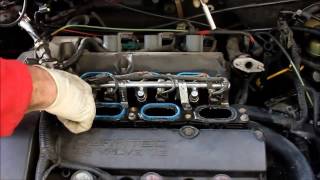
- Check for Broken Linkage: 🎬 Watch this step-by-step Duratec intake manifold removal video The plastic clips and rods that connect the actuator to the runner flaps are a common failure point. Ensure they are all intact and not brittle or cracked.
- Look Inside the Runners: Use a flashlight to look inside the intake ports. Check that the butterfly valves are present, not broken, and are free of heavy carbon buildup.
- Verify Part Numbers: Look for part numbers like YF1Z-9424-DD or YF1Z-9424-DE, which indicate it is for the 4-valve (4V) DOHC engine.
Known Issues, Recalls, and Technical Service Bulletins (TSBs)
While no recalls directly address the intake manifold itself for these vehicles, one related safety recall is important to be aware of.
- NHTSA Recall 96V151000: This recall was issued for some 1996 Taurus and Sable models due to a faulty fuel pressure regulator. A ruptured diaphragm in the regulator could leak raw fuel into the vacuum line connected to the intake manifold, creating a fire risk. While not a manifold defect, the manifold is part of the system affected.
These model years have a high number of Technical Service Bulletins (TSBs) issued by Ford for various issues, with over 200 for 1996 and 1997 alone. However, no prominent TSBs relate specifically to intake manifold failure.
Replacement Cost & Difficulty
Replacing the intake manifold on either the Vulcan or Duratec 3.0L V6 is a moderately difficult job that is feasible for an experienced DIY mechanic.
- Difficulty Rating: 3 out of 5. Access is tight, especially for bolts and connections at the rear of the engine bay. The upper intake must be removed to access spark plugs and coils for the rear bank of cylinders, making this a common procedure for tune-ups.
- DIY Feasibility: Yes, for those comfortable with draining coolant (for OHV), disconnecting fuel lines, and keeping track of numerous vacuum hoses and electrical connectors. A torque wrench is required for proper installation.
- Estimated Time: 2-4 hours.
| Part/Service | Estimated Cost |
|---|---|
| New OEM | $400 - $600+ (Largely discontinued) |
| New Aftermarket | $150 - $280 |
| Used OEM | $50 - $150 |
| Shop Labor | $250 - $500 |
Frequently Asked Questions (FAQ)
How do I know for sure if this intake manifold will fit my car?
Check the 8th digit of your VIN. If it is a 'U' or '2', you need a manifold for the 3.0L OHV Vulcan engine. If it is an 'S', you need a manifold for the 3.0L DOHC Duratec engine. They are physically different and cannot be swapped.
What's the real difference between the Vulcan and Duratec manifolds?
The Vulcan (OHV) manifold is a simpler, one-piece plastic design that primarily directs air and also has a passage for engine coolant. The Duratec (DOHC) manifold is a more complex, two-piece performance-oriented design that uses an electronic system (IMRC) to change airflow characteristics inside the manifold for better power across different engine speeds.
My manifold is leaking. Can I just replace the gaskets?
It depends on the engine. If you have a vacuum leak from a failed gasket, then yes, replacing the gaskets can solve the problem. However, if you have the OHV Vulcan engine and a coolant leak, the cause is almost always a crack in the plastic manifold itself, not the gasket. In this case, the entire manifold must be replaced.
Is a new aftermarket manifold better than a used OEM one?
For the OHV Vulcan engine, a new aftermarket manifold that features a reinforced aluminum coolant crossover is often considered a superior, more durable design than the original all-plastic OEM part. For the DOHC Duratec, a good-condition used OEM part is often a reliable choice, as the failure is typically in the moving plastic IMRC components, which can be inspected before purchase.
Helpful Videos
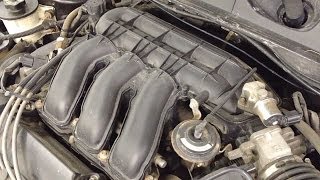
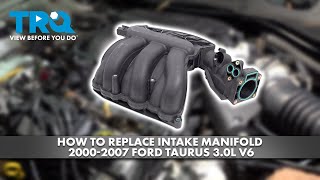
Technical Specifications
OEM Part Numbers: F6DE-9424-JC F6DE-JC F6DE9424JC F6DEJC F6DZ-9424-JC F6DZ9424JC YF1E-9424-EF YF1E9424EF YF1EEF YF1Z-9424-DD YF1Z-9424-DE YF1Z-9424-EF YF1Z9424EF
Fits 3.0L V6 engines. Two distinct versions exist: one for the OHV Vulcan engine (VIN 'U', '2') and one for the DOHC Duratec engine (VIN 'S').
We Have This Part in Stock



The information in this article is provided for general reference and educational purposes only. Vehicle specifications, procedures, and part compatibility can vary by production date, trim level, and region. Always consult your vehicle's factory service manual and verify part numbers before purchasing or performing repairs. Safety-critical components such as airbags, seat belts, and braking systems should be installed by a qualified professional.
- Ford Taurus:
- Mercury Sable:
- 🎬 Helpful Videos
- 🛍️ Shop This Part
- Engine Identification: Is Your 3.0L an OHV Vulcan or a DOHC Duratec?
- Symptoms of a Failing Intake Manifold
- For the 3.0L OHV Vulcan Engine (VIN 'U' or '2')
- For the 3.0L DOHC Duratec Engine (VIN 'S')
- Buying a Used Intake Manifold: What to Inspect
- Inspecting a Used OHV Vulcan Manifold
- Inspecting a Used DOHC Duratec Manifold
- Known Issues, Recalls, and Technical Service Bulletins (TSBs)
- Replacement Cost & Difficulty
- Frequently Asked Questions (FAQ)
- 🎟️ Get 5% Off