

Audi 3.2L Intake Manifold Failure (2008-2012 A4, A5, A6, Q5): Runner Flap & Carbon Issues
A detailed guide to diagnosing and fixing the common intake manifold runner flap problems on the 3.2L FSI V6 engine found in the A4, A5, A6, and Q5.
- The most common failure is not the manifold itself, but the internal runner flaps getting stuck due to heavy carbon buildup, a universal issue for this direct-injection engine.
- Faults are indicated by a Check Engine Light with codes P2006, P2007, P2004, or P2005.
- When replacing the manifold, it is critical to also replace the PCV valve and intake gaskets, and to have the intake ports cleaned of carbon.
- When buying a used manifold, manually check that the flap actuator arms move freely; if they are stuck, the part is likely unusable without extensive cleaning.
Symptoms of a Failing 3.2L Intake Manifold

A problem with the intake manifold on the 2009 Audi A4, 2010-2011 Audi A6, 2008-2010 Audi A5, or 2009-2012 Audi Q5 with the 3.2L V6 engine will almost always manifest as an issue with the intake runner control system. Here are the most common signs:
- Check Engine Light: This is the most common symptom. The engine computer is very effective at detecting when the runner flaps are not in their commanded position.
- Reduced Engine Power: You may notice the car feels sluggish, especially during acceleration or at higher RPMs.
- Rough or Uneven Idle: An improperly positioned flap can disrupt the air-fuel mixture, causing the engine to idle poorly.
- Decreased Fuel Economy: With the engine's airflow compromised, efficiency drops and you'll likely see worse gas mileage.
- Audible Noises: In some cases, you might hear a rattling or clicking from the manifold area, or a distinct whistling/hissing sound at idle if the failure is related to a vacuum leak.
Common Diagnostic Trouble Codes (DTCs)
If your Check Engine Light is on, a scan tool will likely show one or more of the following codes, which point directly to a problem with the intake runner flaps:
- P2006: Intake Manifold Runner Control Stuck Closed, Bank 1
- P2007: Intake Manifold Runner Control Stuck Closed, Bank 2
- P2004: Intake Manifold Runner Control Stuck Open, Bank 1
- P2005: Intake Manifold Runner Control Stuck Open, Bank 2
- P2070: Intake Manifold Tuning (IMT) Valve Stuck Open
You may also see misfire codes (P0300-P0306) as a secondary result of the improper airflow.
Known Issues & TSBs for the 3.2L FSI Intake Manifold


Failures on these manifolds are rarely due to the main plastic body cracking. Instead, two well-documented issues are the primary culprits.
1. Carbon Buildup
The 3.2L engine uses Fuel Stratified Injection (FSI), also known as direct injection. This means fuel is sprayed directly into the cylinder, not into the intake port. As a result, fuel never washes over the intake valves to clean them. Oil vapor from the PCV (Positive Crankcase Ventilation) system bakes onto the hot intake valves and runner flaps, forming thick carbon deposits. Over time, this buildup physically jams the flaps, preventing them from moving and triggering the 'Stuck Closed' or 'Stuck Open' fault codes. This is an inevitable issue on these engines, typically requiring attention between 60,000 and 100,000 miles.
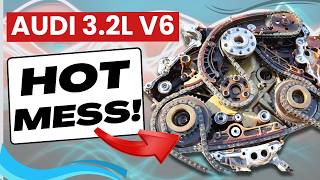
🎬 See: 3.2L FSI carbon buildup cleaning walkthroughPro Tip: Audi released Technical Service Bulletin (TSB) 2019948, which outlines the official procedure for carbon deposit removal. If you are replacing the manifold, it is the perfect time to have the intake ports and valves professionally cleaned (a service often called 'walnut blasting').
2. Actuator and Linkage Failure
The runner flaps are moved by vacuum-operated actuators connected by plastic linkage arms. These components can fail in several ways:
- Cracked Vacuum Lines: The small plastic vacuum lines that control the actuators become brittle from engine heat and can crack, causing a vacuum leak. TSB 2019485/2 specifically identifies cracked vacuum lines as a cause for P2006 and P2007 codes. 🎬 Watch: Quick fix for P2006 and P2007 vacuum line issues
- Worn or Broken Linkage: The plastic ball-and-socket joints on the actuator arms can wear out and pop off, disconnecting the actuator from the flaps.
- Failed Actuator/Sensor: The actuator itself (Part No. 06E133619) contains both a motor and a position sensor. This unit can fail internally, preventing the flaps from moving or sending incorrect position data to the computer.
Buying a Used Engine Intake Manifold: What to Check

A used OEM intake manifold is an excellent, cost-effective alternative to an expensive new unit, especially since the main body is very durable. However, a thorough inspection is critical to ensure you get a good part. Here’s what to look for:
- Check the Flap Linkage: This is the most important check. Locate the actuator arms on the outside of the manifold. Manually move them through their full range of motion. They should move smoothly without binding or excessive force. If they are stuck, the internal flaps are likely jammed with carbon.
- Inspect All Plastic Components: Carefully examine the entire manifold for any cracks, especially around mounting points and vacuum ports. Pay close attention to the small plastic vacuum nipples; they are fragile and can easily break during removal or shipping.
- Verify Actuators are Included and Intact: Ensure the vacuum actuators are present and that their plastic housings are not cracked or damaged. Check that the linkage arms are securely attached.
- Look for Broken Covers or Housings: The initial data for this part mentioned a 'broken cover'. This likely refers to damage to one of the actuator housings or other external plastic pieces. While sometimes cosmetic, any crack can indicate rough handling, so inspect the part carefully.
- Confirm Compatibility: This manifold is for the 3.2L V6 FSI engine only, typically identified by the engine code 'CALA' or the 5th digit of the VIN being 'K'. Double-check the part number against the provided list to ensure it's a match for your vehicle.
Cost of Replacing the Intake Manifold
Replacing the intake manifold is a labor-intensive job. The cost can vary significantly based on part choice and shop labor rates.
| Part/Service | Estimated Cost |
|---|---|
| New OEM Manifold | $750 - $900 |
| New Aftermarket Manifold | $180 - $300 |
| Used OEM Manifold | $200 - $350 |
| Shop Labor Cost | $250 - $450 |
| Total Job (with Used OEM) | $450 - $800 |
| Total Job (with New OEM) | $1000 - $1350+ |
Warning: These estimates are for replacing the manifold assembly. If the root cause is carbon buildup, the cost of walnut blasting the intake ports can add an additional $400 - $800 to the total repair cost.
Replacement Difficulty
- Difficulty: 4 out of 5
- Estimated Time: 2.5 - 4.0 hours
- DIY Feasible: Yes, for experienced mechanics.
While the replacement is mechanically straightforward (disconnecting lines, unbolting the manifold), it is complex due to the number of connections and the brittle nature of the plastic hoses. A critical mistake during reinstallation is to misalign the runner flaps on the wrong side of the internal port dividers. This will cause the flaps to be jammed, and fault codes will return immediately. It is highly recommended to be prepared to replace the PCV valve and various vacuum hoses that are likely to break during disassembly.
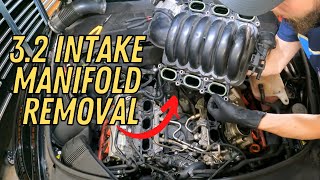
🎬 Watch: Step-by-step 3.2L intake manifold removal guideFrequently Asked Questions (FAQ)
Can I just clean the intake manifold instead of replacing it?
Yes. If the problem is carbon buildup jamming the flaps, and the manifold itself is not damaged, a thorough cleaning is often the correct repair. This involves removing the manifold and manually cleaning the carbon from the internal flaps and runners. This is also the ideal time to clean the intake ports on the cylinder head.
Is this the same intake manifold problem as on the 2.0T engine?
No, the failure mode is different. On many 2.0T engines of the same era, a plastic stop on the outside of the manifold breaks, which can be fixed with an inexpensive external repair bracket. The 3.2L V6 manifold does not have this external stop; its problems are almost always internal (carbon buildup) or related to the actuator system.
If I replace the manifold, should I replace any other parts at the same time?
Absolutely. Since you have to remove the intake manifold to access it, this is the perfect time to replace the PCV valve (oil separator), which is a very common failure item on this engine. You should also install new intake manifold gaskets and be prepared to replace any brittle vacuum or PCV hoses that break during the job.
What happens if I ignore a stuck intake runner flap?
You can continue to drive the car, but you will experience reduced power, poor fuel economy, and a rough idle. Ignoring the issue will not typically cause catastrophic engine damage, but it will make the car unpleasant to drive and prevent it from passing an emissions test. The engine may also enter a 'limp mode' with severely restricted performance.
Helpful Videos

Technical Specifications
OEM Part Numbers: 06E133201AB 06E133201K 06E133201T 06E133210G 06E133210H 06E133210K 06E133210L 06E133210M 06E133210P 06E133210Q
Fits 3.2L V6 FSI engines (Engine Code: CALA). Compatibility can be verified if the 5th digit of the vehicle's VIN is 'K'.
We Have This Part in Stock



The information in this article is provided for general reference and educational purposes only. Vehicle specifications, procedures, and part compatibility can vary by production date, trim level, and region. Always consult your vehicle's factory service manual and verify part numbers before purchasing or performing repairs. Safety-critical components such as airbags, seat belts, and braking systems should be installed by a qualified professional.
- Audi A4:
- Audi A6:
- Audi A5:
- Audi Q5:
- 🎬 Helpful Videos
- 🛍️ Shop This Part
- Symptoms of a Failing 3.2L Intake Manifold
- Common Diagnostic Trouble Codes (DTCs)
- Known Issues & TSBs for the 3.2L FSI Intake Manifold
- 1. Carbon Buildup
- 2. Actuator and Linkage Failure
- Buying a Used Engine Intake Manifold: What to Check
- Cost of Replacing the Intake Manifold
- Replacement Difficulty
- Frequently Asked Questions (FAQ)
- 🎟️ Get 5% Off