

Diagnosing Wobble and Vibration: A Guide to the 1997-2001 Mitsubishi & Dodge V6 Harmonic Balancer
This guide covers the shared engine harmonic balancer for the 1999 Galant, 2000 Eclipse, 1997 Diamante, and the 2001 Sebring/Stratus coupes, focusing on symptoms, replacement, and buying a used part.
- This balancer fits the 3.0L V6 in the 1999 Galant, 2000 Eclipse, and 2001 Sebring/Stratus coupes, plus the 3.5L V6 in the 1997 Diamante.
- Failure is caused by the rubber ring deteriorating, leading to engine vibration, pulley wobble, and noise. It is not a metal failure.
- Do not drive with a suspected bad balancer. Complete failure can throw the belts or cause catastrophic damage to the radiator and other components.
- When buying used, the condition of the rubber is everything. Reject any part with cracks, separation, or signs of dry rot.
Symptoms of a Failing Harmonic Balancer
A failing harmonic balancer can create a range of symptoms, from simple noises to serious vibrations. Because it's connected to critical engine components, ignoring the signs can lead to more extensive damage.
- Engine Vibration: The most common symptom is a new or worsening engine vibration that you can feel in the cabin, through the steering wheel, or across the whole vehicle. This happens because the rubber can no longer absorb the crankshaft's vibrations.
- Wobbling Pulley: If you look at the main pulley at the bottom of the engine while it's running, you may see it wobble. This is a clear sign that the rubber has failed and the outer ring is no longer centered.
- Knocking or Rattling Noises: As the rubber deteriorates, the metal parts of the balancer can start to contact each other, creating a rattling or knocking sound that changes with engine speed.
- Squealing or Chirping Belts: A wobbling balancer can cause the accessory drive belts to misalign, leading to squealing noises, premature wear, or the belts being thrown off the pulleys entirely.
- Visible Damage: A visual inspection may reveal cracks, bulging, or missing chunks of rubber between the inner and outer rings of the balancer.
Why They Fail: The Rubber Connection
Harmonic balancers don't fail because the metal breaks, but because the rubber that bonds the inner and outer sections together wears out. Over many years and miles, exposure to engine heat, oil, and constant flexing causes the rubber to become hard, brittle, and cracked. Once the rubber bond is compromised, the heavy outer ring can slip, wobble, or even separate completely from the hub. This not only stops it from damping vibrations but also creates a dangerous, unbalanced rotating mass on the front of your engine.
Warning: A complete failure where the outer ring separates can be catastrophic. It can damage the radiator, hoses, belts, and even the hood of the car. If you suspect your balancer is failing, it should be inspected immediately.
Vehicle-Specific Information & Known Issues
The vehicles covered in this guide share a common engineering heritage, primarily through Mitsubishi's 6G7 V6 engine family. This leads to similar repair procedures and part compatibility.
1999 Galant, 2000 Eclipse, 2001 Sebring/Stratus Coupes (3.0L 6G72 Engine)
These models all use the Mitsubishi 6G72 3.0L V6 engine. The Chrysler Sebring and Dodge Stratus mentioned here are specifically the coupe models, which were built by Mitsubishi and are mechanically very similar to the 2000 Eclipse. The sedans of the same name are different vehicles and do not share this part. Failure on these models presents with the classic symptoms of wobble and vibration. There are no major recalls or Technical Service Bulletins (TSBs) specifically for the harmonic balancer on these models, as failure is typically considered a result of age and wear.
1997 Mitsubishi Diamante (3.5L 6G74 Engine)
The Diamante uses a larger 3.5L version of the same engine family (the 6G74). While the part is similar in function and design, it is crucial to verify the part number for your specific vehicle. The symptoms and failure mode (rubber deterioration) are identical to its 3.0L cousins.
Buying a Used Engine Harmonic Balancer
Given that new OEM parts can be expensive or discontinued, a good-quality used OEM balancer is a viable option. However, careful inspection is critical.
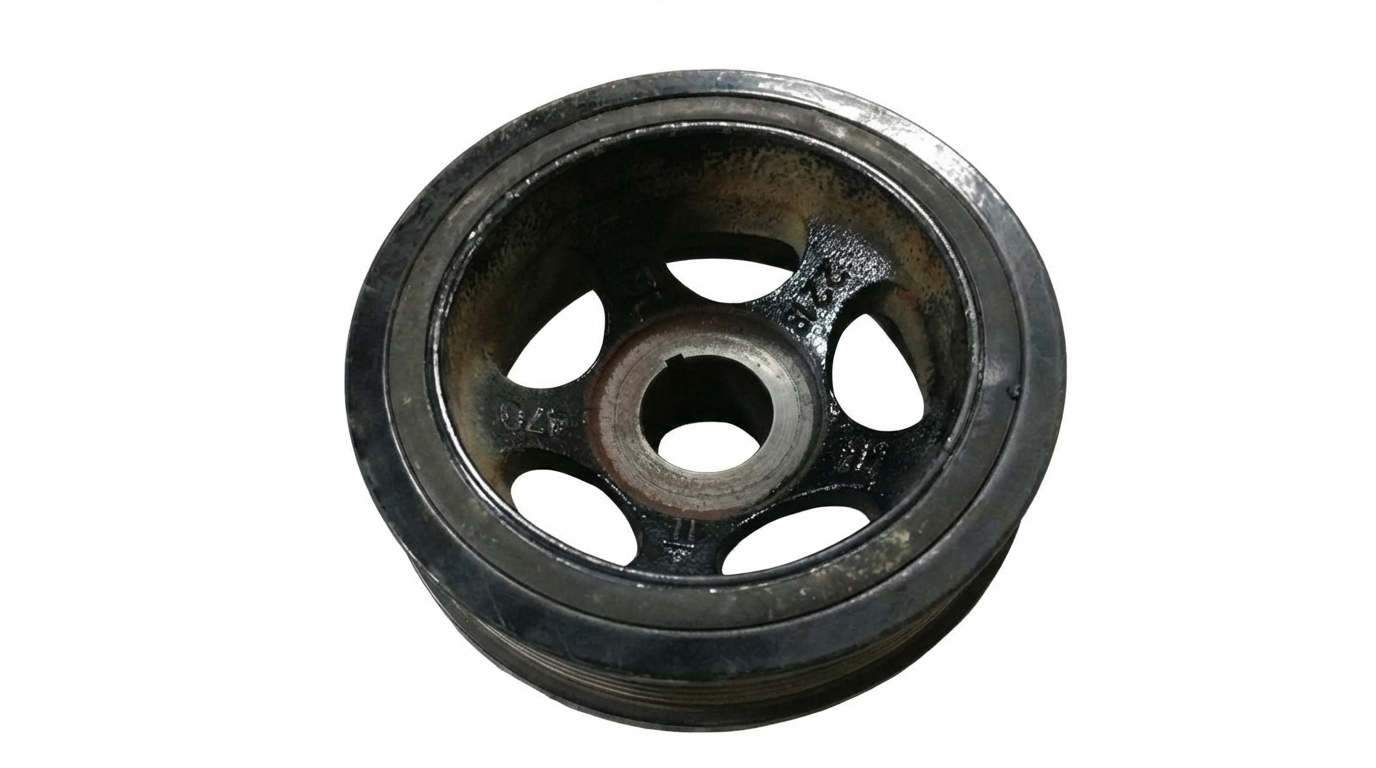
- Inspect the Rubber: This is the most important check. Look for any cracks, even small ones, in the rubber ring. Check for any areas where the rubber looks dry, crumbly, or is bulging out from between the metal rings. Do not buy a balancer with visible rubber damage.
- Check for Separation: Place the balancer on a flat surface and try to rock the outer ring. There should be absolutely no movement between the inner hub and the outer ring. If it moves at all, the bond has failed.
- Examine the Keyway: Look inside the center bore for the keyway slot. Ensure it is not cracked, deformed, or widened. Damage here can cause timing issues and prevent the balancer from seating correctly.
- Check the Pulley Grooves: Run your finger through the serpentine belt grooves. They should be smooth and free of major rust, pits, or damage that could shred a new belt.
- Mileage and Origin: Ask for the mileage of the donor vehicle if possible. A part from a lower-mileage car is always preferable. Avoid parts that are heavily rusted or appear to have been sitting exposed to the elements.
Pro Tip: A used OEM balancer is often a better choice than a cheap, new aftermarket part. Inexpensive aftermarket balancers may use lower-quality rubber or not be balanced as precisely as the original, potentially leading to premature failure or persistent vibration issues.
Replacement Overview & Difficulty
Replacing the harmonic balancer on these V6 engines is a moderately difficult job, primarily due to the tight space and the high torque of the central crankshaft bolt.
- Difficulty: 4 out of 5
- Estimated Time: 2-4 hours
- Special Tools Required: A harmonic balancer puller is essential for removal. A special crankshaft pulley holding tool is also highly recommended to hold the engine while loosening and tightening the extremely tight center bolt.
The general process involves removing the passenger-side front wheel and splash shields, loosening the drive belts, using the special tools to remove the center bolt, pulling the balancer off with the puller, and then reversing the process. The center bolt must be torqued to the manufacturer's specification, which is critical for safety.
Cost Comparison
| Part Type | Estimated Cost |
|---|---|
| New OEM | $180 - $300+ (if available) |
| New Aftermarket | $40 - $130 |
| Used OEM | $50 - $120 |
| Shop Labor | $250 - $550 |
Part Number & Interchange Information
The following OEM part numbers are associated with this group of vehicles. It's crucial to verify the exact part number for your specific VIN before ordering.
- MD333325: Listed for Chrysler/Dodge models.
- MN119375: Listed for Mitsubishi models.
- 1104A011: Superseded Mitsubishi number.
While these parts are often interchangeable across the 3.0L applications, always cross-reference with the vehicle's VIN to ensure a perfect match, especially for the 3.5L Diamante.
Frequently Asked Questions (FAQ)
Can I drive with a bad harmonic balancer?
It is not recommended. A wobbling balancer can throw the drive belts, causing you to lose power steering and alternator function, which will quickly leave you stranded. In a worst-case scenario, the balancer can come apart and cause extensive engine damage.
Is the harmonic balancer the same as the crankshaft pulley?
Yes, the terms are often used interchangeably. The part serves as both the front crankshaft pulley for the belts and the harmonic damper/balancer for the crankshaft itself.
Do I need to replace the crankshaft bolt?
Many manufacturers recommend replacing the crankshaft bolt as it is a 'torque-to-yield' bolt, meaning it stretches upon installation and is designed for one-time use. While some mechanics reuse them, replacing it is the safest practice to ensure it doesn't back out or break.
What happens if the balancer fails completely?
If the outer ring separates from the hub, it can be thrown at high speed into the engine bay. This can destroy the radiator, cooling fans, hoses, and other components. The sudden loss of the accessory belts will also cause the engine to overheat and the battery to stop charging.
Technical Specifications
OEM Part Numbers: MN119375 1104A011 MD333325
Construction: Steel inner hub and outer ring bonded by an elastomer (rubber) layer. Drives serpentine accessory belts.
We Have This Part in Stock



The information in this article is provided for general reference and educational purposes only. Vehicle specifications, procedures, and part compatibility can vary by production date, trim level, and region. Always consult your vehicle's factory service manual and verify part numbers before purchasing or performing repairs. Safety-critical components such as airbags, seat belts, and braking systems should be installed by a qualified professional.
- Mitsubishi Galant:
- Dodge Stratus:
- Mitsubishi Eclipse:
- Chrysler Sebring:
- Mitsubishi Diamante:
- 🛍️ Shop This Part
- Symptoms of a Failing Harmonic Balancer
- Why They Fail: The Rubber Connection
- Vehicle-Specific Information & Known Issues
- 1999 Galant, 2000 Eclipse, 2001 Sebring/Stratus Coupes (3.0L 6G72 Engine)
- 1997 Mitsubishi Diamante (3.5L 6G74 Engine)
- Buying a Used Engine Harmonic Balancer
- Replacement Overview & Difficulty
- Cost Comparison
- Part Number & Interchange Information
- Frequently Asked Questions (FAQ)
- 🎟️ Get 5% Off