

1982-1984 BMW 325e & 528e Harmonic Balancer: Decoding Wobbles and Vibrations
This guide covers the common failure symptoms, replacement costs, and inspection tips for the M20 'eta' engine harmonic balancer in your E30 325e or E28 528e.
- This balancer fits the M20B27 'eta' engine in the 1984 325e and 1982 528e; it is NOT interchangeable with parts from 'i' models.
- Failure is almost always due to the rubber ring degrading from age and oil exposure, leading to vibrations, wobble, and potential separation.
- When buying used, carefully inspect the rubber for cracks, bulging, and oil saturation. Avoid any part with visible damage.
- Replacement requires special tools to handle the extremely high torque (over 300 ft-lbs) of the central crankshaft bolt.
Symptoms of a Failing Harmonic Balancer
A failing harmonic balancer on your 1984 BMW 325e or 1982 BMW 528e will give you several warning signs. Because the 'eta' engine was designed for low-RPM efficiency, a smooth idle is expected, and any new vibration should be investigated immediately.
Engine Vibration
This is the most common symptom. You may feel a new, rhythmic vibration in the cabin, through the steering wheel, or the floor. This vibration might be most noticeable at idle and can change or worsen as engine RPMs increase. On the M20 engine, this can sometimes be misdiagnosed as a rough idle from fuel or ignition issues, but a balancer-related vibration is often more of a deep hum or shake.
Visible Wobble
With the engine running, you may be able to see the crankshaft pulley wobbling at the front of the engine. This is a clear sign that the rubber has degraded and the inner and outer parts are no longer concentric. Do not put your hands or any tools near the pulley while the engine is running. A significant wobble is a major red flag indicating imminent failure.
Chirping or Squealing Noises
As the balancer wobbles, it misaligns the drive belts that run the alternator, power steering pump, and water pump. This can cause a persistent squealing or chirping sound. You might also notice the belt tensioner moving excessively. In some cases, the outer ring can slip and make contact with the timing case, creating a grinding noise.
Catastrophic Separation
In a worst-case scenario, the outer ring can completely separate from the inner hub. When this happens, you will instantly lose power to all belt-driven accessories, resulting in a loss of power steering and alternator function (the battery light will come on). The separated metal ring can also become a dangerous projectile in the engine bay, damaging the radiator, hoses, fan, and timing covers.
Buying a Used Engine Harmonic Balancer
Given the high cost of a new OEM balancer, a quality used part is a great option for these classic BMWs. However, careful inspection is critical, as you are buying a part that relies on the condition of its rubber.
Physical Inspection Checklist:
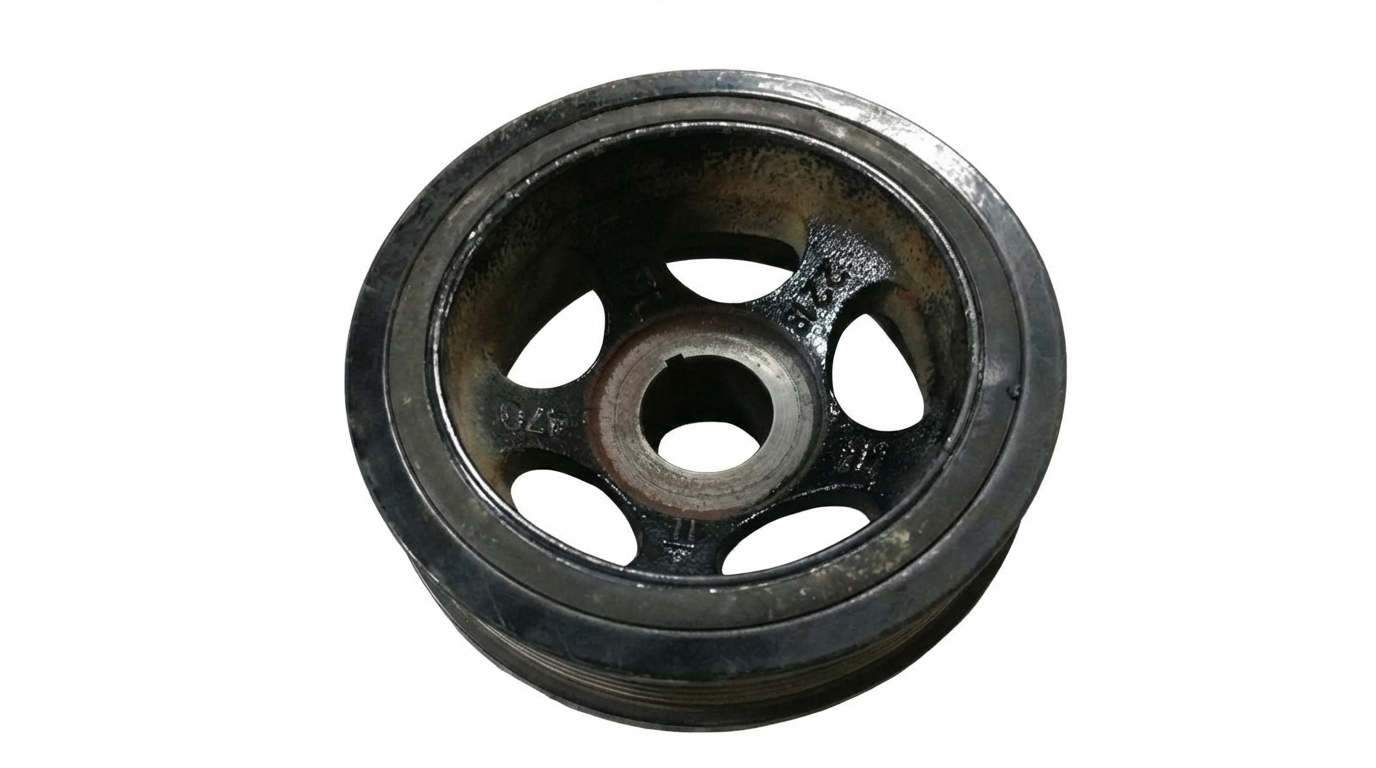
- Inspect the Rubber: This is the most important step. Look for any cracks, splits, or missing chunks in the rubber ring between the inner hub and outer ring. The rubber should be solid and uniform.
- Check for Bulging or Oozing: The rubber should be flush with the metal surfaces. Any bulging or signs that the rubber is pushing out indicates it has failed or is about to.
- Look for Oil Contamination: Oil from a leaking front crankshaft seal is a primary cause of balancer failure, as it degrades the rubber. A part that is soaked in old oil should be avoided, even if the rubber looks intact.
- Check for Slippage: A common failure is when the outer ring spins on the inner hub. On a used part, you can sometimes see a faint line or mark where this has happened. Before installing a used balancer, it's a good practice to draw a paint-pen line across the face from the inner hub to the outer ring. After running the engine, you can check to see if the line is still aligned.
- Examine the Keyway: The balancer is located on the crankshaft by a small woodruff key. Ensure the keyway slot on the inner hub of the used balancer is not damaged, cracked, or worn out.
Pro Tip: A used OEM balancer from a low-mileage, dry-climate car is often a better choice than a cheap, new aftermarket part. The rubber compounds and manufacturing tolerances of the original BMW part are typically superior.
Known Issues, TSBs, and Recalls
For vehicles of this age, formal recalls or Technical Service Bulletins (TSBs) specifically for the harmonic balancer are rare. The primary known issue is age-related failure of the rubber damping element. Searches on the National Highway Traffic Safety Administration (NHTSA) database for the 1984 BMW 325e and 1982 BMW 528e show no recalls related to the harmonic balancer. The failures are well-documented in owner forums like R3vlimited and Bimmerforums as a common maintenance item for high-mileage or 30+ year-old M20 engines.
Warning: This part is specific to the M20B27 'eta' engine used in 325e and 528e models. It is NOT interchangeable with the harmonic balancer from a 325i or 525i, which uses the M20B25 engine. The different engine characteristics require a differently balanced damper. Using the wrong part can lead to damaging vibrations.
Replacement Overview
Replacing the harmonic balancer is a feasible DIY job for an experienced mechanic but can be challenging due to the very high torque on the main crankshaft bolt.
- Difficulty: 3 out of 5
- Procedure: The process involves removing the radiator fan and shroud for access, loosening the drive belts, and then removing the large central bolt (22mm) that holds the balancer to the crankshaft.
- Special Tools: The central bolt is torqued to an extremely high value, often cited as over 300 ft-lbs (410 Nm). Removing it typically requires a very long breaker bar and a method to lock the engine from turning, such as a special flywheel lock tool or by carefully wedging the flywheel ring gear. A standard harmonic balancer puller may be needed if the balancer is seized onto the crankshaft snout.
- Torque Specs: The central crankshaft bolt torque is critical. While forum discussions vary, the Bentley manual and other sources point to a very high torque specification, around 302-305 ft-lbs (410-414 Nm). The smaller bolts holding the pulley to the balancer are much lower, around 16 ft-lbs (22 Nm). Always use a new central bolt if possible and confirm the torque spec for your specific engine.
| Part/Service | Estimated Cost |
|---|---|
| New OEM (Genuine BMW) | $580 - $650 |
| New Aftermarket | $150 - $300 |
| Used OEM | $50 - $125 |
| Shop Labor | $300 - $600 |
Frequently Asked Questions
Can I drive with a wobbly harmonic balancer?
It is not recommended. A wobbly balancer puts extra stress on the crankshaft and engine bearings. More critically, if the outer ring separates, it will cause an immediate loss of the water pump, alternator, and power steering, potentially leaving you stranded and causing other damage.
Will a bad harmonic balancer cause a check engine light?
It is possible, but less common on these older OBD-I vehicles. Severe vibrations could potentially affect the signal from the crankshaft position sensors, which are mounted near the front of the engine, possibly leading to running issues.
Do I need to replace the front crank seal at the same time?
It is highly recommended. The front main seal is located directly behind the harmonic balancer. Replacing it is much easier while the balancer is off and costs very little for the part itself. An old seal is likely to be disturbed during the job and could start leaking afterward.
What is the difference between the 325e/528e 'eta' balancer and a 325i balancer?
The 'eta' (M20B27) engine is a low-revving, high-torque design, while the 'i' (M20B25) engine is a higher-revving design. Their crankshafts produce different vibration frequencies (harmonics). The balancers are specifically 'tuned' with different weights and rubber densities to counteract the vibrations of their respective engines. Using the wrong one will fail to dampen vibrations properly and could harm the engine.
Technical Specifications
OEM Part Numbers: 11231289119 11231705764 1705764
Engine: BMW M20B27. Central Bolt Torque: ~302-305 ft-lbs (410-414 Nm). Pulley-to-Balancer Bolt Torque: ~16 ft-lbs (22 Nm).
We Have This Part in Stock

The information in this article is provided for general reference and educational purposes only. Vehicle specifications, procedures, and part compatibility can vary by production date, trim level, and region. Always consult your vehicle's factory service manual and verify part numbers before purchasing or performing repairs. Safety-critical components such as airbags, seat belts, and braking systems should be installed by a qualified professional.
- BMW 325e:
- BMW 528e:
- 🛍️ Shop This Part
- Symptoms of a Failing Harmonic Balancer
- Engine Vibration
- Visible Wobble
- Chirping or Squealing Noises
- Catastrophic Separation
- Buying a Used Engine Harmonic Balancer
- Physical Inspection Checklist:
- Known Issues, TSBs, and Recalls
- Replacement Overview
- Frequently Asked Questions
- 🎟️ Get 5% Off