

2008 Ford F-150 Engine Control Module: Matching ID Codes and Programming
This guide covers the critical steps for diagnosing, buying, and replacing the ECM in your 2008 Ford F-150, focusing on the essential ID code match and programming requirements.
- You MUST match the ID code (e.g., 7L3A-FJD) from your original ECM's sticker, not just the part number.
- A replacement ECM will NOT start the engine until it is professionally programmed to your truck's VIN and anti-theft system (PATS).
- Common causes of failure are water leaking from the windshield cowl and shorted ignition coils. These root causes must be fixed when replacing the ECM.
- If replacing the ECM due to ignition coil codes (P035x), you must replace all eight coils and plugs to prevent repeat failure.
Critical First Step: Understanding Part Numbers and ID Codes
Warning: Before buying a replacement ECM for your 2008 F-150, you must identify the ID code on your original module. Simply matching the part number is not enough. The module will not work correctly without the exact same ID code, and it will require programming to your vehicle's VIN and anti-theft system before the engine will start.
The most important number on your F-150's ECM is the 'Engineering ID' or 'Calibration Code', such as 7L3A-FJD. This code specifies the exact software and hardware configuration for your truck's engine, transmission, and emissions equipment. While many modules share the base part number 7L3A-12A650, the last three or four letters of the ID code are what determine compatibility. Using a module with a different ID code can lead to shifting problems, poor performance, or a no-start condition, even after programming.
Symptoms of a Failing 2008 F-150 ECM
ECM failure can manifest in many ways, ranging from subtle issues to critical failures that leave you stranded. Here are the most common symptoms.
Engine and Performance Issues
- No-Start Condition: The engine cranks but will not start. This can be due to the ECM not firing the ignition coils or fuel injectors.
- Engine Stalling: The engine may stall unexpectedly while driving or at idle.
- Misfires and Rough Idle: A faulty module can disrupt the air-fuel mixture or ignition timing, leading to a rough idle, hesitation, or engine misfires.
- Check Engine Light: An illuminated Check Engine Light is a common symptom. Codes related to internal module failure (P0600-P0606) are a direct indication.
- Ignition Coil Fault Codes (P0351-P0358): These codes point to a fault in the ignition coil primary circuit. While a bad coil can be the cause, a failed coil can also damage the driver circuit inside the ECM, making the ECM itself the root problem.
- Poor Fuel Economy: If the ECM cannot properly manage the engine, fuel efficiency can drop significantly.
Transmission and Electrical Problems
- Harsh or Erratic Shifting: The PCM controls the automatic transmission, so a failure can cause hard shifts, delayed engagement, or incorrect gear selection.
- No Communication with Scan Tool: If an OBD-II scanner cannot connect to the vehicle, it often points to a failed PCM that is no longer communicating.
- Communication Error Codes (U-codes): Diagnostic trouble codes starting with 'U' indicate a loss of communication between modules, which can be caused by a faulty ECM.
Known Issues and Common Causes of Failure
Two issues are responsible for a large number of ECM failures on this generation of F-150.
1. Water Intrusion from Cowl Leak
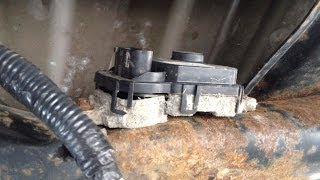
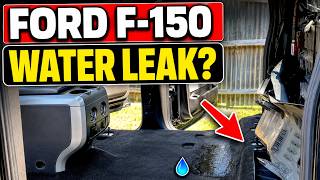
The ECM is located on the passenger-side firewall, directly below the windshield cowl. The foam seal for the cowl is known to degrade over time, allowing rainwater to leak directly onto the ECM's connectors. This water intrusion causes corrosion on the pins and can short-circuit the module internally, leading to a host of electrical gremlins and eventual failure. When inspecting your ECM, look for any signs of water trails on the firewall or green/white corrosion on the connectors.
🎬 Watch how to diagnose and repair water leaks around the cowl.2. Ignition Coil Burnout
A common failure scenario involves a short-circuited ignition coil-on-plug (COP). When a coil fails, it can send a voltage spike back to the ECM, destroying the internal circuit that controls it. This typically results in a persistent P035x code that does not go away even after replacing the coil.
Pro Tip: If you are replacing your ECM due to an ignition coil fault code (P0351-P0358), it is critical to replace ALL eight ignition coils and spark plugs at the same time. Failure to do so will likely cause the new or repaired ECM to fail again immediately.
Buying a Used 2008 F-150 ECM: What You Must Know
Buying a used ECM can be a cost-effective solution, but you must follow these steps carefully to ensure you get the right part.
Step 1: Locate and Identify Your Original ECM
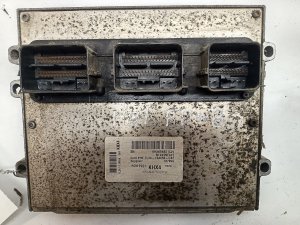
The ECM is mounted to the firewall in the engine bay on the passenger side. It is a silver metal box with three large electrical connectors. You will need a 10mm socket to remove the four bolts holding it in place. On the module, there will be a white sticker with several numbers. You are looking for the large-print ID code, which will be in a format like 7L3A-12A650-FJD. The most important part is the prefix and suffix, 7L3A-FJD.
Step 2: Match the ID Code EXACTLY
When searching for a replacement, you must find a used module with the identical ID code. For example, if your original module is a '7L3A-FJD', you must find another '7L3A-FJD'. A module with a different code (e.g., '7L3A-FZF') is not a direct replacement, as it is programmed for a different vehicle configuration.
Step 3: Inspect the Used Module
Before purchasing, physically inspect the used ECM. Check the connectors for any signs of corrosion, bent pins, or physical damage. Avoid any modules that look like they have been opened or have significant water damage.
ECM Replacement and Programming Requirements
Warning: Replacing the ECM is not a simple plug-and-play job. The engine will not start until the replacement module is programmed to your truck's anti-theft system.
Physical Installation
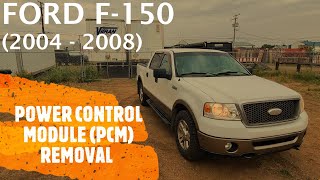
The physical swap is straightforward for a DIY mechanic. Disconnect the negative battery terminal, unplug the three connectors, remove the four 10mm bolts, and swap the modules. The entire process takes less than 30 minutes.
🎬 Watch this step-by-step video on removing your ECM.Programming is NOT Optional
The 2008 F-150 uses Ford's Passive Anti-Theft System (PATS), which links the ignition keys to the ECM. When you install a different ECM, this link is broken, and the PATS will disable the fuel and ignition systems, preventing the engine from starting. 🎬 See how a PATS anti-theft issue causes a no-start condition. Programming is required to:
- Write your vehicle's VIN to the replacement ECM.
- Perform a 'parameter reset' and 'key relearn' to sync the replacement ECM with your existing keys and other modules on the truck.
Who Can Program a Ford ECM?
- Ford Dealership: This is the most reliable, albeit often most expensive, option. They have the proprietary IDS software to guarantee a successful programming session.
- Automotive Locksmith / Mobile Technician: Many professional locksmiths and mobile mechanics have advanced scan tools (like high-end Autel or Snap-on scanners) or specialized software that can perform the PATS key relearn procedure. This is often more convenient and affordable than a dealer.
- Pre-Programmed Modules: Some online vendors sell remanufactured ECMs that are 'pre-programmed' with your VIN. They may also come with new keys already synced to the module. While this aims for a 'plug-and-play' experience, you may still need to perform a simple key-cycling procedure to finalize the installation.
Replacement Cost Comparison
| Part Type | Estimated Cost | Notes |
|---|---|---|
| New OEM | $500 - $1000+ | Often discontinued and difficult to source. |
| Remanufactured / Pre-Programmed | $250 - $450 | A popular balance of cost and convenience. May come with a warranty. |
| Used OEM (Salvage) | $75 - $200 | Cheapest part cost, but requires professional programming. |
| Repair Service | $200 - $350 | You send your original module for repair. No programming needed if repaired correctly. |
| Shop Labor (Programming) | $150 - $300 | Cost for a dealership or independent shop to program a module you provide. |
Frequently Asked Questions (FAQ)
What's the difference between an ECM and a PCM?
On the 2008 F-150, the correct term is Powertrain Control Module (PCM) because it is a single unit that controls both the engine (Engine Control Module - ECM) and the transmission (Transmission Control Module - TCM). However, the terms are often used interchangeably.
Why is it so important to match the ID code like '7L3A-FJD'?
The ID code, or calibration code, identifies the specific software loaded onto the module for a particular combination of engine, transmission, drivetrain (4x2 vs 4x4), and emissions equipment. Using the wrong one can cause drivability issues or prevent certain features from working, even if the main part number is the same.
Will my truck start after I install a used ECM?
No. Due to the PATS anti-theft system, the engine will crank but will not start until the used ECM is programmed to recognize your vehicle's keys.
My mechanic says my ECM is bad because of an ignition coil code (P035x). What should I do?
This is a very common failure. A shorted ignition coil can damage the ECM. To prevent destroying the replacement ECM, you must replace all eight ignition coils and spark plugs when you replace the module. Using high-quality OEM-spec coils is strongly recommended.
Can I avoid programming by sending my original ECM for repair?
Yes. If your original module is successfully repaired, it will retain its original programming. Once you receive it back, it should be plug-and-play, with no additional programming required. This is a good option if you can afford the vehicle downtime.
Helpful Videos

Technical Specifications
OEM Part Numbers: 7L3A-12A650-FJD 7L3A12A650FJD 7L3AFJD 7L3Z-12A650-FJD 7L3Z12A650FJD
Location: Passenger side firewall, engine compartment. Connectors: Three main electrical harness connectors. Fasteners: Held by four 10mm bolts.
We Have This Part in Stock




The information in this article is provided for general reference and educational purposes only. Vehicle specifications, procedures, and part compatibility can vary by production date, trim level, and region. Always consult your vehicle's factory service manual and verify part numbers before purchasing or performing repairs. Safety-critical components such as airbags, seat belts, and braking systems should be installed by a qualified professional.
- Ford F-150:
- 🎬 Helpful Videos
- 🛍️ Shop This Part
- Critical First Step: Understanding Part Numbers and ID Codes
- Symptoms of a Failing 2008 F-150 ECM
- Engine and Performance Issues
- Transmission and Electrical Problems
- Known Issues and Common Causes of Failure
- 1. Water Intrusion from Cowl Leak
- 2. Ignition Coil Burnout
- Buying a Used 2008 F-150 ECM: What You Must Know
- Step 1: Locate and Identify Your Original ECM
- Step 2: Match the ID Code EXACTLY
- Step 3: Inspect the Used Module
- ECM Replacement and Programming Requirements
- Physical Installation
- Programming is NOT Optional
- Who Can Program a Ford ECM?
- Replacement Cost Comparison
- Frequently Asked Questions (FAQ)
- 🎟️ Get 5% Off