

2011 Charger & 300 Engine Control Module: Why VIN Programming is Not Optional
This guide covers the mandatory programming, common failure symptoms, and replacement costs for the Engine Control Module (ECM) in the 2011 Dodge Charger and Chrysler 300.
- A replacement ECM for a 2011 Charger or 300 MUST be programmed to your car's VIN to function; it is not a plug-and-play part.
- The most cost-effective solution is to buy a used or remanufactured ECM from a seller who pre-programs it to your VIN before shipping.
- Common failure symptoms include a no-start condition, random stalling, misfires, and an illuminated check engine light with internal module fault codes (P06xx).
- Alternator failures (subject to a recall) can cause voltage spikes that permanently damage the ECM.
Symptoms of a Failing ECM

A faulty Engine Control Module in a 2011 Dodge Charger or Chrysler 300 can cause a variety of confusing and often intermittent symptoms. Because the ECM controls so many systems, its failure can sometimes be mistaken for other problems.
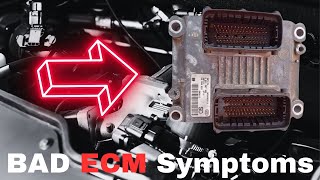
🎬 Watch: A breakdown of common symptoms of a bad ECM- Check Engine Light: An illuminated Check Engine Light is one of the most common signs. While many issues can trigger the light, if it remains on after other potential causes are ruled out, the ECM may be the culprit. Specific codes for internal ECM/PCM failure include P0600, P0601, P0602, P0603, P0604, and P0605.
- Engine Won't Start: The vehicle may crank but refuse to start, or it might start only intermittently. This happens when the ECM fails to send the correct signals for spark and fuel. 🎬 See how to diagnose a Charger that cranks but won't start
- Stalling or Misfiring: The engine may stall unexpectedly while driving, misfire, or run very roughly. This is often due to incorrect fuel and ignition timing commands from the failing module.
- Poor Performance and Fuel Economy: A noticeable loss of power, hesitation during acceleration, and a sudden drop in gas mileage are common symptoms. This can happen if the ECM provides the wrong air-to-fuel mixture.
- Erratic Transmission Shifting: The automatic transmission may shift harshly, at the wrong times, or get stuck in one gear (limp mode). The ECM shares critical data with the Transmission Control Module (TCM), and a fault can disrupt shifting performance.
- No Communication with Scan Tool: In some cases, a diagnostic scan tool will be unable to connect to the vehicle, pointing directly to a dead ECM.
Known Issues, Recalls, and Technical Service Bulletins (TSBs)

While the ECM itself hasn't been the subject of a direct recall, several major electrical system recalls for the 2011 Charger and 300 can affect its operation or cause similar symptoms.
- NHTSA Recall 17V435000 / 14V634000: This recall addresses alternator failure in vehicles with the 3.6L or 5.7L engine. A failing alternator can cause voltage spikes that damage the ECM or cause the vehicle to stall, which may mimic ECM failure.
- NHTSA Recall 12V197000: This recall is for an overheating fuse in the power distribution center that can disable the ABS and Electronic Stability Control (ESC) systems. This indicates a potential for electrical issues in the main power center that feeds all modules, including the ECM.
- TSB 18-031-12 REV. A: This service bulletin was released to address a check engine light for code P0108 (Manifold Absolute Pressure Sensor Circuit High). The fix is to reprogram the PCM with updated software.
- TSB V51: A customer satisfaction campaign was issued to reprogram the Powertrain Control Module, likely to address various drivability concerns.
Diagnosing the Problem: Common Causes of Failure

Diagnosing a bad ECM can be tricky, as the symptoms often overlap with simpler problems like a bad sensor. Technicians typically rule out all other possibilities before condemning the ECM. Common causes of failure include:
- Voltage Spikes: A failing alternator (related to the recall mentioned above) or an improper jump-start can send a surge of voltage through the electrical system, frying the delicate circuits inside the ECM.
- Water Intrusion: The ECM is located in the engine bay and, over time, its protective seals can degrade. Moisture can seep in and corrode the circuit board. On some related Chrysler/Dodge vehicles, water has been known to drip from the cowl or an A/C line directly onto the ECM connectors, causing shorts and malfunctions.
- Heat and Vibration: Years of exposure to engine bay heat and constant vibration can cause internal solder joints to crack and electronic components to fail.
- Internal Shorts: Components that control specific functions, like the ignition coils or alternator charging circuit, can burn out internally.
Warning: Do not assume your ECM is bad without proper diagnosis. Many of the symptoms listed above can also be caused by a bad battery, failing alternator, faulty wiring, or a bad sensor. A full vehicle diagnosis is recommended before purchasing a replacement ECM.
Engine Control Module Replacement
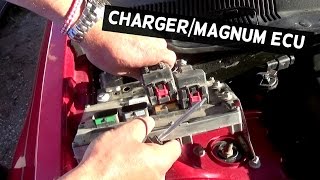
Physically replacing the ECM is a straightforward job that most DIY mechanics can handle. The module is located on the passenger side of the engine bay, near the firewall.
- Disconnect the Battery: The battery is in the trunk. Use a 10mm socket or wrench to disconnect the negative battery terminal and set it aside.
- Access the ECM: In the engine bay, locate the plastic shield on the passenger side near the firewall. Use a plastic trim removal tool to pop out the push pins holding it in place.
- Unbolt the ECM: The ECM is held in a metal bracket. Use a 13mm socket to remove the main bracket bolt and a 10mm socket to remove the two smaller bolts holding the bracket to the ECM itself.
- Disconnect the Connectors: There are two large electrical connectors attached to the ECM. They have red locking tabs. Slide the red tabs to the unlocked position, then press the release button and swing the locking lever to disconnect them. They are color-coded to prevent mix-ups during reinstallation.
- Install the New Module: Installation is the reverse of removal. Connect the electrical plugs, bolt the module and bracket back into place, reinstall the plastic shield, and reconnect the battery.
Buying a Used Engine Control Module (ECM)
This is the most critical section for anyone buying a replacement ECM for their 2011 Charger or 300. Failure to follow these guidelines will result in a part that does not work.
Programming is MANDATORY
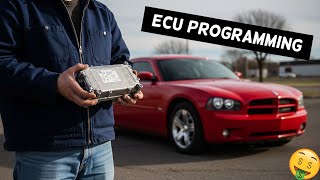
A replacement ECM, whether it's new, used, or remanufactured, will not work until it is programmed to your car's specific Vehicle Identification Number (VIN). This process syncs the module with your vehicle's anti-theft system (known as the Sentry Key Immobilizer Module or SKIM) and other electronic modules. Simply swapping the part will trigger the anti-theft system and the car will not start.
Pro Tip: Many online sellers offer "Plug & Play" or "Pre-Programmed" modules. This is the recommended option for most owners. You provide the seller with your car's VIN when you order, and they flash the used module before shipping it to you. This allows you to install it yourself without needing a trip to the dealer for programming.
What to Look For When Buying Used:
- VIN Programming Service: Only buy from sellers who explicitly offer to program the module to your VIN before shipment. Do not buy a used ECM from a salvage yard assuming you can just plug it in.
- Part Number Matching: Provide your original part number to the seller to ensure you receive a compatible hardware version. While the software can be changed, the base hardware must be correct. For example, the 3.6L engine often uses a module with a hardware code of 05150545AE, while the 5.7L Hemi often uses 05150546AE.
- Warranty: Reputable sellers of remanufactured ECMs will offer a warranty. This is a good sign of a quality part and service.
Police Package Warning: The standard ECM is not compatible with Dodge Charger Pursuit (Police Package) vehicles. These models use a specific ECM with different programming. Ensure you are buying the correct part for your specific vehicle trim.
Cost of Replacing the ECM
The cost can vary significantly based on the route you take for programming and the source of the part.
| Part Source | Estimated Cost | Notes |
|---|---|---|
| New OEM | $600 - $1,200+ | Often only available as remanufactured through dealers. Price is difficult to confirm and typically requires a core charge. |
| Remanufactured / Used OEM (Pre-Programmed) | $250 - $600 | This is the most common and cost-effective solution. Price includes the part and the VIN programming service. |
| Shop Labor (Physical Swap) | $70 - $150 | The physical replacement is quick, taking less than an hour. |
| Shop Labor (Programming Only) | $100 - $250 | If you buy a non-programmed module, a dealer or equipped independent shop must program it. |
Frequently Asked Questions (FAQ)
Can I program a new ECM myself?
For the vast majority of owners, the answer is no. Programming requires a J2534 pass-thru device (which costs several hundred dollars) and an active subscription to Chrysler's wiTECH 2.0 software, which has its own fees, including a $35 per-VIN charge for flashing. It is far more economical to buy a pre-programmed module or pay a professional for one hour of labor.
If I install a pre-programmed ECM, will my keys still work?
Usually, yes. When the ECM is programmed to your VIN, it syncs with the existing anti-theft module that already recognizes your keys. However, in some rare cases, a key relearn procedure may be required, which can be performed by a locksmith or dealer.
Why is there a specific warning for Police Package Chargers?
The Dodge Charger Pursuit has different features and programming compared to civilian models, such as different axle ratios, speed limiters, and sometimes different engine cooling strategies. They require a specific ECM part number (e.g., 68136727AB) that is not interchangeable with the standard R/T or SE/SXT models.
Can a bad alternator really destroy my ECM?
Yes. A failing alternator can produce unstable voltage and powerful voltage spikes. The ECM is a sensitive computer that operates on a stable, low voltage. A sudden spike can overload and permanently damage its internal circuits. This is why it's important to address the alternator recall (17V435000) if it applies to your vehicle.
Helpful Videos

Technical Specifications
OEM Part Numbers: 05150545AD 05150545AE 5150545AD 5150545AE 68110287AB P05150545AA P05150545AB P05150545AC P05150545AD P05150545AE RL150545AE 05150546AE 68065113AC 68065116 P68136726 68136727AB 68060762AE 68146874AB
The ECM/PCM is a GPEC (Global Powertrain Engine Controller). It communicates via a CAN bus network. Programming requires a J2534 compliant pass-thru device and a wiTECH 2.0 software subscription.
We Have This Part in Stock


The information in this article is provided for general reference and educational purposes only. Vehicle specifications, procedures, and part compatibility can vary by production date, trim level, and region. Always consult your vehicle's factory service manual and verify part numbers before purchasing or performing repairs. Safety-critical components such as airbags, seat belts, and braking systems should be installed by a qualified professional.
- Dodge Charger:
- Chrysler 300:
- 🎬 Helpful Videos
- 🛍️ Shop This Part
- Symptoms of a Failing ECM
- Known Issues, Recalls, and Technical Service Bulletins (TSBs)
- Diagnosing the Problem: Common Causes of Failure
- Engine Control Module Replacement
- Buying a Used Engine Control Module (ECM)
- Programming is MANDATORY
- What to Look For When Buying Used:
- Cost of Replacing the ECM
- Frequently Asked Questions (FAQ)
- 🎟️ Get 5% Off