

Audi 2.7T & 2.2T Misfire Fix: Ignition Control Module Diagnosis and Replacement (1992-2005)
This guide covers the common cause of misfires in Audi A6, S4, allroad, S6, and 100 models—a failed Ignition Control Module—and how to diagnose and replace it yourself.
- This part is an Ignition Control Module (ICM), not the main Engine Computer (ECM), and requires NO programming for installation.
- On 2.7T V6 engines, there are two ICMs located on the airbox; it is best practice to replace them as a pair.
- A simple 'swap test' on 2.7T models can definitively diagnose a faulty ICM by seeing if misfire codes move to the other cylinder bank.
- Applying new thermal paste to the base of the replacement module is absolutely critical to prevent premature failure from overheating.
Is It an ECM or an ICM? A Critical Distinction
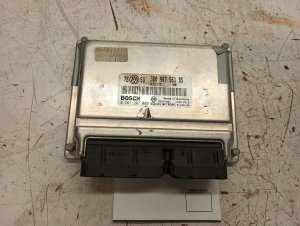
Before diving in, it's important to clarify what this part is. While searching for an "Engine Control Module," you may have found this part. However, the component identified by part numbers like 4A0905351A or Bosch 0227100209 is an Ignition Control Module (ICM), also known as an ignition amplifier. The main engine computer (ECM or ECU) is a separate, more complex part that often requires programming. This ICM, however, is a simpler electronic switch that is completely plug-and-play, requiring no programming.
Symptoms of a Failing Ignition Control Module
A failing ICM is one of the most common causes of ignition problems on the Audi 2.7T V6 and 2.2T 5-cylinder engines. Because the ICM's health directly impacts spark delivery, the symptoms are almost always related to engine misfires.
- Check Engine Light: A flashing or solid Check Engine Light is the most common indicator. A flashing light indicates an active misfire, which can damage your catalytic converters if not addressed.
- Rough Idle: The engine may shake or run unevenly at idle due to inconsistent spark on one or more cylinders.
- Hesitation and Power Loss: During acceleration, the car may stumble, hesitate, or feel significantly down on power.
- Engine Stalling: In severe cases, particularly when the module gets hot, the engine may stall and refuse to restart until it has cooled down.
Common OBD-II Diagnostic Trouble Codes (DTCs)
When an ICM fails, it will typically trigger misfire codes for the cylinder bank it controls. The most common codes include:
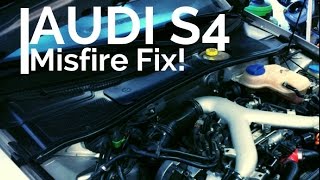
🎬 Watch: How to diagnose and solve Audi misfire issues- P0300: Random/Multiple Cylinder Misfire Detected
- P0301, P0302, P0303: Misfire Detected in Cylinder 1, 2, or 3 (Indicates a problem with the ICM controlling Bank 1 on V6 engines)
- P0304, P0305, P0306: Misfire Detected in Cylinder 4, 5, or 6 (Indicates a problem with the ICM controlling Bank 2 on V6 engines)
- P13xx Codes: You may also see manufacturer-specific codes related to ignition coil power stages or knock control limits, which can point back to a faulty ICM.
Vehicle-Specific Information and Diagnosis
This ICM was used on two distinct engine families. The diagnosis and replacement differ slightly between them.
2.7L V6 Twin-Turbo Models (A6, allroad, S4)
Vehicles like the 2001-2004 Audi A6, 2001-2005 Audi allroad, and 1997-2002 Audi S4 with the 2.7T V6 engine use two identical ICMs. One module controls cylinders 1, 2, and 3 (Bank 1), and the other controls cylinders 4, 5, and 6 (Bank 2). They are conveniently located directly on top of the engine's air filter box, mounted to a metal plate that acts as a heatsink.
Pro Tip: The definitive test for a bad ICM on a 2.7T engine is the "swap test." The electrical connectors are long enough to be swapped between the two modules. If you have misfires on Bank 1 (cylinders 1-2-3), simply swap the connectors, clear the codes, and run the engine. 🎬 Watch: How to perform the ICM swap test on a 2.7T If the misfire codes now appear for Bank 2 (cylinders 4-5-6), you have confirmed that the ICM is the culprit. This simple test can save you from unnecessarily replacing spark plugs or ignition coils.
Compatibility Warning: Later model year 2.7T engines (around 2003-2005), often with the 'BEL' engine code, switched to "push-in" style ignition coils that have the ignition amplifier built-in. These engines do not have the two ICMs on the airbox. Always visually inspect your engine's airbox to confirm you have the external ICMs before ordering parts.
2.2L 5-Cylinder Turbo Models (S6, 100/S4)
The 1992-1994 Audi 100/S4 and 1995-1997 Audi S6 with the 2.2L turbocharged inline-5 engine (engine code 'AAN') use a single ICM. On these models, the module is typically mounted to the firewall or on the vehicle's inner fender, again attached to a metal heatsink to dissipate heat. Diagnosis is more straightforward; if spark is absent or weak across all cylinders and the coils and wiring are good, the ICM is the primary suspect.
Step-by-Step Replacement Guide (2.7T V6)
- Locate the ICMs: Open the hood. The two ICMs are mounted on the top of the black plastic air filter housing.
- Disconnect Electrical Connectors: Press the release tabs and carefully pull the two electrical connectors from each module. The connectors are often color-coded (black and brown/pink).
- Remove the Modules: Each module is held to the heatsink plate by two Phillips or hex-head screws. Remove these screws and lift the old module(s) off. It may be slightly stuck due to the old thermal paste.
- Clean the Mounting Surface: Thoroughly clean the old, dried thermal paste from the heatsink plate using isopropyl alcohol and a lint-free cloth. The surface must be perfectly clean for proper heat transfer.
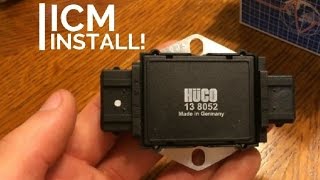
- Apply New Thermal Paste: This is the most critical step. Apply a thin, even layer of new thermal paste to the entire metal base of the new ICM. Computer CPU thermal paste (e.g., Arctic MX-4) works perfectly for this. Failure to apply thermal paste will cause the new module to overheat and fail quickly. 🎬 See this step-by-step ICM installation walkthrough
- Install New Modules: Place the new, greased modules onto the clean heatsink, install the mounting screws, and reconnect the electrical connectors.
Buying a Used Ignition Control Module
A used OEM Ignition Control Module can be a reliable and cost-effective alternative to expensive new parts. Since these modules do not require programming, a compatible used part will work immediately upon installation.
- Verify Compatibility: The most important step is to match the part number. The primary OEM part number is 4A0905351A, and the original Bosch part number is 0227100209. Ensure the part you are buying has one of these numbers.
- Physical Inspection: When inspecting a used module, check for cracks in the black plastic housing, damage to the connector pins, and any signs of extreme corrosion on the metal base plate. A clean, flat base is essential for good contact with the heatsink.
- Why Used OEM is a Good Choice: The original Bosch/Audi units are high-quality components. Their failure is typically due to a long life of heat cycles, not an inherent manufacturing defect. A used OEM part from a lower-mileage vehicle is often more reliable and durable than a brand-new, cheaply made aftermarket alternative.
- Red Flags: Avoid modules with obvious physical damage, bent pins, or heavy corrosion. If the seller cannot confirm the part number, it's best to look elsewhere.
Cost Comparison for Ignition Control Module Replacement (Per Module)
| Part Type | Estimated Cost |
|---|---|
| New OEM (Dealer) | $200 - $300 |
| New Aftermarket (Beru, Bosch) | $50 - $100 |
| Used OEM | $25 - $75 |
| Shop Labor | $50 - $100 |
Note: Prices are estimates and can vary based on location, supplier, and vehicle. 2.7T V6 engines require two modules.
Frequently Asked Questions (FAQ)
Do I need to program a new or used Ignition Control Module?
No. This part is a simple plug-and-play component. It does not need to be programmed, flashed, or coded to the vehicle's VIN. You can install a replacement and it will work immediately.
My 2.7T V6 has two ICMs. Should I replace one or both?
It is highly recommended to replace both ICMs at the same time. They are subjected to the same heat and age, so if one has failed, the other is likely not far behind. Replacing them in pairs ensures reliability and prevents you from having to do the same job twice in the near future.
How important is the thermal paste? Can I skip it?
The thermal paste is absolutely critical and should never be skipped. The ICM generates a lot of heat, and the paste is required to transfer that heat away from the module and into the heatsink. Installing an ICM without thermal paste will cause it to rapidly overheat and fail, sometimes within minutes of running the engine.
Can a bad ICM damage other parts?
Yes. A persistent misfire caused by a bad ICM allows unburnt fuel to enter the exhaust system. This can overheat and destroy the catalytic converters, which is a much more expensive repair. It's important to address a flashing check engine light promptly.
Helpful Videos

Technical Specifications
OEM Part Numbers: 4A0905351 4A0905351A
Aftermarket/OEM Equivalent Part Numbers: 0227100209 (Bosch), ZM063 (Beru), 651102 (Huco)
We Have This Part in Stock




The information in this article is provided for general reference and educational purposes only. Vehicle specifications, procedures, and part compatibility can vary by production date, trim level, and region. Always consult your vehicle's factory service manual and verify part numbers before purchasing or performing repairs. Safety-critical components such as airbags, seat belts, and braking systems should be installed by a qualified professional.
- Audi A6:
- Audi allroad:
- Audi S4:
- Audi S6:
- Audi 100:
- 🎬 Helpful Videos
- 🛍️ Shop This Part
- Is It an ECM or an ICM? A Critical Distinction
- Symptoms of a Failing Ignition Control Module
- Common OBD-II Diagnostic Trouble Codes (DTCs)
- Vehicle-Specific Information and Diagnosis
- 2.7L V6 Twin-Turbo Models (A6, allroad, S4)
- 2.2L 5-Cylinder Turbo Models (S6, 100/S4)
- Step-by-Step Replacement Guide (2.7T V6)
- Buying a Used Ignition Control Module
- Cost Comparison for Ignition Control Module Replacement (Per Module)
- Frequently Asked Questions (FAQ)
- 🎟️ Get 5% Off