

2014-2016 Toyota Highlander 3.5L 2GR-FE V6: Problems, Identification, and Used Replacement
Identify the 2GR-FE V6, understand what kills it, and learn when to swap in a used OEM replacement engine.
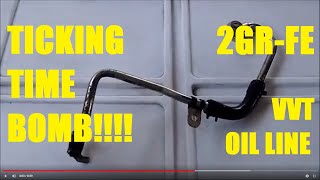
- Before installation, you must verify the used engine has the upgraded all-metal VVT-i oil line (Part # 15772-31030) and oil cooler lines (Part # 15767-31020) to prevent catastrophic oil loss.
- Confirm the donor engine is equipped with an external oil cooler to match the 2014-2016 Highlander, and be prepared to swap your original upper oil pan if moving between FWD and AWD drivetrains.
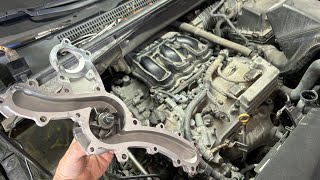
- While the engine is out, proactively replace common failure items like the water pump (Aisin WPT-803), thermostat, spark plugs, and the brittle knock sensor sub-harness (Part # 82219-07010) to avoid thousands in future labor costs.
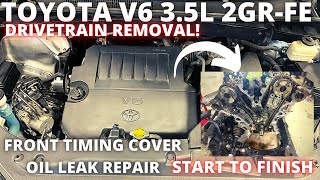
- Resealing the front timing cover is a highly recommended preventative repair on any used engine, especially those with over 100,000 miles, as it is a very common and expensive leak to fix later.
Identification: Is This the Right Engine for Your Highlander?


The engine used in the 2014-2016 Toyota Highlander is the 3.5L V6, known by the engine family code 2GR-FE. This is a 60° V6, DOHC, 24-valve engine that is very common and reliable, but it's crucial to get the exact correct version for your vehicle to ensure a smooth installation.
- Check Your VIN: The easiest way to confirm you have this engine is to check your vehicle's Vehicle Identification Number (VIN). The 5th digit must be a 'K'.
- Confirm the Oil Cooler: Highlanders from 2014-2016 require an engine equipped with an external engine oil cooler. This is a small, radiator-like device located near the oil filter housing on the front, lower passenger side of the engine. It will have coolant lines running to and from it. Engines from other Toyota models may not have this provision.
- Drivetrain Matters: The core engine (long block) is the same for Front-Wheel Drive (FWD) and All-Wheel Drive (AWD) models. However, the upper oil pan and some mounting brackets are different. If you are swapping an engine from a FWD vehicle into an AWD vehicle (or vice-versa), you must transfer your original upper oil pan and brackets to the replacement engine.
Pro Tip: You can physically identify the engine by finding the stamped code '2GR' on the left side of the engine block, near where the transmission bell housing bolts up.
Common Failure Symptoms

While the 2GR-FE is a robust engine, certain symptoms typically indicate a severe internal failure that warrants replacement rather than repair:
- Catastrophic Oil Leaks: A sudden, massive loss of oil, often from a ruptured oil line, can lead to rapid engine seizure.
- Loud Knocking or Rod Knock: A deep, rhythmic knocking sound from the bottom of the engine that increases with engine speed (RPM). This usually means the connecting rod bearings have failed.
- Coolant in Oil: If the oil on your dipstick looks milky or like a chocolate milkshake, it's a sign of a blown head gasket or a cracked block, allowing coolant and oil to mix.
- Excessive Blue or White Smoke: Continuous blue smoke from the exhaust points to failed piston rings or valve seals, while heavy white smoke can indicate a head gasket failure.
- Low Compression: If a compression test shows low or zero pressure in multiple cylinders, it points to significant internal damage like piston or valve failure.
Diagnostic Flowchart
Known Issues, Recalls, and Technical Service Bulletins (TSBs)
Before installing a used 2GR-FE engine, it is critical to address several known issues. Many of these problems were identified in earlier model years (2005-2016 production run) but may still be present on a used engine from a donor vehicle.
VVT-i High-Pressure Oil Line Leak
Warning: This is the most critical issue to check. Failure can cause catastrophic engine damage from oil starvation.
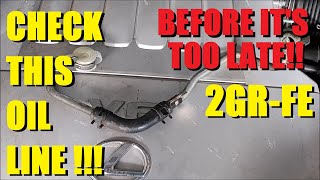
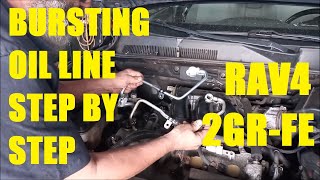
On some earlier 2GR-FE engines (primarily pre-2010), a high-pressure oil line for the Variable Valve Timing-Intelligent (VVT-i) system was made with a rubber section that can degrade, leak, or burst. Toyota issued Limited Service Campaign (LSC) 90K to replace this part. The remedy is to install the updated, all-metal oil line (Toyota Part # 15772-31030). Although this campaign primarily covered earlier models, a used engine's history is often unknown. Always verify the line is all-metal before installation.
Oil Cooler Pipe Leak
Vehicles with the factory towing package, which includes the 2014-2016 Highlander, can experience leaks from the engine oil cooler pipes. The original design used rubber sections that could seep or fail. Toyota addressed this with Technical Service Bulletin T-SB-0201-11 (also referenced as TC-14-036), which instructs technicians to replace the hybrid lines with an all-metal pipe assembly (Toyota Part # 15767-31020). This should be done proactively on any used engine before it is installed.
Improperly Welded Fuel Delivery Pipe (Vehicle-Specific Recall)
This safety recall does not apply to the donor engine itself, but to the recipient 2014-2016 Highlander. Under NHTSA Campaign Number 14V595000 (Toyota recall 20TA06), Toyota identified that a fuel delivery pipe in the engine bay could have been improperly welded, potentially leading to a fuel leak. Verify that the Highlander receiving the engine has had this safety check performed.
VVT Gear Rattle on Cold Start
Some earlier 2GR-FE engines could develop a brief rattle or ticking noise from the VVT-i gears on a cold start. This was addressed in TSB T-SB-0094-09. While often not a critical failure, it is usually caused by low or dirty oil draining from the gears. Ensuring the used engine has clean oil and a quality filter can help prevent it.
What Fails at Every Mileage Band
Pro Tip: The mileage bands below describe the typical condition of USED REPLACEMENT engines at that mileage. The checklists provided are critical steps to perform WHILE INSTALLING the purchased engine on the stand, not general maintenance for your current broken engine.
Under 60,000 Miles
Even low-mileage donor engines can have age-related issues. Early production VVT-i gears could fail, causing a rattle on startup. Water pump failure can also occur at surprisingly low mileage, with some owners reporting issues as early as 50,000 miles.
- ✓Do during install (required): Verify the VVT-i oil line is the updated all-metal design (Toyota Part # 15772-31030). If a rubber section is present, replace it before installation to prevent catastrophic oil loss.
- ✓Do during install (required): If the engine is equipped with an oil cooler, replace the rubber/metal hybrid lines with the all-metal version (Toyota Part # 15767-31020).
- ✓Do during install (recommended): Reseal the front timing cover. While leaks are more common at higher mileage, the sealant can fail with age, and resealing is vastly easier with the engine out. Replace all accessible seals and gaskets, such as the front and rear main seals, valve cover gaskets, and intake manifold gaskets.
- ✓Cheap insurance while the engine is out: Even at low mileage, proactively replacing the water pump with a high-quality OEM (Aisin) unit is cheap insurance against a costly future repair.
60,000 - 100,000 Miles
Water pump leaks are very common in this range. The original pump's lifespan often falls between 90,000 and 120,000 miles. The tell-tale sign is a crusty pink residue near the pump. Front timing cover oil leaks also become more prevalent as a slow seep.
- ✓Do during install (required): Replace the water pump with an OEM Aisin unit (Part # WPT-803) and a new thermostat. This is the prime mileage window for failure.
- ✓Do during install (recommended): Replace the spark plugs (Iridium plugs are specified for 60k-120k mile intervals). Replace the PCV valve. Clean the VVT oil control valve filters located in the valve covers and banjo bolts.
- ✓Cheap insurance while the engine is out: Proactively replace the brittle knock sensor sub-harness located under the lower intake manifold.
100,000 - 150,000 Miles
Front timing cover leaks are a matter of "when," not "if," for many owners in this mileage range. Water pump failure is highly likely if the original is still installed. Oil consumption may begin to appear, often caused by sticking piston rings or aging valve stem seals.
- ✓Do during install (required): Reseal the front timing cover. If a used engine at this mileage isn't already leaking, it is highly likely to start.
- ✓Do during install (recommended): Replace the timing chain tensioners and inspect the chain guides for wear. Replace all ignition coils along with spark plugs.
- ✓Cheap insurance while the engine is out: Perform a thorough cleaning of the throttle body and intake plenum to remove carbon buildup.
Over 150,000 Miles
Oil consumption due to worn or stuck piston rings is a more significant concern here. Consumption of up to one quart per 1,200-1,500 miles may be considered within tolerance by the manufacturer, but anything more warrants investigation. General aging of all seals, gaskets, and plastic components can lead to various oil and coolant leaks.
- ✓Do during install (required): Given the likelihood of oil consumption, it is wise to perform a compression and leak-down test before installation to assess the health of the piston rings and valves.
- ✓Do during install (recommended): Consider replacing the timing chain, sprockets, and guides as a complete set.
- ✓Cheap insurance while the engine is out: Replace all rubber hoses and plastic cooling components as they will be brittle and prone to failure.
Real Owner Experiences
| Source | Mileage | What Happened | Cost |
|---|---|---|---|
| ClubLexus Forum | ~50,000 miles | Owner reported a water pump failure. | Dealer quoted $1,100 for parts and labor. |
| ~35,000 miles | Owner experienced a second water pump leak only 35,000 miles after the first replacement, highlighting the importance of using OEM (Aisin) parts. | Not specified, but requires replacement. | |
| 75,000 miles | Owner replaced a rattling water pump. | Not specified. | |
| Pelican Parts Forum | 94,182 miles | Engine replacement due to a hole in the block after an intermittent oil pressure warning. Covered under an extended warranty. | Minimal (deductible) |
| TheCarCareNut (YouTube) | 98,000 miles | Engine teardown of a 2009 Highlander showed a rattling VVT system and a very minor head gasket seep, but was otherwise in excellent internal condition. | Not specified. |
| BobIsTheOilGuy Forum | ~100,000 miles | A VVT solenoid was replaced due to a check engine light. | $300-$400 at a dealer. |
| 110,000 miles | Owner had the front timing cover resealed, combining the job with a water pump and spark plug replacement. | $2,500 for the combined job. | |
| 115,000 miles | Owner was monitoring a timing cover leak and seeking advice on whether to repair it. | $800 - $2,000+ | |
| 130,000 miles | Dealer quoted $6,200 to fix a timing cover leak on a 2019 Highlander. | $6,200 (dealer quote). | |
| BobIsTheOilGuy Forum | 134,000 miles | Owner reported no major issues, just routine maintenance with 10,000-mile oil changes. | N/A |
| 140,000 miles | Water pump failed by making noise, but did not leak. | Not specified. | |
| 147,000 miles | Engine seized due to a failed water pump and overheating. Dealer quoted $8k for a new engine. Owner was calling other shops and getting higher quotes. | $8,000 - $14,000+ | |
| 185,000 miles | Owner lives with a timing cover leak that consumes less than half a quart of oil every 5,000 miles, avoiding a costly repair. | Repair quoted at $3,000+ years ago. | |
| BobIsTheOilGuy Forum | 190,000 miles | Engine was solid with no major repairs needed, though the water pump had been replaced previously. | Not specified. |
| 242,000 miles | Owner reports a timing cover leak at this high mileage. | Not specified. | |
| BobIsTheOilGuy Forum | 300,000 miles | Owner of an Avalon reports still having the original water pump and idlers with no major issues. | N/A |
Repair or Replace?
When facing a major engine issue, deciding whether to repair your current 2GR-FE or replace it with a used unit comes down to the specific failure and labor costs.
- VVT-i High-Pressure Oil Line Leak: Typical repair cost is $200 - $600. Always repair this. It is a preventative, must-do repair. If the line has not ruptured and the engine is otherwise healthy, replacing the line with the all-metal part is cheap insurance against catastrophic failure.
- Water Pump Failure: Typical repair cost is $600 - $1,000. If the failure is caught immediately (due to noise or a small leak) before the engine overheats, a standalone water pump replacement makes sense. If the engine has already overheated to the point of seizure or head gasket failure, engine replacement is necessary.
- Front Timing Cover Oil Leak/Seep: Typical repair cost is $2,000 - $6,200+. This is a very labor-intensive job requiring engine removal. If the leak is a minor seep (not dripping on the ground), many owners choose to live with it and monitor oil levels. If the engine has high mileage or other issues, it's often more economical to replace the engine with a lower-mileage used unit (and reseal its timing cover) than to pay for this repair alone.
- Blown Head Gasket: Typical repair cost is $2,500 - $4,000+. If the engine has relatively low mileage and did not suffer from prolonged overheating that could warp heads or damage the block, a head gasket job by a reputable shop can be viable. However, the labor is extensive (often 20+ hours), and for a high-mileage engine, the cost approaches that of a used engine swap, making replacement a more reliable and often more economical choice.
Replacement is the smarter option when the engine has suffered catastrophic internal failure (e.g., hole in the block, spun bearings, rod knock), has been severely overheated, or has very high mileage (over 180,000 miles) and requires a costly repair like a timing cover reseal or head gaskets. Given the high labor costs for major internal repairs, swapping in a warrantied, lower-mileage used engine often provides better value and long-term peace of mind.
Questions to Ask Your Installer
- Have you verified that this donor engine has an oil cooler to match my vehicle?
- My vehicle is FWD/AWD. Does the donor engine have the correct upper oil pan, or will you need to swap mine over?
- Will you be proactively replacing the water pump, thermostat, and spark plugs while the engine is out?
- Will you be replacing the brittle knock sensor sub-harness located under the intake manifold?
- Have you inspected the VVT-i and oil cooler lines? Will you be installing the upgraded all-metal versions?
- What is your process for resealing the timing cover? Will you be doing this before installation?
- How do you ensure the cooling system is properly bled to prevent air pockets and overheating after start-up?
- Does your quote include all necessary fluids, gaskets, and seals for the installation?
- What is the warranty on the used engine and on your labor?
Replacement Cost Comparison
Engine replacement costs vary based on the type of engine and labor rates. Shop labor for a V6 engine swap in a Highlander typically requires 12 to 19.4 hours, ranging from $1,500 to $3,000 in labor alone.
| Part Type | Estimated Cost (USD, Part Only) |
|---|---|
| New OEM | $4,000 - $8,000+ |
| Remanufactured | $2,700 - $7,500 |
| Used OEM | $1,800 - $3,600 |
What's Included in a Used Engine Assembly?
When buying a used 2GR-FE, it's important to know what parts are typically included. A standard used engine assembly, or "long block," includes the core components but requires you to transfer over most of your accessories. For example, a verified donor unit might come from a 2010 Toyota VENZA with approximately 98,782 miles in ARA condition grade A.
- What's Usually Included: Engine block and cylinder heads (long block), all internally lubricated parts (pistons, crankshaft, camshafts, valves), upper and lower oil pans, valve covers, intake manifold (including plastic plenum and ACIS valve), timing covers and timing components (chain, guides, tensioners), fuel injectors and fuel rail, throttle body, and harmonic balancer.
- What's Never Included: Alternator, A/C compressor, starter motor, power steering pump, exhaust manifolds, oxygen sensors, and all belts, hoses, and wiring harnesses. You must reuse these parts from your original engine.
Installation: Key Considerations & Common Mistakes

This swap is considered Advanced/Expert difficulty for DIYers. Special tools required include an engine hoist/crane or heavy-duty subframe cradle lift, an engine support bar, a Toyota-specific crankshaft pulley holding tool / harmonic balancer puller, a spill-free coolant funnel or vacuum-lift cooling system bleeding tool, and torque wrenches (ft-lbs and in-lbs).
Required Parts & Fluids
For a reliable installation, always replace the following consumable items while the engine is out of the vehicle and easy to access:
- Oil & Fluids: 6.4 to 6.8 quarts of 0W-20 or 5W-30 synthetic oil (depending on target vehicle spec) and a new high-quality oil filter. Approximately 2 gallons of Toyota Super Long Life Coolant (SLLC) (pink).
- Gaskets & Seals: Intake manifold gaskets (upper and lower plenum), exhaust manifold gaskets, thermostat and water pump gaskets, and front and rear crankshaft seals.
- Maintenance Items: A new AISIN water pump (Part # WPT-803), new OEM thermostat, six new Denso or NGK Iridium spark plugs, and a new serpentine belt.
- Critical Harness: The fragile knock sensor harness, located deep in the 'V' of the block under the lower intake manifold, becomes extremely brittle from heat. Replace this sub-harness (Toyota Part # 82219-07010) proactively.
Installation Gotchas
- The 'Hidden' Rear Engine Bracket Bolt: There is a hard-to-reach bolt on the rear engine bracket near the intermediate shaft. Access it using a long extension with a swivel/flex socket from the wheel well area.
- AWD Transfer Case (PTU) Alignment: Ensure perfect alignment of the splines during mating. Never force the bolts to pull the PTU to the block.
- Timing Cover Sealing Interlock: The upper oil pan and front timing cover interlock. You must remove the upper oil pan first before attempting to pry the timing cover off to avoid cracking the aluminum castings.
- Cooling System Bleeding: The 2GR-FE is known for trapping air. Using a vacuum-lift tool is strongly recommended to prevent air pockets that cause overheating.
Pro Tip: The knock sensor sub-harness (Toyota Part # 82219-07010) is extremely brittle and buried under the intake. Replacing it while the engine is on a stand is a cheap and easy preventative measure.
Common Buyer Mistakes to Avoid
Avoid these costly errors when purchasing and installing a used 2GR-FE engine:
- Ordering for a Non-Oil-Cooler Vehicle: Trying to install this engine into a vehicle without an oil cooler leaves open oil ports on the block/pan, requiring block-off plates or swapping the upper oil pan.
- Failing to Swap the Upper Oil Pan on AWD/FWD Swaps: Assuming the blocks are different when only the upper oil pan and brackets differ. Axles or transfer cases will not bolt up if not swapped.
- Reusing the Rubber VVT-i or Oil Cooler Lines: Installing the engine as-is without upgrading these lines to all-metal versions, risking catastrophic engine failure shortly after install.
- Not Replacing the Water Pump and Spark Plugs on the Stand: Skipping these cheap maintenance items while the engine is out, leading to expensive, multi-hour headaches later in the cramped engine bay.
Warning: Never reuse the original rubber VVT-i or oil cooler lines. Installing the engine without upgrading to the all-metal versions risks catastrophic engine failure shortly after installation.
Freight & Delivery Reality

When ordering a used 2GR-FE engine assembly, understand that it will not arrive in a standard cardboard box. Verified shipping data shows this assembly weighs approximately 421 lbs and measures roughly 48" x 40" x 36" before crating. It ships as LTL (Less-Than-Truckload) freight on a wooden pallet.
Because of its size and weight, delivery requires a freight truck equipped with a liftgate if you are delivering to a residential address or a shop without a loading dock. Always perform a pre-purchase verification interview with the seller to confirm the engine's VIN, mileage, and oil cooler configuration. Upon delivery, you must inspect the engine for transit damage (such as cracked plastic intake plenums or bent sensors) before signing the driver's delivery receipt.
Before the First Start: Priming and Fluids
Starting a used engine dry will cause instant damage. Because the replacement engine has been sitting, all the oil has drained into the bottom pan. You must prime the engine (pump oil through the moving parts) before letting it actually run.
Mandatory Fresh Fluids
Never reuse old fluids. Before you try to start the replacement engine, fill it with the correct new fluids:
- Engine Oil: Use fresh 0W-20 full synthetic motor oil. Install a brand-new oil filter.
- Engine Coolant: Use Toyota Super Long Life Coolant (the pink fluid) or an equivalent 50/50 pre-mixed coolant made specifically for Asian vehicles.
How to Prime the Engine
Follow these steps to build oil pressure safely:
- Disable the fuel system: Open the under-hood fuse box and remove the EFI (Electronic Fuel Injection) fuse or the fuel pump fuse. This stops the engine from getting gas so it will not start.
- Crank the engine: Turn the key to the "Start" position and let the engine turn over for 10 to 15 seconds.
- Let the starter rest: Wait one full minute so the starter motor does not overheat.
- Repeat: Crank the engine again for 10 to 15 seconds. Watch the dashboard. Stop when the red low oil pressure warning light turns off. This means oil has successfully reached the top of the engine.
- Start the engine: Put the fuse back in place. Start the engine normally and let it idle. Listen for any strange noises and check underneath the vehicle for leaks.
Frequently Asked Questions (FAQ)
Do I need to reprogram the computer (ECU) after installing a used engine?
No. The 2GR-FE is a purely mechanical swap. As long as you reuse your original ECU, wiring harness, and sensors, the vehicle will start and run immediately without any programming or immobilizer re-marriage.
Will a 2GR-FE engine from a Toyota Camry, Sienna, or Lexus RX350 work?
No. While those vehicles use the same core 2GR-FE engine, they have different mounting brackets, oil pan configurations, oil cooler provisions, wiring harnesses, and ECU calibrations. This specific assembly is configured only for the 2014-2016 Highlander and a few other select models. Using an engine from another model would require extensive parts swapping and is not recommended.
Is it really necessary to replace the water pump?
Yes. The water pump is a known failure point, typically between 60,000 and 140,000 miles. Replacing it while the engine is out of the car is a simple, inexpensive task that provides significant peace of mind and prevents a much more labor-intensive repair down the road.
How long will a used 2GR-FE engine last?
The 2GR-FE is widely regarded as a durable, long-life engine. With consistent maintenance—specifically 5,000 to 7,500-mile oil changes with quality synthetic oil—many examples comfortably exceed 200,000 to 250,000 miles. Well-maintained units have been known to surpass 300,000 miles, with some anecdotal reports of 400,000 miles or more.
What special tools are required for this engine swap?
You will need an engine hoist/crane or heavy-duty subframe cradle lift, an engine support bar, a Toyota-specific crankshaft pulley holding tool (harmonic balancer puller), a spill-free coolant funnel or vacuum-lift cooling system bleeding tool, and torque wrenches capable of measuring both foot-pounds and inch-pounds.
Why is the knock sensor harness so important to replace?
The knock sensor sub-harness (Toyota Part # 82219-07010) is located deep in the 'V' of the engine block, directly under the lower intake manifold. It is subjected to extreme heat cycles and becomes incredibly brittle over time. Replacing it while the engine is on the stand takes minutes; replacing it after the engine is installed requires removing the entire intake manifold assembly.
Helpful Videos
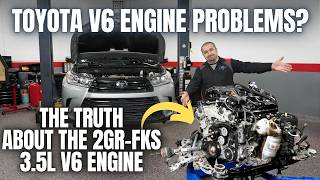
Technical Specifications
OEM Part Numbers: 15772-31030 15767-31020 WPT-803 82219-07010
Engine Code: 2GR-FE; Displacement: 3.5L; Configuration: 60° V6; Valvetrain: DOHC, 24-valve; VIN Digit 5: K; Oil Capacity: 6.4 - 6.8 quarts; Recommended Oil: 0W-20 or 5W-30 Synthetic; Coolant Type: Toyota Super Long Life Coolant (SLLC); Weight: ~421 lbs; Shipping Dimensions: ~48" x 40" x 36"
We Have This Part in Stock


The information in this article is provided for general reference and educational purposes only. Vehicle specifications, procedures, and part compatibility can vary by production date, trim level, and region. Always consult your vehicle's factory service manual and verify part numbers before purchasing or performing repairs. Safety-critical components such as airbags, seat belts, and braking systems should be installed by a qualified professional.
- Toyota HIGHLANDER:
- 🎬 Helpful Videos
- 🛍️ Shop This Part
- Identification: Is This the Right Engine for Your Highlander?
- Common Failure Symptoms
- Diagnostic Flowchart
- Known Issues, Recalls, and Technical Service Bulletins (TSBs)
- VVT-i High-Pressure Oil Line Leak
- Oil Cooler Pipe Leak
- Improperly Welded Fuel Delivery Pipe (Vehicle-Specific Recall)
- VVT Gear Rattle on Cold Start
- What Fails at Every Mileage Band
- Under 60,000 Miles
- 60,000 - 100,000 Miles
- 100,000 - 150,000 Miles
- Over 150,000 Miles
- Real Owner Experiences
- Repair or Replace?
- Questions to Ask Your Installer
- Replacement Cost Comparison
- What's Included in a Used Engine Assembly?
- Installation: Key Considerations & Common Mistakes
- Required Parts & Fluids
- Installation Gotchas
- Common Buyer Mistakes to Avoid
- Freight & Delivery Reality
- Before the First Start: Priming and Fluids
- Mandatory Fresh Fluids
- How to Prime the Engine
- Frequently Asked Questions (FAQ)
- 🎟️ Get 5% Off