

2011-2016 Corolla & 2011-2014 Matrix 1.8L 2ZR-FE Engine: Problems, Identification, and Used Replacement
Identify the 1.8L 2ZR-FE, learn what causes excessive oil consumption or catastrophic failure, and discover when swapping in a used OEM engine is the smartest fix.
- Verify you have the correct 2ZR-FE engine by checking for the 5th VIN digit 'U' and ensuring there is no large 'Valvematic' actuator on the valve cover.
- To prevent the common oil consumption issue, shorten oil change intervals to 5,000-7,500 miles using 0W-20 or 5W-20 full synthetic oil.
- When installing a used engine, always replace the water pump, serpentine belt, and timing chain tensioner gasket to prevent common failures.
- You must reuse your vehicle's original ECU and wiring harness during the swap to avoid triggering the engine immobilizer; no ECU reprogramming is required.
- Before installing a used engine, perform a compression and leak-down test to verify the health of its piston rings and seals.
Is This the Right Engine for Your Toyota?


The engine used in the 2011–2016 Toyota Corolla and 2011–2014 Toyota Matrix is the 2ZR-FE, part of Toyota's ZR family. It is a reliable 1.8-liter, inline 4-cylinder engine used only in Front-Wheel Drive (FWD) models. Before buying a replacement, it's critical to verify that this is the exact engine your vehicle needs.
The Critical VIN Check
The easiest and most accurate way to confirm your engine is by checking your car's 17-digit Vehicle Identification Number (VIN). You can find the VIN on the driver's side dashboard (visible through the windshield) or on the sticker in the driver's side door jamb.
- For this specific engine, the 5th digit of your VIN must be 'U'.
Visual Checks on Your Car
You can also identify the engine by looking under the hood.
- Engine Code Stamping: The code '2ZR' is stamped on the front-left side of the engine block, near where the engine connects to the transmission.
- Valve Cover: The 2ZR-FE has a simple, black plastic valve cover. If you see a large, rectangular metal actuator on the back of the valve cover (near the firewall), you have the incompatible 2ZR-FAE "Valvematic" engine.
Warning: Not all 1.8L Toyota engines are the same. The 2ZR-FE is NOT interchangeable with other similar-sounding engines. The following will not fit or work correctly:
- 2ZR-FAE (Valvematic) engines: Found in some Corolla models (like the LE Eco), these have a different cylinder head and require different computer controls.
- 2ZR-FXE (Hybrid) engines: Used in the Prius, these operate on a different thermodynamic cycle (Atkinson cycle) and are completely different.
- Engines from other models: Even if they are labeled 2ZR-FE, units from a Scion xD, Pontiac Vibe, or Toyota Yaris swaps may have different wiring harness pinouts, engine mounting brackets, oil pans, and accessory drive layouts that make them incompatible.
When Is the Engine Actually Bad?
Many engine problems can be fixed with targeted repairs. However, a complete used engine assembly is often the most cost-effective solution when you experience major internal failures. Symptoms that point to a necessary replacement include:
- Severe internal knocking or banging (rod knock) that gets louder with engine speed.
- Metal shavings found in the engine oil during an oil change, which looks like metallic glitter in the drained oil.
- Low or no oil pressure, even after replacing the oil pressure sensor.
- Catastrophic overheating that has caused the aluminum cylinder head to warp.
- Loss of compression in two or more cylinders, leading to a major loss of power.
Common 2ZR-FE Problems and Factory Fixes

This engine is known for its reliability, with an expected service life of 200,000 to 250,000 miles (and many reaching 300,000+ miles) if properly maintained. However, some common issues have been documented by Toyota in official Technical Service Bulletins (TSBs) and recalls.
Excessive Oil Consumption
| Symptom | The engine consumes a significant amount of oil between changes, requiring frequent top-offs. |
| Affected Years | Primarily 2009–2013 models, with some occurrences in 2014–2016 if maintenance was poor. |
| Cause & Fix | A design flaw in the original low-tension piston oil control rings could cause them to stick from carbon buildup, allowing oil to bypass and burn. Toyota addressed this under Warranty Enhancement Program ZE7 (also referenced in TSB POL14-12) by replacing the pistons and piston rings with an updated design. Shortening oil change intervals from 10,000 miles to 5,000-7,500 miles is the best way to prevent this. | 🎬 Watch: Why Toyota engines consume oil and how to prevent it
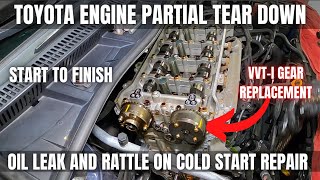
Cold Start VVT-i Gear Rattle
| Symptom | A brief, 1-2 second metallic rattle or knocking sound immediately after starting the engine when it's cold. |
| Affected Years | 2009–2016 Corolla and Matrix models. |
| Cause & Fix | The intake camshaft timing gear (VVT-i actuator) fails to lock in the proper position when the engine is shut down. Toyota issued TSB T-SB-0087-09 to replace the faulty camshaft timing gear assembly. |
Water Pump Leak or Bearing Noise
| Symptom | A whining or grinding noise from the passenger side of the engine, or visible pink/crusty coolant residue around the water pump pulley. |
| Affected Years | 2009–2016 Corolla/Matrix. |
| Cause & Fix | The mechanical water pump bearing can fail, or the gasket can leak. TSBs T-SB-0055-24, T-SB-0316-17, and T-SB-0094-11 address procedures related to this area. Replacement of the water pump assembly is the only remedy. | 🎬 See this step-by-step water pump replacement walkthrough
Timing Chain Tensioner Gasket Oil Leak
| Symptom | A slow oil leak appearing on the back of the engine block (firewall side). |
| Affected Years | 2009–2016 Corolla/Matrix. |
| Cause & Fix | The small metal-and-rubber gasket for the timing chain tensioner fails over time. The part is inexpensive, but access is very difficult with the engine in the car. Toyota TSBs T-SB-0119-10 and T-SB-0110-17 address procedures related to this area. | 🎬 Watch: How to replace the timing chain tensioner
Recall: Brake Vacuum Port Freezing
| Symptom | In extremely cold weather, the brake pedal may become very hard to press, and stopping distances can increase significantly. |
| Affected Years | 2009–2010 Corolla and Matrix. |
| Cause & Fix | Moisture from the crankcase ventilation system could freeze and block the brake booster's vacuum port inside the intake manifold. This was addressed under NHTSA Recall ID 09V338000 (Toyota Campaign 90H), which involved installing a newly designed intake connector to relocate the port. |
Diagnostic Flowchart
What Fails at Every Mileage Band
Pro Tip: The mileage bands below describe used replacement units of that mileage. The checklists are things to do WHILE INSTALLING the purchased engine, not maintenance for your current engine.
Under 60,000 Miles
Major failures are rare at this mileage. Some owner reports mention rough idle, check engine lights for the EVAP system, and rare instances of ignition coil failure. Note: A known costly repair often discussed online applies to the 2ZR-FAE Valvematic engine, not this standard 2ZR-FE.
- ✓Do during install (required): Full Synthetic Oil Change (Use 4.4 quarts of premium 0W-20 or 5W-20 synthetic oil and a new oil filter). Coolant (Fill with ~6.5 quarts of Toyota Super Long Life Coolant (SLLC) pink pre-diluted 50/50).
- ✓Do during install (recommended): Basic Tune-Up (Install 4 new Iridium spark plugs, Denso SC20HR11 or equivalent).
- ✓Cheap insurance while the engine is out: Gasket & Seal Inspection (Even at low mileage, inspect the timing chain tensioner gasket and water pump for any signs of weeping).
60,000 - 100,000 Miles
The mechanical water pump is a common failure item in this range, leading to coolant leaks or bearing noise. The timing chain tensioner gasket is also known to start leaking oil. Ignition coils can fail, leading to misfires, and starters can begin to show signs of wear.
- ✓Do during install (required): Mandatory Replacements (Replace the water pump, serpentine belt, and timing chain tensioner gasket. These are common failure points and are much easier to access with the engine out). Full Service (Perform a full synthetic oil change, coolant flush, and replace all spark plugs).
- ✓Do during install (recommended): Clean MAF/Throttle Body (Clean the Mass Air Flow sensor and throttle body to ensure smooth idling and proper fuel trims).
- ✓Cheap insurance while the engine is out: Inspect Mounts (Check engine and transmission mounts for wear or cracking).
100,000 - 150,000 Miles
This is the mileage where oil consumption due to carbon-stuck piston rings can become noticeable, particularly in 2011-2013 models and engines with extended oil change intervals. The likelihood of starter motor or solenoid failure increases, and automatic transmissions may show shifting issues.
- ✓Do during install (required): All 60-100k Recommendations (Perform all the required tasks from the previous band: water pump, tensioner gasket, belt, fluids, plugs).
- ✓Do during install (recommended): Assume Oil Consumption Potential (Check for signs of oil burning. Regardless, replacing the PCV valve is cheap insurance). Clean Intake Manifold (If accessible, cleaning the intake manifold can help with performance).
- ✓Cheap insurance while the engine is out: Timing Chain (While designed for the life of the engine, its lifespan can be shortened by low oil levels. Inspecting the tensioner's extension and guide wear is prudent).
Over 150,000 Miles / High Mileage
The primary concern at this mileage is the rate of oil consumption. If not managed by regularly checking and topping off oil, it can lead to catastrophic failure from oil starvation. Failures at this stage are also often caused by botched previous repairs, such as misplaced O-rings leading to oil pressure loss. Head gasket issues can occur, often accelerated by overheating from a failing water pump.
- ✓Do during install (required): All Previous Recommendations (water pump, tensioner gasket, seals, plugs, fluids, PCV valve). Compression & Leak-Down Test (Before purchase or installation, perform a compression and leak-down test to verify the health of the piston rings and cylinder head sealing).
- ✓Do during install (recommended): Seal Replacement (Strongly consider replacing the front crankshaft seal and rear main seal while the engine is out).
- ✓Cheap insurance while the engine is out: Full Gasket Kit (Using a full engine gasket kit to replace all accessible seals and gaskets is a wise investment to prevent future leaks).
Real Owner Experiences
| Source | Mileage | What Happened | Cost |
|---|---|---|---|
| 42,000 | A 2016 Corolla with the 1.8L engine required a major, dealer-only repair costing around $5,000. The dealer noted this "happens with those 1.8L engines." However, further discussion clarified this is a known issue with the 2ZR-FAE Valvematic engine, not the standard 2ZR-FE. | ~$5,000 | |
| Car Talk Community | 90,000-97,000 | A 2011 Corolla that was not well-maintained experienced a rough idle and repeated failure of the ignition coil on cylinder 1. | Not specified |
| Kelley Blue Book Review | 150,000+ | Owner of a 2012 Corolla reported zero problems besides normal wear items like brakes, battery, and tires. | Normal Maintenance |
| PriusChat Forum | ~100,000+ | A forum member notes that oil consumption on 2ZR engines often begins to appear after 100,000 miles if 10k-mile oil change intervals were followed. | Ongoing cost of adding oil |
| Bob Is The Oil Guy Forum | 170,000 | Owner of a Corolla with a 2ZR-FE reports oil consumption, attributing it to known issues with dirty/bound oil control rings. | N/A |
| Autoblog / I Do Cars Teardown | 260,000 | A 2ZR-FE engine failed catastrophically. The teardown revealed the failure was not due to a design flaw, but from a botched timing chain job where O-rings were installed incorrectly, leading to oil starvation and bearing failure. | Catastrophic Engine Failure |
| Yaris World Forum | 450,000 km (~280,000 miles) | An owner reported their 2ZR engine was still running in daily duty when pulled at this mileage, despite a suspected poor maintenance history before they acquired it at 350,000 km. | N/A |
| Car Talk Community | 23,000 | Insurance offered a used engine from a 2014 Corolla with 5k miles for a ~$500 cost to owner, or a new engine for ~$1800 cost to owner. Owner was inclined to take the low-mileage used engine with a 1-year warranty that included labor. | ~$500 |
| Reddit r/Toyota | 69,000 | Quoted $4,500 for a used engine, $10,500 for a rebuild. Opted for a used engine with 69k miles. The mechanic verified its condition internally and performed a complete reseal. | $5,100 (including reseal) with a 2-year unlimited mileage warranty. |
| Reddit r/Toyota | Not specified | Up to $10,000 from a dealership for a replacement. Another user reported having a used JDM engine installed in their 2012 Prius (different engine, but relevant cost data). | $3,500 |
| Car Talk Community | Not specified | A user estimated a total replacement cost of around $1,900 ($400 for a used engine + $1500 for labor). | N/A (Estimate) |
Repair or Replace?

When facing engine trouble, deciding whether to repair your current engine or replace it with a used unit comes down to economics and the severity of the damage.
| Problem | Estimated Repair Cost (USD) | Recommendation |
|---|---|---|
| Cold Start VVT-i Gear Rattle | $500 - $2,500 | Repair makes sense if the noise is the only symptom. The cost varies based on whether just the gear is replaced or if it's part of a larger timing chain service. |
| Timing Chain Tensioner Gasket Oil Leak | $533 - $716 | Almost always worth repairing unless the engine has other major issues. The gasket is inexpensive, but labor is the main cost due to difficult access. |
| Water Pump Coolant Leak / Bearing Noise | $498 - $646 | This is a standard maintenance item that is always more economical to replace than the entire engine. |
| Excessive Oil Consumption | $2,000 - $7,000+ | If minor, try a piston soak or new PCV valve first. A full rebuild for stuck rings is very expensive and often approaches the cost of a used engine. |
When Replacement is Smarter: Replacement with a quality used engine is often the most economical choice when facing severe internal damage, such as spun bearings, a thrown rod, or significant oil consumption caused by scored/damaged cylinder walls. If the cost of a single repair (like a full oil consumption-related rebuild) exceeds the all-in cost of a lower-mileage used engine (typically $3,000 - $5,000 installed), replacement is the smarter financial decision.
Questions to Ask Your Installer
- Have you installed a JDM engine in this type of car before? Are you familiar with swapping over the US-spec sensors and manifolds?
- Does your quote include replacing critical 'while-you're-in-there' parts on the used engine, such as the water pump, thermostat, and timing chain tensioner gasket?
- What is the source and mileage of the used engine, and what kind of warranty is provided on both the engine itself and your labor?
- How will you bleed the cooling system after installation to prevent air pockets and overheating?
- Will you be reusing my car's original ECU and wiring harness to avoid immobilizer and compatibility issues?
- Can you perform a compression or leak-down test on the replacement engine before it is installed to verify its health?
Engine Replacement Cost Comparison
The cost of replacing a 2ZR-FE engine varies based on the type of replacement unit you choose. Labor costs for the swap are also a significant factor.
| Part Type | Estimated Part Cost (USD) | Notes |
|---|---|---|
| New OEM | $4,000 - $6,000+ | Brand new from a Toyota dealer. Offers the best longevity but is the most expensive option. New units are not commonly sold; remanufactured is the typical 'new' equivalent. |
| Remanufactured | $2,900 - $5,300 | Rebuilt to OEM specifications with new internal wear parts. Often comes with a good warranty. |
| Used OEM | $1,300 - $2,500 | A recycled engine from a donor vehicle (e.g., a 2016 Corolla with 31,720 miles). Price depends heavily on mileage and condition. |
Labor Costs
A professional shop will typically charge for 8 to 12 hours of labor to swap the engine. With hourly rates between $125 and $200, you can expect labor costs to be in the $1,000 to $2,400 range (or up to $3,000 in high-cost areas).
Freight & Delivery Reality

If you are ordering a used 2ZR-FE engine online, it is important to understand how it will arrive. An engine assembly is not a parcel; it ships as LTL (Less Than Truckload) freight on a wooden pallet. The verified shipping weight for this specific assembly is approximately 210 lbs, and it measures roughly 36" x 36" x 36" before crating.
Because of its size and weight, delivery requires a forklift or a truck equipped with a liftgate. Always inspect the engine thoroughly before signing the delivery receipt. Look closely for damage to fragile components like the plastic intake manifold, valve cover, and oil pan, which can easily be cracked if mishandled or if tools are dropped on them during transit.
Before the First Start: Priming and Fluids
A used engine has likely been sitting on a shelf for months. The oil has drained away from the moving metal parts. If you start the engine dry, the metal parts will scrape together and cause instant damage. You must prime the oil system first.
Mandatory Fresh Fluids
Never use the old fluids that came with the used engine. Before you try to start the car, you must add:
- Engine Oil: Fill the engine with fresh 0W-20 full synthetic motor oil and install a new oil filter.
- Engine Coolant: Fill the radiator with Toyota Pink 50/50 pre-mixed coolant (also called Super Long Life Coolant). Do not use universal green coolant, as it can damage the water pump and seals.
The Oil Priming Procedure
Priming means pumping oil through the engine before it actually runs. You do this by cranking the engine (turning it over with the starter motor) without letting it fire up.
- Disable the fuel system: Open the fuse box under the hood. Remove the EFI fuse (Electronic Fuel Injection) or the fuel pump relay. This stops fuel from entering the engine so it cannot start.
- Crank the engine: Turn the ignition key and crank the engine for 10 to 15 seconds.
- Let the starter rest: Wait 30 seconds so the starter motor does not overheat and burn out.
- Repeat: Crank the engine again for 10 to 15 seconds. Watch the dashboard. Keep repeating this cycle until the red oil pressure warning light turns off. When the light goes out, oil pressure has built up and oil has reached the top of the engine.
- Reconnect the fuel system: Put the EFI fuse or fuel pump relay back into its exact spot in the fuse box.
- Start the engine: Turn the key to start the car normally. Let it idle (run without pressing the gas pedal) and immediately check under the car for any fluid leaks.
Frequently Asked Questions (FAQ)
Do I need to program the computer (ECU) after an engine swap?
No. The 2ZR-FE engine itself does not require any programming, ECU re-marriage, or immobilizer synchronization when swapped. It is a purely mechanical swap. However, you must reuse your vehicle's original Engine Control Module (ECU/ECM) and wiring harness. If you attempt to swap the ECU from the donor vehicle, the Toyota engine immobilizer system will lock you out and prevent the engine from starting.
What parts should I replace during the engine swap?
To ensure reliability and prevent future leaks, it is wise to replace several key items while the engine is out: the water pump and gasket, front crankshaft seal, timing chain tensioner gasket, intake manifold gasket, exhaust manifold gasket, thermostat gasket, throttle body gasket, and serpentine belt. It's also the perfect time to install 4 new Iridium spark plugs (Denso SC20HR11 or equivalent) and change the oil and coolant.
What is typically included with a used engine assembly?
A standard used engine assembly includes the engine block, cylinder head(s), internally lubricated parts, oil pan, valve covers, timing covers, harmonic balancer, intake manifold, fuel injectors, throttle body, and sensors/wiring harness left on the engine for convenience. Accessories like the A/C compressor, starter, power steering pump, alternator, exhaust manifold, ignition coils, and ECU are generally not included and should be transferred from your old engine.
How do I prevent the new engine from overheating after installation?
Air pockets trapped in the cooling system are a common cause of overheating after a swap, which can warp the aluminum cylinder head. It is crucial to properly bleed the cooling system. Using a spill-free funnel kit that attaches to the radiator is the best method to ensure all air is purged as you fill the system with new Toyota Super Long Life Coolant.
What special tools are required for this engine swap?
While an advanced DIYer can perform this swap, you will need specific tools: an engine hoist (cherry picker) and load leveler, a fuel line disconnect tool, quality clip pliers for plastic harness clips, and a torque wrench. The torque wrench is critical for the Torque-to-Yield (TTY) flywheel/flexplate bolts, which must be tightened in an exact star pattern with medium thread locker (blue Loctite).
Can I save money on A/C recharging during the swap?
Yes. You can unbolt the A/C compressor from the engine block and wire-tie it out of the way in the engine bay without disconnecting the refrigerant lines. This allows you to swap the engine without having to pay for an A/C system evacuation and recharge.
Helpful Videos
Technical Specifications
Engine Code: 2ZR-FE; Displacement: 1.8 Liters; Cylinders: Inline 4-Cylinder; Drivetrain Application: Front-Wheel Drive (FWD); VIN Identifier (5th Digit): U; Oil Type: 0W-20 or 5W-20 Full Synthetic; Oil Capacity: 4.4 quarts; Coolant Type: Toyota Super Long Life Coolant (SLLC) Pink 50/50; Coolant Capacity: ~6.5 quarts; Spark Plugs: Iridium (Denso SC20HR11 or equivalent); Shipping Weight: ~210 lbs
We Have This Part in Stock


The information in this article is provided for general reference and educational purposes only. Vehicle specifications, procedures, and part compatibility can vary by production date, trim level, and region. Always consult your vehicle's factory service manual and verify part numbers before purchasing or performing repairs. Safety-critical components such as airbags, seat belts, and braking systems should be installed by a qualified professional.
- Toyota Corolla:
- Toyota Matrix:
- 🎬 Helpful Videos
- 🛍️ Shop This Part
- Is This the Right Engine for Your Toyota?
- The Critical VIN Check
- Visual Checks on Your Car
- When Is the Engine Actually Bad?
- Common 2ZR-FE Problems and Factory Fixes
- Excessive Oil Consumption
- Cold Start VVT-i Gear Rattle
- Water Pump Leak or Bearing Noise
- Timing Chain Tensioner Gasket Oil Leak
- Recall: Brake Vacuum Port Freezing
- Diagnostic Flowchart
- What Fails at Every Mileage Band
- Under 60,000 Miles
- 60,000 - 100,000 Miles
- 100,000 - 150,000 Miles
- Over 150,000 Miles / High Mileage
- Real Owner Experiences
- Repair or Replace?
- Questions to Ask Your Installer
- Engine Replacement Cost Comparison
- Labor Costs
- Freight & Delivery Reality
- Before the First Start: Priming and Fluids
- Mandatory Fresh Fluids
- The Oil Priming Procedure
- Frequently Asked Questions (FAQ)
- 🎟️ Get 5% Off