

2014-2016 Nissan Rogue 2.5L QR25DE: Problems, Identification, and Used Replacement
Identify the 2.5L QR25DE engine, understand what causes timing chain and oil consumption failures, and learn exactly what it takes to install a used OEM replacement.
- Verify fitment using the VIN; the 1st digit (country of origin) determines if harnesses and mounts must be swapped, and the 4th digit must be 'A'.
- Before installing a replacement engine, you must inspect the original exhaust manifold's pre-catalytic converter for damage to prevent debris from destroying the new unit.
- After installation, mandatory electronic 'relearn' procedures for the idle air volume and crankshaft position sensor must be performed with a bi-directional scan tool.
- This engine does not fit the 2014-2015 Rogue Select, which is a different body style (T31) and requires a different engine.
- When swapping between FWD and AWD models, the original oil pan and related PTU components must be transferred from the old engine.
Is This the Right Engine for Your Rogue?

The 2.5-liter QR25DE inline four-cylinder engine is the standard powerplant for the 2014-2016 Nissan Rogue. However, confirming you are buying the correct used engine requires careful identification, as not all Rogues from this era are the same.
Warning: This engine does not fit the 2014-2015 Rogue Select. The Rogue Select is a continuation of the older, first-generation (T31) body style and uses a different engine design, despite the overlapping model years.
Vehicle Identification Number (VIN) Check
Your vehicle's 17-digit VIN is the most reliable way to confirm fitment. You can find it on a tag at the base of the driver's side windshield or on the sticker in the driver's doorjamb. Two digits are critical:
| VIN Digit | Meaning & Implications |
|---|---|
| 1st Digit (Country of Origin) | Indicates where the vehicle was built. '5' is USA-built, 'J' is Japan-built, and 'K' is Korea-built. |
| 4th Digit (Engine Code) | Should be 'A' to confirm the vehicle was factory-equipped with the 2.5L QR25DE engine. |
Warning: While the core engine is the same across different countries of origin, installing a USA-built engine into a Japan or Korea-built vehicle requires swapping the wiring harness, engine mounts, and accessory brackets from your original engine to ensure proper fitment and electrical compatibility.
Drivetrain Considerations (FWD vs. AWD)
The core engine block and cylinder head are identical for both Front-Wheel Drive (FWD) and All-Wheel Drive (AWD) models. However, if you are swapping an engine from a FWD donor into an AWD vehicle (or vice-versa), you must transfer the original oil pan and any related components for the intermediate shaft or Power Transfer Unit (PTU) from your old engine.
Common Failure Symptoms

An engine replacement is a major repair. Before condemning the engine, it's important to rule out smaller component failures. Symptoms that strongly point toward a needed engine replacement often involve significant internal damage:
- Engine Knocking or Bottom-End Noise: A deep, rhythmic knocking sound that increases with engine speed often indicates failed rod bearings, which requires a complete rebuild or replacement.
- Excessive Oil Consumption with Smoke: While some oil use can be normal on high-mileage engines, consuming more than a quart every 1,000 miles, accompanied by blueish smoke from the exhaust, often points to failed piston rings or scored cylinder walls. 🎬 Watch: Diagnose and fix common Nissan oil burning issues
- Catastrophic Coolant or Oil Loss: A cracked block or warped cylinder head from severe overheating can cause rapid loss of fluids and mixing of oil and coolant, visible as a milky-white substance in the oil or oil slicks in the coolant reservoir.
- Metal Shavings in Engine Oil: Finding significant metallic particles in the engine oil or on the oil filter during an oil change is a clear sign of severe internal wear and impending failure.
- Loss of Compression: If the engine cranks but won't start, or runs very poorly with no power, a compression test can reveal internal damage like a blown head gasket, failed valves, or piston/cylinder wall damage.
Diagnostic Flowchart
Known Problems, Recalls, and Technical Service Bulletins (TSBs)
The QR25DE is a generally durable engine, but it has several well-documented issues. Knowing these can help in diagnosis or in preventative maintenance on a replacement unit.
Recalls & Service Campaigns
- NHTSA Recall 15V197000 (Fuel Pump Failure): Affects some 2014 Rogue models manufactured between June 11, 2013, and June 7, 2014. Improper plating on a fuel pump component could cause it to fail, leading to an engine stall. The remedy was a dealer replacement of the fuel pump assembly.
- Nissan TSB NTB18-050A (ECM Reprogram): This voluntary service campaign applies to certain 2014–2017 Rogue vehicles to address potential emissions issues or false Check Engine Lights by reprogramming the Engine Control Module (ECM).
Commonly Reported Issues
- Timing Chain Rattle on Cold Start: High-mileage units can suffer from a worn timing chain tensioner that bleeds down oil pressure when parked. This causes a brief, loud rattle for a few seconds on a cold start. If ignored, it can lead to chain slack and jumped timing, causing severe engine damage. Replacement of the chain, tensioner, and guides is the recommended fix.
- Excessive Oil Consumption: Particularly on engines over 100,000 miles, wear on piston rings can lead to increased oil consumption. Closely monitoring the oil level is critical. Some owners report that switching to a slightly thicker 5W-30 full synthetic oil can help reduce consumption.
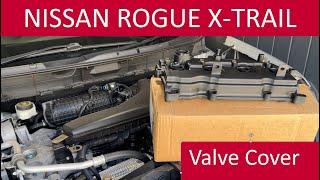
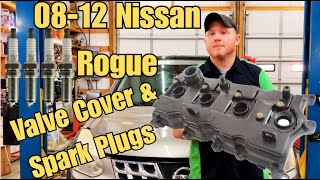
- Valve Cover Gasket & Spark Plug Tube Seal Leaks: The plastic valve cover is prone to leaking oil externally and internally into the spark plug wells. Oil in the wells can cause ignition coil failure and misfires. Replacing the valve cover gasket and tube seals is a common maintenance item.
- TSB NTB15-026B (Reduced Power in Heavy Snow): For 2014–2016 Rogues, this TSB addresses an issue where snow can be ingested into the air intake, clogging the air filter and causing a loss of power. The fix involves installing an updated air cleaner duct design.
- Pre-Catalytic Converter Failure: Though more common on earlier versions of the QR25DE, the ceramic material inside the exhaust manifold's integrated catalytic converter can break apart. Debris can be sucked back into the engine through exhaust gas reversion, scoring cylinder walls and destroying the engine.
Warning: It is critical to inspect the old exhaust manifold for damage before installing a replacement engine. If the pre-catalytic converter is damaged, debris can be sucked into the new engine and cause immediate, catastrophic failure.
What Fails at Every Mileage Band
Pro Tip: The mileage bands below describe the typical condition of USED REPLACEMENT engines at that mileage. The checklists provided are critical steps to perform DURING the installation of your purchased used engine, while it is still on the engine stand, to ensure long-term reliability.
Under 60,000 Miles
While major engine failure is uncommon at this mileage, some issues can appear. The NHTSA recall for fuel pump failure (15V197000) affects certain 2014 models and can cause stalling. Some owner complaints mention issues related to the CVT transmission, which can be misdiagnosed as engine problems, such as hesitation or shuddering. A/C system issues, such as the compressor, are reported in 2014-2016 models. Failures of camshaft or crankshaft position sensors can occur, leading to stalling or no-start conditions, but are relatively inexpensive to fix.
- ✓Do during install (required): Replace engine oil (0W-20 full synthetic, approx. 4.9 - 5.1 quarts) and filter, all fluids (Nissan Blue Long Life 50/50 coolant), and critical gaskets like intake and exhaust manifold gaskets.
- ✓Do during install (recommended): Replace the valve cover gasket and spark plug tube seals, as they are prone to leaking.
- ✓Cheap insurance while the engine is out: Check the condition of the serpentine belt, tensioner, and idler pulleys. Inspect motor mounts for any signs of premature wear or cracking.
60,000 - 100,000 Miles
Oil consumption may begin or increase, sometimes starting around 60,000 miles. The timing chain tensioner may begin to wear, causing a rattling noise on cold starts. Valve cover gaskets are a common failure point, leading to oil leaking into the spark plug wells. Alternator failure can occur, sometimes prematurely due to its location near the hot exhaust manifold. CVT transmission problems are frequently reported in this range, with symptoms like shuddering, jerking, and delayed acceleration.
- ✓Do during install (required): All items from the 'Under 60K' band, plus replace spark plugs with four (4) OEM NGK Laser Iridium spark plugs (Part # DILKAR6A11), thermostat, and water outlet gaskets.
- ✓Do during install (recommended): If the donor engine has over 80k miles, strongly consider replacing the timing chain, tensioner, and guides. A rattling noise on startup indicates this is necessary.
- ✓Cheap insurance while the engine is out: Carefully inspect the pre-catalytic converter in the exhaust manifold for any signs of damage or disintegration to prevent debris from entering the new engine.
100,000 - 150,000 Miles
Excessive oil consumption is more common and may require frequent top-offs (e.g., 1 quart per 1,000-1,500 miles). This is often due to worn piston rings. Timing chain replacement is often necessary in this mileage range if not already done; failure to do so can lead to catastrophic engine damage. Catalytic converter failure becomes a higher risk, which can be caused by long-term oil burning. Motor mounts are likely to be worn, causing significant engine vibration.
- ✓Do during install (required): Replace the timing chain, tensioners, and guides. It is not worth the risk of failure. Replace the front and rear crankshaft main seals. Replace the complete set of motor and transmission mounts.
- ✓Do during install (recommended): Clean the fuel injectors and throttle body. Replace the variable valve timing (VVT) solenoids, as they can stick and cause rough idling or error codes.
- ✓Cheap insurance while the engine is out: Switch to a 5W-30 full synthetic oil to help mitigate oil consumption on higher-mileage units.
150,000+ Miles
At this stage, the engine is nearing the end of its expected service life, and the risk of major component failure (piston rings, bearings) increases significantly. Oil consumption is expected to be high. The engine block itself is considered robust, but the accumulation of wear on all internal and external components makes failure more likely.
- ✓Do during install (required): A used engine in this mileage band is a high-risk purchase. A complete overhaul or remanufactured engine is a more reliable long-term solution.
- ✓Do during install (recommended): If installing a high-mileage used engine, a complete re-gasketing (including head gasket) and replacement of all timing components, seals, water pump, and oil pump should be considered mandatory for any hope of reliability.
- ✓Cheap insurance while the engine is out: Thoroughly inspect the cylinder walls with a borescope before installation.
Real Owner Experiences
| Source | Mileage | What Happened | Cost |
|---|---|---|---|
| Reddit r/askcarguys | 82K miles | Experienced catastrophic engine failure (thrown connecting rod). Nissan denied assistance as it was outside the 9-year assistance window. | Faced with replacing the engine out of pocket or getting a new car. |
| Reddit r/AskMechanics | Under 50k miles | Owner had a no-start issue. Towed to Nissan dealer who heard a knock and quoted $16,500 for an engine replacement, claiming the oil was bone dry shortly after an oil change. | N/A - owner seeking advice on the exorbitant quote. |
| Kelley Blue Book Consumer Review | 208,000 miles (current) | Owner reports no engine or transmission issues with only normal maintenance performed. | N/A |
| Cars.com Consumer Review | 95,000 miles | Owner had to replace the transmission at 95,000 miles. This is a common issue with the CVT, not the engine itself, but relevant for overall vehicle reliability context. | N/A |
Repair or Replace?
Deciding whether to repair your current QR25DE or replace it with a used unit comes down to the severity of the failure and the overall cost.
| Issue | Typical Repair Cost | Recommendation |
|---|---|---|
| Timing Chain Tensioner Wear (Cold Start Rattle) | $1,527 - $2,065 | Repair makes sense when this is the only significant issue and the rest of the engine is healthy. |
| Valve Cover Gasket & Spark Plug Well Seal Leaks | $250 - $450 | Always repair this. This is a routine maintenance item. |
| Excessive Oil Consumption | $2,500 - $4,000+ | This is a grey area. A true repair costs more than a lower-mileage used engine. |
When Replacement is Smarter: Replacement is the smarter option when there is a catastrophic internal failure like a thrown connecting rod, spun bearings, or severe overheating that has warped the cylinder head or block. It also makes sense when a high-mileage engine suffers from multiple issues simultaneously, such as a rattling timing chain combined with heavy oil consumption. In these cases, the combined cost and labor of individual repairs would exceed the cost of a lower-mileage used engine replacement.
Questions to Ask Your Installer
- Have you worked on this specific generation of Nissan Rogue (T32) before?
- Will you be transferring my original wiring harness, mounts, and brackets to the donor engine to ensure compatibility?
- What is your source for the used engine and what kind of warranty do they provide?
- Does the quoted price include all necessary consumable parts like new gaskets (intake, exhaust, valve cover), seals (crankshaft), fluids (oil, coolant, CVT fluid), and torque-to-yield bolts?
- Will you inspect the old exhaust manifold's pre-catalytic converter for damage to prevent debris from entering the new engine?
- How will you handle the fragile crankshaft position sensor during the swap to prevent damage?
- Do you have the proper bi-directional scan tool to perform the mandatory idle air volume and crankshaft position pattern relearn procedures after installation?
- Can you provide a detailed, itemized quote that separates the cost of the engine, labor, and all additional parts and fluids?
Replacement Cost Comparison
Engine replacement costs vary based on the type of engine, your location, and the repair shop. The labor for this job typically ranges from 10 to 18.6 hours, costing roughly $1,200 to $2,500 in shop fees.
| Part / Service | Estimated Cost (USD) | Notes |
|---|---|---|
| New OEM | $8,000 - $10,000+ | A brand new engine directly from Nissan. Often not cost-effective for an older vehicle. Remanufactured long blocks from Nissan are sometimes sold for around $4,000. |
| Remanufactured | $2,900 - $4,000 | A professionally rebuilt engine with new internal wear components, meeting or exceeding original specifications. Often comes with a warranty. |
| Used OEM | $550 - $1,800 | A salvaged engine from a donor vehicle. Price depends heavily on mileage and condition. |
| Installation Labor | $1,200 - $2,500 | Shop labor costs to remove the old engine and install the replacement. |
Installation: Critical Steps & Common Mistakes

Proper installation is key to the longevity of a replacement engine. This is an advanced, DIY-unfriendly job requiring specialized tools like an engine hoist/crane with a load leveler, a subframe support stand, a fuel line quick-disconnect tool, a bi-directional scan tool (Nissan CONSULT-III plus or equivalent), and a torque angle meter.
Key Procedures & Required Parts
- Required Consumables: Always use new fluids and gaskets. This includes 0W-20 full synthetic oil (approx. 4.9 - 5.1 quarts), Nissan Blue Long Life 50/50 Pre-Diluted Antifreeze/Coolant, an oil filter, intake and exhaust manifold gaskets, and new spark plugs. You will also need Nissan NS-3 CVT fluid to top off any transmission fluid lost during the swap.
- Programming: After installation, several electronic "relearn" procedures must be performed with a bi-directional scan tool. These include Idle Air Volume Learning, Throttle Valve Closed Position Learning, Accelerator Pedal Released Position Learning, and Crankshaft Position (CKP) Sensor Cog Pattern Learning to ensure the engine idles and runs correctly.
- Torque-to-Yield (TTY) Bolts: The bolts holding the flexplate to the crankshaft and the main harmonic balancer crank pulley bolt are single-use and must be replaced with brand-new OEM Nissan fasteners. Reusing them can lead to catastrophic failure.
Warning: The Crankshaft Position (CKP) sensor is extremely fragile. It is located at the back of the engine where it meets the transmission. It MUST be removed before separating the engine and transmission and only reinstalled after the replacement engine is fully bolted in place to prevent shearing it off.
Common Buyer & Installer Mistakes
- Buying for a Rogue Select: Purchasing this engine for the older T31 body style Rogue Select, which it will not fit.
- Ignoring Country of Origin: Failing to swap the wiring harness, brackets, and mounts when installing a USA-built engine (VIN '5') into a Japan (VIN 'J') or Korea-built (VIN 'K') vehicle, leading to electrical issues and fitment problems.
- Reusing the Old Pre-Catalytic Converter: Installing a new engine without inspecting the old exhaust manifold. If the catalyst inside is damaged, it will destroy the replacement engine.
- Skipping Relearn Procedures: Failing to perform the necessary electronic relearn procedures with a scan tool, resulting in a poor idle, stalling, and drivability problems.
- AWD Transfer Case (PTU) Alignment: Failing to ensure dowel pins align perfectly. Never use bellhousing bolts to pull the engine and transmission together.
- Electronic Throttle Body Damage: Manually pushing the butterfly valve open with your fingers when cleaning or transferring, which strips the internal plastic gears.
- Grounds: Failing to ensure the main engine ground strap is clean, free of corrosion, and torqued properly to avoid phantom electrical codes.
- Torque Converter Bolt Access: Forgetting that access requires removing a small metal access plate on the back of the engine block; rotate the crankshaft manually and be careful not to drop bolts into the bellhousing.
Freight & Delivery Reality

When ordering a used engine assembly, it is critical to understand how it will arrive. A complete 2.5L QR25DE engine assembly weighs approximately 295 lbs and measures roughly 28" x 26" x 22" before crating. Because of this size and weight, it ships as LTL (Less Than Truckload) freight on a wooden pallet—it is NOT a standard parcel delivery.
Freight deliveries require a delivery truck equipped with a liftgate to lower the pallet to the ground. It is standard industry practice to perform a pre-purchase verification interview with the seller to confirm your VIN, drivetrain, and delivery logistics. When the engine arrives, you must thoroughly inspect the unit for any shipping damage (such as broken sensors, cracked plastic covers, or crushed oil pans) before signing the driver's delivery receipt. Signing without noting damage can void your ability to file a freight claim.
Before the First Start: Priming and Fluids
A used engine has likely been sitting on a warehouse shelf for months. The oil has drained away from the moving parts. If you start the engine dry, the metal parts will rub together and cause instant damage. You must add fresh fluids and prime the oil system before the engine runs.
Mandatory Fresh Fluids
Never reuse old fluids in a replacement engine. You must install a new oil filter and fill the engine with the correct, factory-spec fluids:
- Engine Oil: Use fresh 0W-20 full synthetic motor oil. This thin oil flows quickly to protect the engine during cold starts.
- Engine Coolant: Use Nissan Blue Long Life Antifreeze/Coolant, or an equivalent 50/50 premix designed for Asian vehicles. Do not mix blue coolant with older green coolants, as this can cause sludge to form in the cooling system.
Oil Priming Procedure
Priming means pumping oil through the engine before it actually fires up. This builds oil pressure and coats the bearings (the metal rings that support the spinning engine parts) with a protective layer of oil.
- Fill the engine with the correct amount of 0W-20 oil and install a new oil filter.
- Fill the radiator and coolant reservoir with the correct blue coolant.
- Disable the fuel system so the engine cannot start. The easiest way to do this is to remove the fuel pump fuse from the fuse box.
- Turn the key and crank the engine for 10 to 15 seconds. The engine will turn over but will not start. This action uses the engine's oil pump to push oil through the dry engine block.
- Stop cranking and wait one full minute. This lets the starter motor cool down so it does not overheat and burn out.
- Reinstall the fuel pump fuse.
- Start the engine normally. Let it idle (run without pressing the gas pedal) and immediately check underneath the vehicle for any oil or coolant leaks.
Frequently Asked Questions (FAQ)
Will this engine fit my 2014 Rogue Select?
No. The Rogue Select is based on the previous generation platform (T31) and uses a different engine assembly. This engine is only for the redesigned T32 body style Rogue that began in 2014.
Do I have to swap any parts from my old engine?
Yes, almost always. At a minimum, you will transfer your external accessories like the A/C compressor, alternator, and starter. If the donor engine is from a vehicle with a different country of origin (e.g., USA-built into a Japan-built car) or drivetrain (FWD into AWD), you must also transfer the wiring harness, mounts, and oil pan from your original engine.
Does the computer (ECU) need to be reprogrammed?
The ECU itself does not need to be replaced or "remarried" to the new engine. However, it must be taught several parameters from the new engine's sensors using a bi-directional scan tool (like Nissan Consult III). This includes Idle Air Volume Learning and Crankshaft Position Sensor Cog Pattern Learning. This is a mandatory step for the engine to run correctly.
What parts are included with a used engine assembly?
A standard used engine assembly typically includes the engine block, cylinder head, oil pan, valve cover, timing cover, intake manifold, fuel injectors, fuel rail, throttle body, and harmonic balancer. It generally does NOT include the A/C compressor, starter motor, alternator, power steering pump, exhaust manifold, or the Engine Control Unit (ECU).
Why did my original engine fail?
The most common causes of catastrophic failure in the QR25DE are severe oil starvation (due to excessive oil consumption from worn piston rings), jumped engine timing (caused by a worn timing chain tensioner that was ignored), or internal scoring from ingesting ceramic debris from a failed pre-catalytic converter.
Helpful Videos

Technical Specifications
Engine Code: QR25DE; Displacement: 2.5 Liters; Configuration: Inline 4-Cylinder; Applicable Model Years: 2014, 2015, 2016; Vehicle: Nissan Rogue (T32 Body Style); Oil Type: 0W-20 Full Synthetic; Oil Capacity: 4.9 - 5.1 quarts; Coolant: Nissan Blue Long Life 50/50 Pre-Diluted; Spark Plugs: NGK DILKAR6A11 (x4); Approx. Weight: 295 lbs; Approx. Dimensions: 28" x 26" x 22"
We Have This Part in Stock


The information in this article is provided for general reference and educational purposes only. Vehicle specifications, procedures, and part compatibility can vary by production date, trim level, and region. Always consult your vehicle's factory service manual and verify part numbers before purchasing or performing repairs. Safety-critical components such as airbags, seat belts, and braking systems should be installed by a qualified professional.
- Nissan Rogue:
- 🎬 Helpful Videos
- 🛍️ Shop This Part
- Is This the Right Engine for Your Rogue?
- Vehicle Identification Number (VIN) Check
- Drivetrain Considerations (FWD vs. AWD)
- Common Failure Symptoms
- Diagnostic Flowchart
- Known Problems, Recalls, and Technical Service Bulletins (TSBs)
- Recalls & Service Campaigns
- Commonly Reported Issues
- What Fails at Every Mileage Band
- Under 60,000 Miles
- 60,000 - 100,000 Miles
- 100,000 - 150,000 Miles
- 150,000+ Miles
- Real Owner Experiences
- Repair or Replace?
- Questions to Ask Your Installer
- Replacement Cost Comparison
- Installation: Critical Steps & Common Mistakes
- Key Procedures & Required Parts
- Common Buyer & Installer Mistakes
- Freight & Delivery Reality
- Before the First Start: Priming and Fluids
- Mandatory Fresh Fluids
- Oil Priming Procedure
- Frequently Asked Questions (FAQ)
- 🎟️ Get 5% Off