

2019-2022 Mazda 3 & CX-30 2.5L Skyactiv-G (VIN L): Problems, Identification, and Used Replacement
Identify the VIN L cylinder deactivation engine, understand common failures like cylinder head cracking, and learn what to check before buying and installing a used OEM replacement.
- You must verify the 8th digit of the vehicle's VIN is 'L' to ensure engine compatibility; this specific engine is not interchangeable with other Mazda 2.5L variants.
- After installation, a mandatory Crankshaft Position (CKP) sensor relearn procedure is required with a professional scan tool to prevent a persistent P0315 trouble code.
- When installing a used engine, proactively address known issues by inspecting for cylinder head cracks (TSB 01-002/23) and considering replacement of the Coolant Control Valve (TSB 01-004/23).
- Always replace all one-time-use seals and gaskets during the swap, especially the high-pressure fuel system seals and the updated multi-layer steel exhaust gasket.
Engine Identification: Is This Your Engine?


This guide covers the naturally aspirated 2.5L Skyactiv-G PY-VPS engine found in the 2019-2020 Mazda 3 and 2020-2022 Mazda CX-30. The key feature of this specific engine version is its use of Cylinder Deactivation, a technology that shuts down two of the four cylinders during light-load cruising to improve fuel efficiency. This system makes it mechanically and electronically different from other 2.5L Skyactiv engines.
The VIN 'L' Code: Your First Check
The most reliable way to identify this engine is by checking your vehicle's Vehicle Identification Number (VIN). The 8th digit of your VIN must be 'L'. You can find the VIN on the driver's side of the dashboard (visible through the windshield) or on the certification label in the driver's side door jamb.
Warning: Not all 2.5L Skyactiv-G engines are the same. This specific 'VIN L' engine will NOT work in other Mazda models like the CX-5, CX-50, or Mazda 6, even if they also use a 2.5L engine. Those models have different engine mounts, wiring harnesses, and computer calibrations. It is also not interchangeable with turbocharged (VIN 'Y') or non-cylinder deactivation (VIN 'A' or 'M') versions.
What It Fits (And What It Doesn't)
This engine assembly is a direct fit for the following vehicles only:
- 2019-2020 Mazda 3 [2.5L, VIN L (8th digit)]
- 2020-2022 Mazda CX-30 [2.5L, VIN L (8th digit, naturally aspirated)]
- 2021 Mazda MZCX30
Common Failure Symptoms
While generally reliable, certain symptoms may indicate a severe internal engine problem that requires replacement. These go beyond simple maintenance items and point to a deeper mechanical issue.
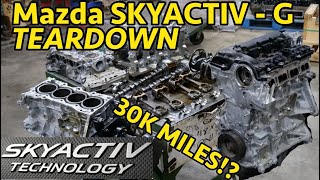
- Catastrophic Failure: A loud knocking or banging sound from the engine (rod knock), often followed by a complete loss of power or a visible hole in the engine block. 🎬 Watch: Complete teardown of a blown Skyactiv-G 2.5 engine
- Severe Coolant or Oil Leaks: Significant external coolant leaks from the cylinder head area, or milky, frothy engine oil, which indicates coolant is mixing internally.
- Persistent Misfires and Stalling: Engine shaking, rough running, or stalling that is not resolved by replacing spark plugs, coils, or injectors. This can be a symptom of internal damage from a dropped rocker arm.
- Low or No Compression: A diagnostic test showing that one or more cylinders cannot hold pressure, indicating a problem with pistons, rings, or valves.
Diagnostic Flowchart
Known Problems, Recalls, and Technical Service Bulletins (TSBs)

Several known issues affect this engine family. If you are buying a used engine, it is wise to check if these repairs have been performed or to address them during installation.
Cylinder Head Cracking
Issue: Some engines may develop external coolant leaks from the cylinder head, typically around the exhaust manifold. This is caused by stress that can lead to cracks forming near the stud bolt holes.
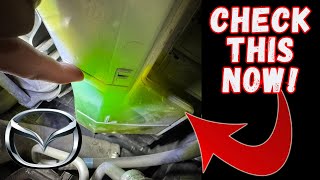
Symptoms: Visible coolant residue (often green or blue) on the engine block below the exhaust, a sweet smell of antifreeze after driving, or unexplained coolant loss.
Affected Vehicles: Models with the 2.5L engine with cylinder deactivation.
Official Fix: Mazda released TSB 01-002/23, which involves replacing the cylinder head with an updated part and using a revised multi-layer steel exhaust gasket to reduce stress. Mazda has also extended the warranty for this specific issue on some vehicles under Special Warranty Extension CSP11 (10 years or 120,000 miles).
Rocker Arm Misfire & Engine Stall
Issue: A software problem in the Powertrain Control Module (PCM) can cause a hydraulic valve lifter to operate incorrectly when the engine switches from two-cylinder to four-cylinder mode. This can cause an intake valve rocker arm to fall out of place, potentially leading to engine misfires, loss of power, or a stall.
Symptoms: Sudden loss of power, rough running, check engine light, and in some cases, the engine may stall and not restart.
Affected Vehicles: Primarily early production 2019 Mazda 3 models.
Official Fix: Mazda issued NHTSA Recall 19V497000 (Mazda campaigns 3719C and 3719F) to reprogram the PCM software free of charge. The updated software adjusts the hydraulic valve control to prevent the issue. Any used engine should have this recall completed.
Coolant Control Valve (CCV) Failure
Issue: The engine uses a complex Coolant Control Valve to manage engine temperature for efficiency. A diaphragm inside its integrated fail-safe thermostat can deform, causing it to stick open.
Symptoms: Check Engine Light with code P0126:00, engine taking a very long time to warm up, temperature gauge fluctuating, or poor heater performance.
Affected Vehicles: 2019-2023 Mazda 3 and 2020-2023 Mazda CX-30, among other models.
Official Fix: TSB 01-004/23 (and its predecessors) outlines a procedure to replace the fail-safe thermostat with an updated part or a "dummy plug" kit and update the PCM software. Mazda has extended the warranty for this part under SSPD8 to 15 years or 150,000 miles.
Oil Seepage from Front Cover
Issue: Oil may seep from the front timing cover on 2018-2023 models with cylinder deactivation.
Official Fix: TSB 01-001/24 outlines the procedure to reseal the front timing cover.
What Fails at Every Mileage Band
Pro Tip: The mileage bands below describe the historical failure points of used replacement units at that specific mileage. The checklists provided are critical steps to perform WHILE INSTALLING your purchased used engine, not maintenance for your current broken engine. Taking care of these items while the engine is on a stand will save you thousands in future labor.
Under 60,000 Miles
Engines in this range are generally very healthy, but early production units are susceptible to factory defects. The most common issues are Cylinder Head Cracking (TSB 01-002/23), Coolant Control Valve Failure (TSB 01-004/23), and the Rocker Arm Dislodgement software issue (Recall 19V497000). Premature factory battery failure (18 months to 3 years) is also widely reported.
- ✓Do during install (required): Verify the Rocker Arm Recall (19V497000) software update has been performed on any 2019 engine.
- ✓Do during install (required): Inspect the cylinder head casting around the exhaust manifold for any signs of coolant seepage or staining, indicative of the crack described in TSB 01-002/23.
- ✓Do during install (required): Replace all one-time-use gaskets and seals (intake, exhaust, crank seals).
- ✓Do during install (required): Install fresh OE-spec 0W-20 synthetic oil, a new genuine Mazda oil filter, and Mazda FL22 pre-diluted long-life coolant.
- ✓Do during install (recommended): Proactively replace the Coolant Control Valve (or at least the internal fail-safe thermostat) with the updated part to prevent future P0126 codes, even if it hasn't failed yet.
60,000 - 100,000 Miles
At this mileage, Carbon Buildup on Intake Valves becomes a factor. Because this is a direct-injection (GDI) engine, fuel does not wash over the intake valves, allowing carbon to accumulate and potentially cause rough idling. Coolant Control Valve failures and Cylinder Head Cracking can still occur if not previously addressed.
- ✓Do during install (required): All items from the 'Under 60k' band apply.
- ✓Do during install (recommended): Strongly consider a manual intake valve cleaning (walnut blasting). This is the perfect opportunity to remove carbon buildup while the engine is out of the vehicle, preventing future performance degradation.
- ✓Do during install (recommended): Replace spark plugs with genuine NGK/Mazda parts (PE5R-18-110 or PE5S-18-110) if their service history is unknown (recommended every 75,000 miles).
- ✓Cheap insurance while the engine is out: Inspect and consider replacing the serpentine drive belt and tensioner.
100,000+ Miles
Higher mileage units may begin to show Increased Oil Consumption due to wear on thin oil scraper rings. While not widespread, Timing Chain Rattle on startup can occur around 124,000 miles (200,000 km) due to chain stretch or tensioner wear. High-Pressure Fuel Pump (HPFP) failures have also been reported in this range.
- ✓Do during install (required): All items from the previous bands are critical.
- ✓Do during install (required): Mandatory intake valve cleaning (walnut blasting) should be performed.
- ✓Do during install (required): Replace the front and rear main crankshaft seals as a preventative measure against leaks.
- ✓Do during install (required): Replace the high-pressure fuel pump seals and fuel injector seals and O-rings.
- ✓Do during install (recommended): Replace the PCV valve to help manage crankcase pressure and potentially reduce oil consumption.
- ✓Cheap insurance while the engine is out: Replace the water pump, thermostat housing, and all major coolant hoses as 'cheap insurance' while access is easy.
Real Owner Experiences
The following table highlights real-world failures and repair costs reported by owners of vehicles utilizing this 2.5L Skyactiv-G engine family.
| Source | Mileage | What Happened | Cost |
|---|---|---|---|
| YouTube / I Do Cars | 30,000 | A 2021 CX-30 engine from a rental car was condemned by a dealer for a no-start condition. Teardown revealed significant rust and water in cylinder 1, suggesting a failure that allowed moisture into the combustion chamber, possibly related to the known cylinder head issue. | N/A (Engine Replaced) |
| 55,000 | Owner of a 2019 CX-9 (which uses a similar engine family) experienced an overheat warning due to a coolant leak at the cylinder head, as described in TSB 01-002/23. Dealer repair for cylinder head coolant leak. Mazda offered to pay for half. | $2,750 (after Mazda covered half of the $5,500 repair bill) | |
| Under 30,000 | A 2020 non-turbo model displayed a P0126 code, indicating an issue with the Coolant Control Valve. The repair was covered under the powertrain warranty. | $0 (Warranty) | |
| 66,000 | Owner of a CX-9 experienced an internal coolant leak, but the dealer claimed it was unrelated to the TSB for external leaks, leading to a dispute over coverage. | Disputed | |
| 80,000 | A user with an 80k mile Mazda 6 reported their intake valves were still clean, attributing it to Mazda's engine design, though others in the same discussion were skeptical and expect buildup eventually. | N/A | |
| 130,000 | A 2016 Mazda 6 owner reported no issues beyond routine maintenance like oil changes, brakes, and tires. | N/A (Routine Maintenance) | |
| 145,000 | A 2017 model required a new high-pressure fuel pump. | Not Stated | |
| 285,000 | A user test-drove a well-maintained Mazda 6 with 285k miles and reported the engine was still strong and smooth. | N/A | |
| Not Stated | 2019 CX-5 replaced coolant control valve under warranty after getting CEL. Another user reported paying around $875 for the same repair out of warranty. | $0 (Warranty) / ~$875 (Out of Warranty) | |
| 150,000 | 2012 Mazda 3 Skyactiv dealer quote for engine replacement due to rod knock. Owner was advised by others to seek a used engine replacement from an independent shop for an estimated $2,000-$3,000. | $7,600 (Quote) |
Replacement Cost Comparison
Engine replacement costs vary based on the source of the part. Labor costs for the swap are additional.
| Part Type | Estimated Cost (Part Only) | Notes |
|---|---|---|
| New OEM | $8,000 - $12,000 | Brand new from a Mazda dealer. Highest cost but comes with a full factory warranty. |
| Remanufactured | $3,700 - $5,000 | Professionally rebuilt to meet or exceed original specifications. Often includes a multi-year warranty. |
| Used OEM | $900 - $2,000 | A recycled engine from a donor vehicle. Price depends heavily on mileage and condition. Typically includes a 90-day to 1-year warranty. |
| Installation Labor | $1,200 - $2,500 | Shop estimates range from 10 to 17 hours. Varies by shop rate and drivetrain (AWD is more complex). |
Repair or Replace?
Deciding whether to repair your current engine or replace it with a used unit depends heavily on the specific failure and your warranty status.
- Coolant Control Valve (CCV) Failure (DTC P0126:00): Typical repair cost is $650 - $1,500. Always repair. This is a common, relatively low-cost repair. Mazda has a warranty extension (SSPD8) for up to 15 years/150,000 miles, making it a no-cost repair at a dealer if qualified. Out-of-warranty costs at an independent shop are reported between $650-$1,100.
- Cylinder Deactivation Rocker Arm Misfire (Recall 19V497000): Typical repair cost is $0. Always repair. This is a factory safety recall. A Mazda dealer will reprogram the vehicle's Powertrain Control Module (PCM) for free.
- Cylinder Head Cracking (TSB 01-002/23): Typical repair cost is $2,500 - $5,500+. Repair makes sense if the vehicle qualifies for Mazda's warranty extension (CSP11), which covers the repair for 10 years/120,000 miles. If out of warranty, replacement is often smarter. A dealer quote can exceed $5,500. Given that a low-mileage used engine costs $900-$2,000 plus $1,200-$2,500 in labor (totaling $2,100 - $4,500), replacing the entire engine is often more economical and provides a chance to address other potential issues like carbon buildup.
Replacement is the only viable choice when the engine has suffered catastrophic internal failure (such as rod knock, spun bearings, or piston damage) or if a cylinder head crack has led to severe overheating and block damage.
Questions to Ask Your Installer
- Have you confirmed this used engine is from a vehicle with VIN 'L' (8th digit) to ensure it has cylinder deactivation and is compatible?
- Will you be performing the mandatory Crankshaft Position (CKP) sensor relearn procedure with a Mazda-compatible scan tool after installation to prevent a P0315 code?
- Are you planning to replace one-time-use seals and gaskets, such as the high-pressure fuel pipe seals, injector seals, and the updated multi-layer steel exhaust gasket?
- My vehicle is [FWD/AWD]. Will you be transferring my original oil pan and any necessary brackets to the donor engine to ensure proper fitment?
- While the intake manifold is off, can you inspect the intake ports for carbon buildup and provide a quote for cleaning them?
- Have you checked the status of the Coolant Control Valve (CCV) on the donor engine? Should we consider replacing it preventatively based on TSB 01-004/23?
- Can you verify you have the specific torque-to-yield (TTY) bolts and the correct torque specifications for critical components?
Installation: What to Know Before You Start

Swapping this engine is an expert-level task that requires special tools and procedures.
Required Programming and Calibration
Warning: After installation, the engine will start but you will almost certainly get a Check Engine Light with code P0315 (Crankshaft Position System Variation Not Learned). This is not an optional step. A Crankshaft Position (CKP) sensor "relearn" procedure must be performed using a Mazda-specific diagnostic tool (like MDARS/IDS/M-MDS) or a high-end professional bidirectional scanner. Failure to do this will result in rough running and a persistent check engine light. If the CKP sensor is loosened or removed, you must use the specialized alignment tool (Crankshaft TDC peg SST 49-JE01-061) to set the precise gap and angle relative to the trigger wheel to prevent a no-start or misfire.
Critical "Gotchas" and Common Mistakes
- FWD vs. AWD: If swapping between a Front-Wheel Drive and All-Wheel Drive vehicle, you MUST transfer the original oil pan and related intermediate shaft brackets to the replacement engine.
- High-Pressure Fuel System: The direct injection fuel system operates at extremely high pressure. It must be properly depressurized before service using high-pressure fuel line disconnect tools. The high-pressure fuel pipe and injector seals are one-time-use and must be replaced.
- Reusing Gaskets: Do not reuse old gaskets, especially the intake manifold and exhaust manifold gaskets. The updated multi-layer steel exhaust gasket is critical to prevent future cylinder head stress.
- AWD Transfer Case (PTU) Alignment: Be extremely careful when mating the PTU to the transmission and engine block to avoid damaging splines or tearing axle seals.
- Cylinder Deactivation Solenoid Sensitivity: Ensure no dirt or debris enters the oil passages during the swap, and prime the engine with clean oil before starting.
- Torque-to-Yield (TTY) Bolts: Critical components like cylinder heads or main bearing caps use single-use TTY bolts that must be replaced if disassembled.
Freight & Delivery Reality

When purchasing a used 2.5L Skyactiv-G engine assembly, it is crucial to understand how it will arrive. This is a heavy industrial component, not a standard parcel.
- Weight and Dimensions: The engine assembly weighs approximately 325 lbs and measures roughly 36" x 36" x 36" before being crated or palletized.
- Shipping Method: It will ship via LTL (Less Than Truckload) freight on a wooden pallet. It cannot be shipped via UPS Ground or FedEx Home Delivery.
- Delivery Requirements: Delivery requires a commercial loading dock, a forklift, or a truck equipped with a liftgate to lower the pallet to the ground. Residential freight delivery is possible but usually incurs an extra fee and requires a scheduled appointment.
- Inspect Before Signing: When the freight carrier arrives, you must thoroughly inspect the engine for any damage that occurred during transit (e.g., cracked plastic sensors, crushed oil pan, or damaged valve cover) before signing the delivery receipt. Once you sign, you are accepting the shipment in its current condition.
- Pre-Purchase Verification: A reputable supplier will conduct a pre-purchase verification interview to confirm your vehicle's 8th VIN digit is 'L' and to verify your drivetrain (FWD vs. AWD) to ensure you are receiving the exact correct variant.
Frequently Asked Questions (FAQ)
How do I know for sure if I have the cylinder deactivation engine?
Check the 8th character of your vehicle's VIN. If it is the letter 'L', you have the 2.5L engine with cylinder deactivation.
Can I use a 2.5L engine from a Mazda CX-5 or Mazda 6?
No. While they are part of the same Skyactiv-G family, engines from other models have different physical mounting points, wiring harnesses, and are calibrated for different vehicle weights and transmissions. You must use an engine specified for the 2019-2020 Mazda 3 or 2020-2022 CX-30.
What parts typically come with a used engine?
Used engines are typically sold as a "long block" assembly. This includes the engine block, cylinder head, oil pan, valve cover, intake manifold, timing cover, fuel injectors, fuel rail, high-pressure fuel pump, throttle body, harmonic balancer, and all internally lubricated parts. Accessories like the starter, alternator, A/C compressor, exhaust manifold, engine wiring harness, and power steering pump are generally not included and must be transferred from your original engine.
Will the engine work without being reprogrammed?
The engine will physically run, but the vehicle's computer (PCM) must be recalibrated. A procedure called a "Crankshaft Position Sensor Relearn" is required to clear a P0315 trouble code and ensure the engine runs smoothly and efficiently. This requires a professional-grade scan tool.
What is the expected service life of this engine?
With proper maintenance, many owners and experts report that the 2.5L Skyactiv-G engine can reliably exceed 200,000 miles. The single most critical factor for longevity is strict adherence to oil change intervals (many recommend 5,000 miles) with high-quality 0W-20 full synthetic oil. Proactively addressing known TSBs and recalls is also crucial to preventing catastrophic failure.
Helpful Videos


Technical Specifications
Engine Name: 2.5L Skyactiv-G PY-VPS; Aspiration: Naturally Aspirated; Key Technology: Cylinder Deactivation; VIN Identifier: L (8th Digit); Displacement: 2.5L; Recommended Oil: 0W-20 Full Synthetic; Recommended Coolant: Mazda FL22 Pre-diluted Long-Life
We Have This Part in Stock


The information in this article is provided for general reference and educational purposes only. Vehicle specifications, procedures, and part compatibility can vary by production date, trim level, and region. Always consult your vehicle's factory service manual and verify part numbers before purchasing or performing repairs. Safety-critical components such as airbags, seat belts, and braking systems should be installed by a qualified professional.
- Mazda 3:
- Mazda CX-30:
- 🎬 Helpful Videos
- 🛍️ Shop This Part
- Engine Identification: Is This Your Engine?
- The VIN 'L' Code: Your First Check
- What It Fits (And What It Doesn't)
- Common Failure Symptoms
- Diagnostic Flowchart
- Known Problems, Recalls, and Technical Service Bulletins (TSBs)
- Cylinder Head Cracking
- Rocker Arm Misfire & Engine Stall
- Coolant Control Valve (CCV) Failure
- Oil Seepage from Front Cover
- What Fails at Every Mileage Band
- Under 60,000 Miles
- 60,000 - 100,000 Miles
- 100,000+ Miles
- Real Owner Experiences
- Replacement Cost Comparison
- Repair or Replace?
- Questions to Ask Your Installer
- Installation: What to Know Before You Start
- Required Programming and Calibration
- Critical "Gotchas" and Common Mistakes
- Freight & Delivery Reality
- Frequently Asked Questions (FAQ)
- 🎟️ Get 5% Off