

2020-2023 Accent & Rio 1.6L Smartstream G4FM: Problems, Identification, and Used Replacement
Identify the G4FM engine, understand what causes excessive oil consumption, and learn when to swap in a used OEM assembly.
- Verify the engine is a G4FM by checking the 8th VIN digit ('6' for Accent, 'D' for Rio) and confirming it has Dual-Port Fuel Injection (DPFI), not GDI.
- This G4FM engine is not interchangeable with the older G4FD GDI engine or 1.6L engines from other models like the Venue or Elantra.
- The most common major issue is excessive oil consumption (TSB ENG222), which may be fixed with a dealer-performed combustion chamber cleaning before resorting to engine replacement.
- During installation, it is mandatory to use a new OEM torque-to-yield (TTY) crankshaft pulley bolt, as the original is a one-time-use part.
- After installation, several electronic relearn procedures for the crankshaft sensor and throttle body are required using a professional scan tool.
Is This Your Engine? Key Identifiers

This engine is the Smartstream G1.6, also known by its engineering code G4FM. It is a 1.6-liter, naturally aspirated (non-turbo) inline four-cylinder engine used in specific North American subcompact cars from Hyundai and Kia. This engine features Dual-Port Fuel Injection (DPFI), which is a key identifier.
Vehicle Identification Number (VIN) Check
The most reliable way to confirm this engine is correct for your vehicle is to check the 8th digit of your 17-digit Vehicle Identification Number (VIN), typically found on your driver's side dashboard or door jamb sticker.
| Vehicle | Required 8th VIN Digit |
|---|---|
| 2020-2022 Hyundai Accent | '6' |
| 2020-2023 Kia Rio (and 2020 Rio 5) | 'D' |
Engine Code and Visual Checks
You can also physically verify the engine. Look for the engine code "G4FM" stamped on the front-left side of the engine block, near where the engine and transmission meet. Visually, the most important check is to confirm the fuel system. This G4FM engine is a Dual-Port Fuel Injection (DPFI) unit. This means it does not have the bulky, silver, high-pressure mechanical fuel pump bolted to the top of the valve cover, which is characteristic of older engines.
Warning: Do not confuse this engine with the older 1.6L GDI engine (code G4FD) used in 2018-2019 models. They are not interchangeable. The G4FM has a different fuel system, wiring, and computer calibration.
What Will NOT Interchange
While other contemporary Hyundai and Kia models like the Venue, Elantra, and Forte use versions of the 1.6L Smartstream engine, they are not direct replacements. Those versions have different engine mounting brackets, wiring harness pinouts, accessory drive layouts, and require different computer software. Attempting to install an engine from one of those models will result in significant fitment and electronic compatibility issues. This specific used engine assembly only fits the 2020-2022 Accent and 2020-2023 Rio/Rio 5.
Diagnosing a Bad G4FM Engine
Major Failure Symptoms
While minor issues can cause rough running, a complete engine assembly replacement is typically only necessary for catastrophic internal failures. Key symptoms include:
- Persistent and loud knocking or tapping sounds from deep within the engine.
- Significant loss of power accompanied by engine noise.
- Metal shavings or glitter found in the engine oil during an oil change.
- Excessive, visible blue or white smoke from the exhaust, indicating severe oil consumption or internal coolant leaks.
Known Issues, Service Bulletins, and Recalls
This engine family is subject to a few key factory communications that owners and technicians should be aware of.
Technical Service Bulletin (TSB) ENG222 (Rev 1-8): Excessive Oil Consumption
This is the most significant known issue. It applies to a wide range of Hyundai/Kia engines, including the Smartstream family. 🎬 Watch: Hyundai 1.6L engine reliability and common problems Vehicles may experience oil consumption exceeding one quart per 1,000 miles. The cause is often attributed to piston rings becoming stuck. The official dealer procedure is a multi-step diagnostic and cleaning process involving a specialized combustion chamber soak to free the rings. If this cleaning procedure does not resolve the oil consumption, engine replacement is the recommended final remedy.
Service Campaign T9J / TSB 22-01-082H: ECU Logic Improvement
This campaign applies to 2020-2021 models and involves a software update for the Engine Control Module (ECM) and Transmission Control Module (TCM). The update is designed to improve overall drivability and the coordination between the engine and the Intelligent Variable Transmission (IVT). This is a software flash performed at a dealership and does not involve replacing physical parts.
Replacing Your 1.6L Smartstream Engine
Replacement Cost Estimates
Engine replacement costs vary by location and the type of part used. Shop labor typically takes between 8 and 12 hours. The following table provides a rough estimate of costs in the US market.
| Part or Service | Estimated Cost (USD) |
|---|---|
| New OEM Engine Assembly | $4,000 - $7,000+ |
| Remanufactured Engine Assembly | $3,000 - $4,500 |
| Used OEM Engine Assembly | $1,300 - $2,500 |
| Installation Labor | $1,200 - $2,500 |
What's Included in a Used Engine Assembly
A used engine assembly, as defined by the Automotive Recyclers Association (ARA), is a "long block." This means it includes the core internal components but not the accessories needed to make it run.
| Typically Included | Typically Not Included (Must Transfer) |
|---|---|
| Cylinder block, cylinder head, oil pan, valve cover, intake manifold, timing cover, fuel injectors, fuel rail, throttle body, harmonic balancer, and all internally lubricated parts (crankshaft, pistons, connecting rods, camshafts, and valves). | A/C compressor, starter motor, alternator, exhaust manifold, ignition coils, and the engine computer (ECU/PCM). |
Installation: Key Considerations
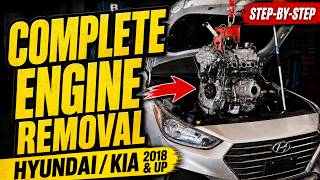
Installation is an advanced job best left to a professional technician. 🎬 See this step-by-step engine removal walkthrough Several critical steps are required for a successful swap.
- Special Tools: An engine hoist/crane with a load leveler, a flywheel/flexplate holding tool, and a professional-grade, bi-directional scan tool are required.
- Programming: While the engine does not need to be programmed to the vehicle's VIN to run, several "relearn" procedures are mandatory. These include a Crankshaft Position (CKP) sensor relearn, throttle body idle air volume relearn, and clearing the adaptive learning values in the ECU and TCM. A potential immobilizer re-sync may also be needed.
- Wiring Harness: You must transfer your original engine wiring harness onto the replacement engine. This ensures all electrical connectors, sensor pinouts, and accessory plugs match perfectly.
- Consumables: You will need 3.8 quarts (3.6 liters) of 0W-20 fully synthetic oil meeting API SN Plus, API SP, ILSAC GF-6, or ACEA C5/C6 specifications. Use a genuine OEM Hyundai/Kia oil filter to prevent dry-start timing chain rattle. You also need phosphate-based Ethylene Glycol coolant, new intake/exhaust/thermostat gaskets, and four new Iridium spark plugs (gap: 1.1 mm / 0.043 in, torqued to 23 Nm / 17 lb-ft).
Warning: The crankshaft pulley bolt is a torque-to-yield (TTY) fastener. It is designed for one-time use and permanently stretches when tightened. It MUST be replaced with a new OEM bolt during installation. Reusing the old bolt can lead to it backing out, causing catastrophic timing failure.
Pro Tip: When installing the engine to the Intelligent Variable Transmission (IVT), ensure the torque converter is fully and deeply seated into the transmission fluid pump. If it is not fully engaged, tightening the bellhousing bolts will crack the pump, requiring a transmission replacement.
Diagnostic Flowchart
What Fails at Every Mileage Band

Pro Tip: The mileage bands below describe used replacement units of that mileage. The checklists are things to do WHILE INSTALLING the purchased engine, not maintenance for your current engine.
Under 60,000 Miles
Engines in this range are generally healthy, but excessive oil consumption related to stuck piston rings (TSB ENG222) may begin to appear. ECU/TCM software glitches on 2020-2021 models requiring a logic update (Service Campaign T9J) are common. There are occasional reports of minor electrical issues, sensor malfunctions, or rattling/pinging noises during acceleration.
- ✓Do during install (required): Standard consumables (oil, filter, coolant, gaskets) are sufficient. Ensure the ECU/TCM has the latest software updates, especially for 2020-2021 models.
- ✓Do during install (recommended): Thoroughly inspect the serpentine belt and tensioner for any signs of premature wear.
- ✓Cheap insurance while the engine is out: Replace the spark plugs.
60,000 - 100,000 Miles
At this stage, ignition coil failures leading to misfires become more common. The crankshaft position sensor may fail, often when the engine is hot. There is an increased likelihood of significant oil consumption if previous oil change intervals were extended. Spark plugs are scheduled for replacement around 70,000 km (approx. 43,500 miles) but can wear more rapidly, causing rough idling.
- ✓Do during install (required): Replace spark plugs and ignition coils as a set. Replace the serpentine belt and tensioner.
- ✓Do during install (recommended): Inspect all rubber hoses and vacuum lines for brittleness or swelling and replace as needed.
- ✓Cheap insurance while the engine is out: Strongly consider replacing the water pump and thermostat as preventative maintenance.
100,000 - 150,000 Miles
Expect a higher potential for oil consumption due to piston ring wear, especially if maintenance was neglected. Components like the alternator and starter motor may reach the end of their service life. Engine mounts may begin to show wear, leading to increased vibration.
- ✓Do during install (required): Replace engine mounts. Replace the PCV valve.
- ✓Do during install (recommended): Flush the cooling system and inspect the radiator for any signs of degradation.
- ✓Cheap insurance while the engine is out: Inspect and consider replacing the fuel injectors if there's any sign of hesitation or poor performance.
150,000+ Miles
Reliability beyond this point is heavily dependent on prior maintenance history. The engine's simpler multi-port fuel injection (DPFI) design contributes to better long-term durability than older GDI engines. However, expect general wear and tear, an increased risk of timing chain stretch or guide wear, and potential for severe oil consumption. With consistent maintenance (5,000-mile oil changes), the G4FM is expected to last around 200,000 miles, though some analyses suggest a lower average lifespan of around 113,000 miles.
- ✓Do during install (required): Flush or replace the oil cooler, especially if the previous engine failed from an oil-related issue.
- ✓Do during install (recommended): Replace all accessible sensors, such as the crankshaft and camshaft position sensors, and the oxygen sensors.
- ✓Cheap insurance while the engine is out: Strongly consider replacing the timing chain, guides, and tensioners for maximum longevity.
Real Owner Experiences
| Source | Mileage | What Happened | Cost |
|---|---|---|---|
| 59,000 | Owner reported daily redlining with no issues, performing oil changes every 5,000 miles. | N/A | |
| 20,000 | A minor oil pan leak was reported and presumably repaired under warranty. | Warranty | |
| CarComplaints.com | Not Specified (2018 Model) | Owner reported random acceleration and deceleration, a common symptom of a failing throttle position sensor (TPS). | Not Specified |
| 83,000 | Owner sold the car after 83,000 trouble-free miles. | N/A | |
| 96,000 | Owner experienced a weird electrical issue with the alarm and TPMS, which resolved on its own. No other engine issues before the car was totaled. | N/A | |
| 190,000 (2016 Gamma II engine) | Owner reports a 2016 1.6L Gamma II (a predecessor to the Smartstream G4FM) with 190,000 miles that could easily reach 200,000. This suggests a good lineage. | N/A | |
| 230,000 (2012 GDI engine) | Owner of a 2012 Accent with a 1.6L GDI engine reached 230,000 miles with only minor repairs by following a strict maintenance schedule (5k oil changes, 30k brake fluid/PCV, 50k trans fluid/coolant). | Self-performed maintenance | |
| N/A (Kia Forte) | Quoted $3,000 for a used engine and $7,000 for labor from a shop, which the user felt was excessively high. | N/A | |
| N/A (2020 Hyundai Tucson) | Engine replacement was approved under warranty, but only after the owner paid $2,500 in out-of-pocket diagnostic and teardown fees that the dealer claimed were required by the warranty department. | $2500 (in diagnostics) | |
| N/A (2013 Kia Sportage) | Engine seized and the owner was quoted $10,400 by a Kia dealership for a replacement. | N/A | |
| 50,000 (2017 Hyundai Sonata) | For an excessive oil consumption issue, the dealer quoted $600 for the TSB combustion chamber cleaning procedure as a first step before considering engine replacement. | N/A |
Repair or Replace?

Deciding whether to repair your current engine or replace it with a used unit comes down to the severity of the failure and the economics of the repair.
When Repair Makes Sense
The primary failure mode for this engine is excessive oil consumption (TSB ENG222). Repair makes sense if the engine is consuming oil but has not yet suffered catastrophic internal damage from oil starvation. The multi-step "Combustion Chamber Cleaning" procedure is designed to free stuck piston rings, which is the root cause. This repair typically costs between $600 and $1,400. If this cleaning is successful, a costly engine replacement can be avoided.
When Replacement is Smarter
Replacement becomes the necessary option when the TSB ENG222 combustion chamber cleaning fails to resolve excessive oil consumption, or when the engine has already suffered catastrophic failure (e.g., rod bearing failure, engine knock, seizure) as a result of running with critically low oil levels. At that point, the internal damage is too severe for a cleaning procedure to fix. Used replacement units typically run $1,300 to $2,500, making them a cost-effective alternative to a new OEM engine.
Questions to Ask Your Installer
- Have you confirmed this used engine is a G4FM and not the older G4FD GDI engine?
- Will you be replacing the one-time-use torque-to-yield crankshaft pulley bolt with a new OEM part?
- What is your process for ensuring the torque converter is fully seated in the IVT transmission before installation?
- Will all required electronic relearn procedures, like the Crankshaft Position (CKP) sensor relearn, be performed after installation?
- If this repair is being considered under warranty, will I be refunded for diagnostic fees if the engine replacement is approved?
- Does the quoted price include all new fluids, such as 0W-20 synthetic oil, coolant, and topping off the proprietary IVT transmission fluid?
- If my old engine failed catastrophically, is flushing the radiator and oil cooler lines included in the quote to prevent contamination of the replacement unit?
Freight & Delivery Reality

If you are purchasing a used G4FM engine online, understand that it will not arrive in a standard cardboard box. A verified used G4FM engine assembly weighs approximately 310 lbs and measures roughly 30" x 28" x 34" before being crated. Because of this size and weight, it must ship as LTL (Less-Than-Truckload) freight on a wooden pallet.
Pro Tip: Always inspect the engine for shipping damage before signing the delivery receipt. Note any issues on the bill of lading to protect your claim.
Freight delivery requires a commercial address with a forklift or a loading dock. If shipping to a residential address or a shop without a forklift, you must request a truck with a liftgate. Always inspect the engine thoroughly while the delivery driver is present. Check for any physical damage to the oil pan, valve cover, or sensors before signing the delivery receipt. Finally, perform a pre-purchase verification: ensure the 8th digit of the donor VIN is a '6' or 'D', the block stamp reads 'G4FM', and it features DPFI rather than a high-pressure GDI pump.
Arrival Inspection: Compression and Leak-Down Testing
When your used engine arrives, test its internal health before you spend time installing it. The best way to do this is by performing a compression test or a cylinder leak-down test while the engine is still sitting on the shipping pallet.
- Compression Test: This measures the squeezing pressure inside each cylinder when the engine turns over. A healthy 1.6L Smartstream engine should show strong pressure, usually above 150 PSI (pounds per square inch). The most important detail is consistency. The pressure in the lowest cylinder must be within 10% to 15% of the highest cylinder.
- Leak-Down Test: This test pumps compressed air into a closed cylinder to see how much air escapes. It tells you if the piston rings or engine valves have a bad seal. A good used engine should show less than 15% air leakage in every cylinder.
Frequently Asked Questions
Is this the same as the 1.6L GDI engine in older Accents and Rios?
No. This is the newer Smartstream G4FM engine with Dual-Port Fuel Injection (DPFI). The older 2018-2019 models used a Gasoline Direct Injection (GDI) engine, code G4FD. They are not interchangeable due to differences in their fuel systems, wiring, and engine management computers.
Does the car's computer need to be reprogrammed?
A full, VIN-specific reprogramming by a dealer is not typically required for the engine to start and run. However, several electronic "handshake" or "relearn" procedures are mandatory for smooth and correct operation. This includes a Crankshaft Position Sensor relearn, throttle body idle air volume relearn, and clearing adaptive memory from the engine and transmission computers. A professional-grade scan tool is required for this.
What kind of oil and how much does the G4FM engine take?
The G4FM engine requires 3.8 quarts (3.6 liters) of 0W-20 full synthetic oil that meets API SN Plus, SP, ILSAC GF-6, or ACEA C5/C6 specifications. It is highly recommended to use a genuine Hyundai/Kia OEM oil filter to prevent potential timing chain rattle on startup.
How much does this engine weigh for shipping?
A used G4FM engine assembly weighs approximately 310 lbs before being crated. It is too large and heavy for parcel shipping and must be shipped on a pallet via LTL (Less-Than-Truckload) freight carrier.
What are the most common mistakes buyers make during installation?
Common mistakes include confusing this DPFI engine with the older GDI engine, reusing the stretched torque-to-yield crankshaft pulley bolt, failing to prime the oil system before starting, neglecting to top off the proprietary SP-CVT1 transmission fluid, assuming the electronics are plug-and-play without doing relearns, and ignoring fluid system contamination if the old engine failed catastrophically.
Why are the fuel injector connectors so fragile?
The plastic locking tabs on the dual-port injector connectors become extremely brittle from constant exposure to engine heat. They must be handled with extreme care during the engine swap to avoid breaking them, which would require splicing in new pigtail connectors.
Helpful Videos
Technical Specifications
Engine Code: G4FM; Common Name: Smartstream G1.6; Displacement: 1.6 Liters; Aspiration: Naturally Aspirated; Cylinders: Inline 4-Cylinder; Fuel System: Dual-Port Fuel Injection (DPFI); Oil Type: 0W-20 Full Synthetic; Oil Spec: API SN Plus, API SP, ILSAC GF-6, or ACEA C5/C6; Oil Capacity: 3.8 quarts (3.6 liters); Coolant Type: Phosphate-based Ethylene Glycol; Spark Plug Type: Iridium; Spark Plug Gap: 1.1 mm (0.043 in); Spark Plug Torque: 23 Nm (17 lb-ft); Weight (Used Assembly): Approx. 310 lbs; Crated Dimensions: Approx. 30" x 28" x 34"
We Have This Part in Stock


The information in this article is provided for general reference and educational purposes only. Vehicle specifications, procedures, and part compatibility can vary by production date, trim level, and region. Always consult your vehicle's factory service manual and verify part numbers before purchasing or performing repairs. Safety-critical components such as airbags, seat belts, and braking systems should be installed by a qualified professional.
- Hyundai Accent:
- Kia Rio:
- 🎬 Helpful Videos
- 🛍️ Shop This Part
- Is This Your Engine? Key Identifiers
- Vehicle Identification Number (VIN) Check
- Engine Code and Visual Checks
- What Will NOT Interchange
- Diagnosing a Bad G4FM Engine
- Major Failure Symptoms
- Known Issues, Service Bulletins, and Recalls
- Replacing Your 1.6L Smartstream Engine
- Replacement Cost Estimates
- What's Included in a Used Engine Assembly
- Installation: Key Considerations
- Diagnostic Flowchart
- What Fails at Every Mileage Band
- Under 60,000 Miles
- 60,000 - 100,000 Miles
- 100,000 - 150,000 Miles
- 150,000+ Miles
- Real Owner Experiences
- Repair or Replace?
- When Repair Makes Sense
- When Replacement is Smarter
- Questions to Ask Your Installer
- Freight & Delivery Reality
- Arrival Inspection: Compression and Leak-Down Testing
- Frequently Asked Questions
- 🎟️ Get 5% Off