

2024-2025 F-150 & 2025 Expedition 3.5L EcoBoost: Problems, Identification, and Used Replacement
Identify the 3rd-generation 3.5L twin-turbo V6, understand its common failures, and learn when to swap it for a used OEM assembly.
- Always verify the 8th digit of the VIN to ensure you are ordering the correct engine ('8' for F-150/Expedition, 'G' for Expedition High Output) and not an incompatible variant like the PowerBoost ('D').
- Before installation, check for open safety recalls, especially NHTSA 25V198000 (cup plug leak) and 25V344 (connecting rod defect), as these can cause catastrophic failure.
- Installation requires dealer-level programming for the Crankshaft Position (CKP) sensor (to clear P0315 code) and fuel injectors; skipping these steps will result in check engine lights and poor performance.
- Never reuse Torque-to-Yield (TTY) bolts for the crankshaft pulley and flexplate, or old turbocharger oil and coolant lines, as this can lead to catastrophic failure or immediate leaks.
- Used engines almost never include turbochargers; you must transfer them from your old engine, making it the ideal time to inspect or replace them.
Is This Your Engine? Identification Guide

This article covers the third-generation Ford 3.5L EcoBoost V6 engine, found in the 2024-2025 Ford F-150 and the 2025 Ford Expedition. This engine is a twin-turbocharged, direct-injected V6 known for its strong power output and towing capability. The third generation of this engine family began with the 2021 model year.
How to Identify Your Engine
The most reliable way to confirm you have this specific engine is by checking the Vehicle Identification Number (VIN). The VIN is a 17-digit code found on your driver's side dashboard (visible through the windshield) and on the driver's side door jamb sticker. Check the 8th digit of your VIN.
| 8th VIN Digit | Vehicle Application | Engine Type |
|---|---|---|
| '8' | 2024-2025 F-150 | Standard 3.5L EcoBoost |
| '8' | 2025 Ford Expedition | Standard Output 3.5L EcoBoost |
| 'G' | 2025 Ford Expedition | High Output 3.5L EcoBoost |
Warning: Do not confuse this engine with other 3.5L variants. A VIN digit of 'D' signifies the 3.5L PowerBoost Hybrid, which has a different electrical system. A VIN digit of 'G' in an F-150 signifies the high-output Raptor engine, which uses different internal components and turbochargers.
Critical Fitment Differences
It is crucial to order the correct engine for your specific vehicle and year. Significant changes in wiring, sensors, and computer controls prevent interchange with other models.
| Incompatible Model | Reason for Incompatibility |
|---|---|
| Older Models (2011-2023) | Different wiring harnesses, engine control calibrations, and casting differences in the block and heads. |
| Ford Transit Vans | Completely different layout, including unique turbocharger placement, oil pan, and accessory mounts. |
| Transverse Vehicles | Will not work in FWD-based vehicles (Explorer Sport, Flex, MKT) which mount the engine sideways. |
Common Problems & Failure Symptoms

While many 3.5L EcoBoost engines run reliably for many miles, certain issues can lead to catastrophic failure requiring a complete engine replacement. Key symptoms pointing to severe engine trouble include a loud bottom-end knocking noise, significant loss of power, heavy white or blue smoke from the exhaust, and a low oil pressure light that stays on.
Major Recalls and Technical Service Bulletins (TSBs)
Always check with a Ford dealer or on the NHTSA website with your VIN to see if these recalls apply to your truck and if they have been completed.
NHTSA Recall 25V198000 (Ford Recall 25S30): Engine Cup Plug Leak. This severe recall affects some 2024-2025 F-150 and Expedition models. A misaligned 13-millimeter cup plug at the rear of the cylinder head can pop out, causing a rapid and massive oil leak. 🎬 Watch: Learn more about this severe engine recall This can lead to engine seizure, loss of power, and a significant fire risk. The remedy is a dealer inspection and, if necessary, replacement of the affected plugs.
NHTSA Recall 25V344 (Ford Recall 25S55): Connecting Rod Defect. This severe recall was issued for a small number of 2025 F-150s. Improperly machined connecting rods can fail, leading to bearing failure, connecting rod bolt failure, or connecting rod cap failure. This results in catastrophic engine damage and an immediate stall without warning. The remedy is a complete engine long block replacement performed by a dealer.
TSB SSM 52295: Bellhousing Rattle/Scraping on Startup. This TSB applies to 2021-2024 F-150 and 2023-2024 Expedition models. A rattling or scraping noise from the area between the engine and transmission on startup may be caused by the torque converter studs hitting the engine-to-transmission spacer plate. The fix involves removing the transmission to replace the damaged plate.
TSB 24-2264: Right-Side Turbocharger Concerns. This addresses a turbo overspeed condition caused by a deformed air deflector on 2024 3.5L PowerBoost Hybrid models, but any turbo-related symptoms on a standard EcoBoost should be investigated immediately. Symptoms include reduced power, smoke from the exhaust, or a whistling/grinding noise.
🎬 Watch: Step-by-step EcoBoost turbocharger replacement tips
Other Known Issues
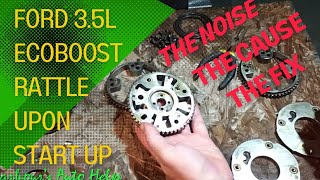
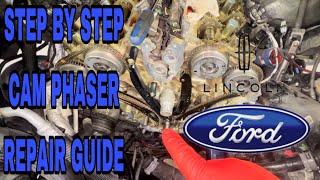
- Cam Phaser Rattle: A common issue on the EcoBoost family is a rattling or knocking sound from the top of the engine that is most noticeable during a cold start and lasts for a few seconds. While a new engine design for the third generation aimed to fix this, it can still occur. 🎬 See: How Ford's updated cam phasers fix the rattle Sometimes, a similar noise can be caused by a loose turbocharger wastegate linkage.
- Rough Idle on Cold Start: Some owners report a slightly rough or uneven idle for the first minute after a cold start. This is often a normal characteristic of the engine's warm-up strategy designed to heat the catalytic converters quickly for emissions control. It typically smooths out as the engine reaches operating temperature.
Diagnostic Flowchart
What Fails at Every Mileage Band
Pro Tip: The mileage bands below describe used replacement units of that mileage. The checklists are things to do WHILE INSTALLING the purchased engine, not maintenance for your current engine.
Under 60,000 Miles
Engines in this range are generally very healthy, but they are still subject to factory defects like the cup plug leak (Recall 25V198000) or connecting rod machining errors (Recall 25V344). Some early turbocharger failures have also been reported due to heat and lack of airflow.
- ✓Do during install (required): Verify Recall Compliance. Ensure both NHTSA recalls (25V198000 and 25V344) have been addressed by a Ford dealer.
- ✓Do during install (recommended): Inspect Spacer Plate. Check the engine-to-transmission spacer plate for any signs of contact from torque converter studs (related to TSB SSM 52295). Perform a full fluid service with Motorcraft specifications.
- ✓Cheap insurance while the engine is out: Replace Spark Plugs. Spark plugs on EcoBoost engines have a recommended service life of 40,000-60,000 miles. Replace them with Motorcraft SP-580 plugs gapped to 0.030-0.033 inches.
60,000 - 100,000 Miles
At this mileage, wear-and-tear items begin to show their age. Cam phasers remain a potential issue, causing a distinct rattle on cold starts before oil pressure builds. Water pumps and gaskets (valve cover, oil pan) can also begin to leak.
- ✓Do during install (required): Timing System Service. If any startup rattle was noted on the donor vehicle, it is highly advisable to replace the cam phasers, timing chains, tensioners, and guides with the latest updated parts while the engine is out. Replace the water pump.
- ✓Do during install (recommended): Reseal Common Leak Points. Proactively replace the valve cover gaskets, oil pan gasket, and the mechanical vacuum pump gasket at the back of the passenger-side cylinder head to prevent future oil leaks.
- ✓Cheap insurance while the engine is out: Ignition System Refresh. Replace spark plugs and consider replacing ignition coils, as they can wear out after 80,000-100,000 miles.
100,000 - 150,000 Miles
The life expectancy of the stock turbos is often cited as being between 120,000 and 150,000 miles. Failure is often due to oil starvation from clogged feed lines or bearing wear. Timing chain stretch can also become an issue, leading to noise and performance problems.
- ✓Do during install (required): Mandatory Timing Job. Do not install an engine in this mileage band without a complete timing service, including new chains, phasers, guides, and tensioners.
- ✓Do during install (recommended): Turbocharger Inspection/Replacement. Thoroughly inspect the turbochargers for wastegate linkage play, shaft play, and signs of oil leaks. Replace all accessible gaskets and seals, including front and rear main seals, oil cooler O-rings, and all turbo-related lines.
- ✓Cheap insurance while the engine is out: Intake Valve Cleaning. Have the intake valves professionally cleaned (walnut blasted) to remove any carbon deposits.
Over 150,000 Miles
Beyond 150,000 miles, the risk of internal wear on components like piston rings and bearings increases. Failures are often a result of the cumulative effect of heat cycles and wear on all components.
- ✓Do during install (required): Complete Overhaul. Assume a near-complete overhaul is necessary. This includes a full timing job, new water pump, new oil pump, new turbochargers, and resealing the entire engine.
- ✓Do during install (recommended): Inspect Rotating Assembly. Have a machine shop inspect the block and rotating assembly (crankshaft, bearings, pistons, rods) for wear before installation.
- ✓Cheap insurance while the engine is out: Consider Remanufactured. Purchasing a used engine with this mileage is a significant gamble. A professionally remanufactured engine is a more reliable long-term option.
Real Owner Experiences
| Source | Mileage | What Happened | Cost |
|---|---|---|---|
| f150forum.com | 54,000 | Owner of a 2024 model reported two serpentine belts breaking or popping off while driving. | Not specified, likely warranty |
| f150forum.com | 69,000 | Experienced the classic cam phaser rattle on cold start. | Partial dealer/manufacturer assistance on $4,000 repair |
| slashgear.com user report | 215,000 | Had to replace both turbochargers within a month of each other. | $3,000 per side |
| f150forum.com | 200,000 | Required a major reseal of the valve covers and front of the motor (cab-off repair). Also replaced a leaking vacuum pump and a failed starter. | $2,500 for the reseal service |
| Reddit / F-150 EcoBoost forum | 200,000+ | Multiple owners report reaching well over 200,000 miles, with some surpassing 400,000, citing meticulous maintenance as the key. | Varies |
| Ford Truck Enthusiasts Forum | >150,000 | Advised to seek a used low-mileage engine from a recycler to avoid massive dealership replacement costs. | Quoted $16,000-$20,000 for new; expected under $10,000 for used |
| Reddit r/f150ecoboost | 136,000 | Had cam phasers replaced. | Quoted $4,000-$5,800; another user paid $3,900 |
| Reddit r/fordexpedition | 5,650 | Full engine replacement diagnosed and covered under manufacturer warranty for an engine shudder and flashing check engine light. | $0 (Warranty) |
| Reddit r/MechanicAdvice | 113,000 | Dealer quote to replace both turbos. Advised by community to seek quotes from independent shops. | Quoted $9,000 |
Replacement Engine Cost

The cost of replacing a 3.5L EcoBoost engine can vary widely based on the type of replacement unit, local labor rates, and the extent of the failure. The estimates below do not include taxes or necessary fluids and gaskets.
| Engine or Service Type | Estimated Price (USD) | Notes |
|---|---|---|
| New OEM | $8,500 - $16,000+ | A brand new engine from a Ford dealer. Prices can be very high and may require a special order. |
| Remanufactured | $5,200 - $8,000 | A professionally rebuilt engine with new internal wear parts. Often includes a multi-year warranty. |
| Used (Recycled OEM) | $4,500 - $7,500 | A tested, running engine from a salvage vehicle. Price depends heavily on mileage and condition. |
| Shop Labor for Installation | $2,400 - $4,800 | Represents an estimated 16-24 hours of professional labor. Most shops perform this job by lifting the truck's cab off the frame. |
Repair or Replace?
Deciding whether to repair your current engine or replace it entirely depends on the specific failure and the overall condition of your truck.
- When Repair Makes Sense: Issues like Cam Phaser Rattle ($3,500 - $5,800), Turbocharger Leaks/Failure ($2,500 - $4,500 for one, $5,000 - $9,000 for both), and the Bellhousing Rattle TSB SSM 52295 ($500 - $1,500) are typically worth repairing if the rest of the engine is healthy. The Engine Cup Plug Leak (Recall 25V198000 / 25S30) should always be repaired immediately, as it is a free safety recall from Ford.
- When Replacement is Smarter: Replacement is the best option in cases of catastrophic internal failure, such as the Connecting Rod Defect (Recall 25V344 / 25S55) if it is somehow not covered by warranty. If your vehicle has very high mileage and needs cam phasers, turbos, and shows signs of oil consumption, the combined repair cost will exceed the price of a lower-mileage used engine. Spending $7,000-$10,000 on a replacement engine is often more economical than buying a new truck for $60,000+.
Questions to Ask Your Installer
- Have you confirmed this replacement engine is a 3rd Generation (2021+) unit and not an earlier, incompatible model?
- Will you be performing the Crankshaft Position (CKP) sensor relearn procedure with a Ford-specific scan tool like FDRS or FORScan after installation?
- If we are using the injectors from the replacement engine, will you be coding their individual flow rates to my vehicle's PCM?
- Are you replacing all turbocharger oil and coolant lines, gaskets, and O-rings with new parts?
- Will you be installing a new torque-to-yield (TTY) crankshaft pulley bolt and new TTY flexplate bolts?
- How will you prime the oiling system before the first start-up to prevent dry running?
What's Included in a Used Assembly?
When buying a used engine, it's important to know what parts are typically included. Recyclers generally sell a "long block" assembly.
| Usually Included | Usually Not Included |
|---|---|
| Engine Block and Cylinder Heads | Turbochargers |
| Oil Pan and Valve Covers | Alternator, Starter Motor, and A/C Compressor |
| Timing Covers and Components | Power Steering Pump |
| Intake Manifold | Exhaust Manifolds |
| Fuel Injection System and Throttle Body | Engine Wiring Harness and ECU/PCM |
| Harmonic Balancer |
Pro Tip: Assume the turbochargers are NOT included. You will need to carefully transfer the turbos from your old engine to the replacement one. This is the perfect time to inspect them for shaft play or oil leaks and replace them if necessary.
Freight, Delivery & Pre-Purchase Verification

A used 3.5L EcoBoost engine is a massive piece of machinery. Verified shipping data shows this assembly weighs approximately 550 lbs and measures roughly 36" x 38" x 36" before crating. Because of this size and weight, it ships as LTL (Less Than Truckload) freight on a wooden pallet—it is NOT a standard parcel delivery.
- Delivery Requirements: LTL freight requires a loading dock, a forklift, or a truck equipped with a liftgate to lower the pallet to the ground. Most residential deliveries will require a liftgate service.
Warning: Inspect Before Signing. When the freight carrier arrives, inspect the engine thoroughly before signing the delivery receipt. Check for any damage to the oil pan, valve covers, or sensors that may have occurred during transit. If you sign for it without noting damage, you lose the ability to file a freight claim.
- Pre-Purchase Verification: Before ordering, confirm the 8th digit of your 17-digit VIN is '8' (standard 3.5L EcoBoost) or 'G' (2025 Expedition High Output). Ensure it is not 'D' (PowerBoost Hybrid). Also, confirm whether your vehicle is 2WD or 4WD, as the oil pan configuration differs to accommodate the front differential.
Installation & Programming Essentials
Installing this engine is a complex job best left to experienced technicians. The estimated shop labor is 16-24 hours. Most professional shops lift the cab off the frame to perform this swap. For driveway swaps, the entire front core support, radiator, and grille must be removed to slide the engine out forward.
Special Tools Required
- Engine hoist with heavy-duty load leveler or Ford V6 engine lift plate (e.g., Milton/Steck STC50133).
- Quick-disconnect tool set for fuel and A/C lines.
- High-quality torque wrench.
- Camshaft holding/alignment tools (e.g., Lisle 37350 or Ford 303-1655).
- Diagnostic scan tool capable of performing Crankshaft Position (CKP) sensor relearn (Ford IDS, FDRS, or FORScan).
Required Programming
After the mechanical installation, the vehicle's computer (PCM) must be programmed. Failure to do so will result in check engine lights and poor performance.
- Crankshaft Position (CKP) Sensor Relearn: This procedure synchronizes the new engine's sensor with the PCM. Skipping it will cause a persistent P0315 trouble code.
- Fuel Injector Coding: Each direct injector has a unique calibration code printed on it. If you use the injectors that came with the replacement engine, these new codes must be programmed into the PCM. If you transfer your original injectors, they must be reinstalled in their exact original cylinders to avoid this step.
Warning: These programming steps require a dealer-level diagnostic tool like Ford's IDS/FDRS or a high-end aftermarket scanner like FORScan. Most generic code readers cannot perform these functions.
Installation "Gotchas" & Common Mistakes
- Reusing Turbo Hardware: Do NOT reuse old turbo oil feed lines, coolant lines, or their quick-connect (Jiffy-Tite) fittings. Their internal rubber seals flatten and dry out, causing immediate leaks. Replace them with new parts.
- Skipping Oil System Priming: The high-pressure direct injection fuel system must be properly bled, and the oil system must be primed before starting to prevent dry-running damage. Use Ford's "Clear Flood Mode" (holding the accelerator to the floor while cranking) to build oil pressure safely before starting.
- Mixing Coolants: This engine requires Motorcraft Yellow Prediluted Antifreeze/Coolant (Ford specification WSS-M97B57-A2). Mixing it with older orange or generic green coolants will cause a chemical reaction, forming a thick gel that clogs the radiator and heater core.
- Ignoring Ground Straps: Ensure all engine and transmission grounding straps are clean and securely reconnected to avoid electrical issues.
- Harness Compatibility: The main engine harness is typically not included. You must carefully transfer the harness from your original engine. 2024-2025 models have unique electrical architectures and CAN bus protocols that are incompatible with older 3.5L EcoBoost harnesses.
Warning: Do Not Reuse TTY Bolts. Critical fasteners like the crankshaft pulley bolt and flexplate/flywheel bolts are Torque-to-Yield (TTY). They are designed to stretch and must be replaced with brand-new bolts every time they are removed. Reusing them can lead to catastrophic failure.
Frequently Asked Questions (FAQ)
Can I use an engine from a 2023 or older F-150 in my 2024 truck?
No. The electrical architecture, wiring, and computer systems are different. You must use an engine from the correct 2024-2025 year range to ensure compatibility.
Do used engines come with turbochargers?
Almost never. Used engine assemblies are typically sold as long blocks without the turbos, alternator, or starter. You must transfer these parts from your original engine.
What happens if I don't do the computer relearn procedures?
You will likely have a persistent check engine light with a P0315 code for the crankshaft position sensor. If you swap injectors without programming their codes, you may experience rough running, poor fuel economy, and other performance issues.
Is the 2WD engine the same as the 4WD engine?
The core long block is the same, but the oil pan is often different between 2WD and 4WD models to accommodate the front differential. Always verify the oil pan on the replacement engine matches your vehicle's drivetrain configuration.
What oil and coolant does this engine require?
The 3.5L EcoBoost requires 6.0 Quarts (5.7 Liters) of Motorcraft SAE 5W-30 Full Synthetic oil (Ford specification WSS-M2C961-A1) and a Motorcraft FL-500S oil filter. For coolant, you must use Motorcraft Yellow Prediluted Antifreeze/Coolant (Ford specification WSS-M97B57-A2).
How do I prime the oil system after installation?
You must use Ford's "Clear Flood Mode." Press the accelerator pedal completely to the floor and hold it there while turning the key or pressing the start button. The engine will crank but will not start, allowing the oil pump to build pressure and lubricate the bearings and turbos safely.
Helpful Videos

Technical Specifications
Engine: 3.5L EcoBoost V6 (Third Generation); Induction: Twin-Turbocharged; Fuel System: Direct-Injected; Model Years: 2024-2025; Vehicles: Ford F-150, Ford Expedition; VIN Digit (F-150): 8; VIN Digit (Expedition): 8 (Standard), G (High Output); Weight: ~550 lbs; Crated Dimensions: ~36" x 38" x 36"; Oil Type: Motorcraft SAE 5W-30 Full Synthetic; Oil Specification: WSS-M2C961-A1; Oil Capacity: 6.0 Quarts (5.7 Liters); Oil Filter: Motorcraft FL-500S; Coolant Type: Motorcraft Yellow Prediluted Antifreeze/Coolant; Coolant Specification: WSS-M97B57-A2; Spark Plugs: Motorcraft SP-580; Spark Plug Gap: 0.030-0.033 inches
We Have This Part in Stock


The information in this article is provided for general reference and educational purposes only. Vehicle specifications, procedures, and part compatibility can vary by production date, trim level, and region. Always consult your vehicle's factory service manual and verify part numbers before purchasing or performing repairs. Safety-critical components such as airbags, seat belts, and braking systems should be installed by a qualified professional.
- Ford F-150:
- Ford Expedition:
- 🎬 Helpful Videos
- 🛍️ Shop This Part
- Is This Your Engine? Identification Guide
- How to Identify Your Engine
- Critical Fitment Differences
- Common Problems & Failure Symptoms
- Major Recalls and Technical Service Bulletins (TSBs)
- Other Known Issues
- Diagnostic Flowchart
- What Fails at Every Mileage Band
- Under 60,000 Miles
- 60,000 - 100,000 Miles
- 100,000 - 150,000 Miles
- Over 150,000 Miles
- Real Owner Experiences
- Replacement Engine Cost
- Repair or Replace?
- Questions to Ask Your Installer
- What's Included in a Used Assembly?
- Freight, Delivery & Pre-Purchase Verification
- Installation & Programming Essentials
- Special Tools Required
- Required Programming
- Installation "Gotchas" & Common Mistakes
- Frequently Asked Questions (FAQ)
- 🎟️ Get 5% Off