

2013-2014 Ford F-150 3.5L EcoBoost V6: Problems, Identification, and Used Replacement
Identify the exact VIN T engine, learn what causes catastrophic timing and turbo failures, and discover when replacing it with a used OEM unit is the smartest choice.
- Verify fitment for a 2013-2014 F-150 by checking for VIN 'T' and the single electronic blow-off valve; engines from other years or models are not direct swaps.
- Proactively replace the timing chain, VCT phasers, guides, and tensioners on any used engine before installation to prevent common and costly cold-start rattle and potential failure.
- Always replace single-use items during installation, including Torque-to-Yield (TTY) bolts, turbo coolant line quick-connect fittings, and various gaskets to ensure a leak-free and reliable repair.
- After installation, a Crankshaft Position (CKP) Sensor Relearn procedure is mandatory using a dealer-level scan tool to ensure proper engine operation and misfire detection.
Identifying the Correct 2013-2014 3.5L EcoBoost Engine

The engine used in the 2013-2014 Ford F-150 is the first-generation 3.5L EcoBoost V6. This is a twin-turbocharged, direct-injected engine known for its impressive power and torque. When sourcing a used replacement, it is critical to ensure you are getting the correct version for these specific model years.
Confirming Fitment on Your Truck
To verify that a used engine is compatible with your F-150, follow these steps:
- Check the VIN: The most important identifier is the 8th digit of your truck's Vehicle Identification Number (VIN). It must be the letter 'T'. You can find the VIN on your dashboard or the driver's side door jamb sticker.
- Verify Production Date (for 2014 models): If you own a 2014 F-150, check the safety certification label on the driver's door pillar. The production date must be on or before December 15, 2013.
- Identify the Turbo System: These engines have a single electronic blow-off valve (BOV) located on a plastic Y-pipe near the radiator. This is a key difference from earlier 2011-2012 models, which used mechanical BOVs on the turbochargers themselves.
Warning: Not all 3.5L EcoBoost engines are the same. Engines from 2011-2012 F-150s or 2015-2016 F-150s are not direct replacements. Likewise, 3.5L EcoBoost engines from other Ford and Lincoln vehicles like the Explorer, Flex, Taurus SHO, Transit, Expedition, and Lincoln Navigator will not fit due to significant differences in engine mounts, oil pans, wiring harnesses, and accessory layouts.
Common Failure Symptoms
While some issues can be repaired, certain symptoms often indicate catastrophic engine damage that makes a complete used engine replacement the most practical solution.
- Knocking or Thumping Noises: A deep knock from the lower part of the engine often signals a spun rod bearing or other serious internal failure.
- Catastrophic Timing Failure: If the timing chain breaks or jumps several teeth, it can cause the pistons to hit the valves, resulting in severe and often irreparable engine damage.
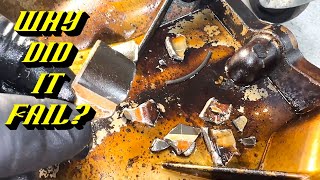
- Metal Shavings in Oil: Finding significant amounts of metallic debris in the engine oil during an oil change is a clear sign of severe internal wear and impending failure. 🎬 Watch: Teardown of a failed 3.5L EcoBoost engine
- Persistent Low Oil Pressure: If the low oil pressure warning light stays on despite using the correct oil and replacing the sensor, it may point to worn internal components causing excessive clearances.
Diagnostic Flowchart
Known Problems, Recalls, and Technical Service Bulletins (TSBs)

The first-generation 3.5L EcoBoost has several well-documented issues. When purchasing a used engine, it's wise to assume these problems may be present and should be addressed before installation.
| Problem / Symptom | Affected Years | Official Fix / TSB |
|---|---|---|
| Timing Chain Stretch and Cam Phaser Rattle A brief (2-5 second) rattling noise from the front of the engine on cold starts. Can lead to a check engine light (P0016) and poor performance. |
2011-2016 | Replace primary timing chain, all four VCT phasers, guides, and tensioners. See TSB 15-0131, TSB 16-0027, and TSB 18-2305. |
| Charge Air Cooler (CAC) Condensation Misfire Violent shudder, misfire, and loss of power during hard acceleration in humid weather as ingested water causes a misfire. |
2011-2013 | Install an air deflector shield on the intercooler and reprogram the PCM (TSB 13-8-1, TSB 14-0017). A common DIY fix is drilling a 1/16-inch weep hole. |
| Intake Valve Carbon Buildup Rough idle, hesitation, and loss of power due to carbon deposits from the PCV system baking onto the intake valves. |
2011-2016 | No official recall. The most effective cleaning is media blasting (walnut blasting) with the intake manifold removed, costing $500 - $1,500. |
| Unexpected Downshift Recall (19S07) Transmission may suddenly downshift to first gear at highway speeds, potentially causing a loss of control. |
2011-2013 (w/ 6R80) | A PCM software update performed by a dealer free of charge prevents the downshift. See NHTSA 19V075 (Ford recall 19S07). |
| Exhaust Manifold Warping and Broken Studs A ticking or chirping noise, especially when cold, caused by an exhaust leak from a warped manifold and broken mounting studs. |
2011-2016 | Replace the warped manifold and install new, higher-quality stainless steel studs and nuts. |
| Fuel Dilution in Engine Oil Fuel seeps past piston rings, diluting the oil and reducing lubrication, especially with frequent short trips. |
2011-2016 | Addressed in TSB 14-0014. Prevent with frequent oil changes (3,000-5,000 miles) and avoiding excessive short trips. |
| Mechanical Vacuum Pump Oil Leak Oil leak from the mounting O-ring of the brake vacuum pump, located on the rear of the passenger-side cylinder head. |
2011-2016 | Replace the pump's mounting O-ring. This must be done while the engine is on a stand due to impossible access in the truck. |
Pro Tip: It is highly recommended to perform the full timing chain and phaser service on a used engine while it is on an engine stand. Doing this job after the engine is installed in the truck is significantly more labor-intensive and expensive.
Replacement Cost Comparison
Engine replacement costs can vary significantly based on the type of engine, supplier, and local labor rates. The labor for this job is substantial, typically estimated between 12 and 25 hours.
| Engine Type | Estimated Part Cost (USD) | Notes |
|---|---|---|
| New OEM | N/A | New complete crate engines from Ford are reportedly no longer available for this generation, only short blocks. |
| Remanufactured OEM | $3,900 - $7,000 | Professionally rebuilt to meet or exceed original specifications, often with updates to address known flaws. |
| Used OEM | $2,800 - $4,600 | A salvaged engine from a donor vehicle. Price depends heavily on mileage and condition. |
| Installation Labor | $1,800 - $5,000+ | Varies by shop rate. A common professional method is to lift the cab off the frame, which adds to the time and cost. |
What's Included in a Used Engine Assembly?
A used engine assembly, as defined by the Automotive Recyclers Association (ARA), is a "long block" with some additional components. Understanding what is and is not included is crucial.
- Typically Included: Engine block, cylinder heads, all internally lubricated parts, oil pan, valve covers, intake manifold, timing covers, fuel injectors, high-pressure fuel pump, throttle body, and harmonic balancer.
- Typically NOT Included: Starter motor, alternator, A/C compressor, power steering pump, and exhaust manifolds. You will need to transfer these parts from your old engine.
Warning: Less Turbos! Used engine assemblies almost never include the twin turbochargers. You must be prepared to reuse your existing turbos or purchase them separately.
Installation: Critical Steps & Common Mistakes

Installing this engine is an advanced job with a DIY difficulty rating of Advanced to Expert. Whether you're tackling it yourself or hiring a professional, be aware of these critical points.
Required Parts & Fluids
Always replace key consumables during an engine swap. You will need:
- 6.0 quarts of high-quality full synthetic or synthetic blend 5W-30 motor oil meeting Ford specification WSS-M2C946-A.
- Motorcraft FL-500S oil filter.
- Approximately 3.5 to 4 gallons of Motorcraft Orange (or updated Motorcraft Yellow) coolant mixed 50/50 with distilled water.
- 6 new Motorcraft SP-580 (or SP-534) spark plugs manually gapped to 0.028-0.030 inches.
- Upper and lower intake manifold gaskets, exhaust manifold gaskets, stainless steel manifold studs, and nuts.
- Turbocharger mounting gaskets, oil feed/drain gaskets, and brand-new turbo coolant line quick-connect fittings.
- Valve cover gaskets, front crankshaft seal, and oil pan gasket (if disturbed).
- Torque-to-Yield (TTY) bolts: crankshaft pulley bolt, camshaft phaser bolts, and high-pressure fuel pump mounting bolts.
Special Tools & Programming
This job requires specific tools, including a Camshaft Holding Tool (Ford OEM 303-1248), a Crankshaft Vibration Damper Remover/Installer (Ford OEM 303-1521), a Stretch Belt Installer Tool (Lisle 59350), a Ford-specific timing tool kit, and fuel line disconnect tools.
After installation, the vehicle's computer requires a "Crankshaft Position (CKP) Sensor Relearn" (Misfire Monitor Neutral Profile Correction) and a Throttle Body Idle Relearn. This procedure teaches the computer the profile of the new engine's crankshaft and is necessary to ensure accurate misfire detection. It requires a dealer-level scan tool like Ford IDS or an advanced diagnostic scan tool such as Snap-on or FORScan with an OBDLink adapter. You must also reuse your original 2013-2014 engine wiring harness to ensure all connections map correctly.
Common Installation Errors
- Reusing Turbo Coolant Fittings: The "Jiffy-Tite" quick-connect fittings for the turbo coolant lines are notoriously fragile and prone to leaking once disturbed. Always replace them with new fittings.
- Ignoring Turbo Oil Feed Line Filters: These lines contain tiny inline filter screens that can starve your turbos of oil if clogged. Always replace these feed lines and screens.
- High-Pressure Fuel Pump (HPFP) Alignment: Ensure the camshaft lobe is at its lowest point (base circle) before tightening the pump down to avoid stripping threads or bending the plunger.
- Incorrect Spark Plug Gap: EcoBoost engines are very sensitive to spark plug gap. Plugs straight out of the box must be manually gapped down to the 0.028-0.030 inch specification to prevent spark blowout under boost.
- Reusing Torque-to-Yield (TTY) Bolts: Critical bolts like the crankshaft pulley bolt, camshaft phaser bolts, and HPFP bolts are designed to stretch and must be replaced every time they are removed.
- Not Cleaning the Intercooler: Failing to clean the intercooler and associated piping of debris or oil from a previous engine failure will send that trash straight into your new engine.
What Fails at Every Mileage Band
Pro Tip: The mileage bands below describe what typically fails on used replacement engines at these mileages. The checklists provided are critical steps to perform WHILE INSTALLING the purchased engine on the stand, not general maintenance for your current truck.
Under 60,000 Miles
Engines in this range are generally healthy, but early signs of timing chain rattle can occasionally appear. Intercooler condensation causing sputtering (TSB 13-8-1) and premature spark plug or ignition coil boot failures are the most common complaints. Isolated turbocharger failures can happen, though they are rare.
- ✓Do during install (required): Replace spark plugs with new Motorcraft plugs (SP-580 or SP-534) and manually gap them to 0.028-0.030 inches. Replace all single-use Torque-to-Yield (TTY) bolts.
- ✓Do during install (recommended): Replace the fragile turbo coolant line 'Jiffy-Tite' quick-connect fittings and their O-rings. Replace the O-ring for the mechanical vacuum pump on the rear of the passenger-side cylinder head.
- ✓Cheap insurance while the engine is out: Remove the timing cover to inspect the timing chain, guides, and tensioner for any signs of premature wear or slack. Drill a 1/16" weep hole in the bottom of the intercooler to prevent condensation buildup.
60,000 - 100,000 Miles
This is the window where timing chain stretch and cam phaser rattle ('cold start rattle') becomes a significant and common issue. Turbocharger failures due to oil starvation from clogged feed line filters or oil coking from improper shutdowns increase. Leaking plastic oil pans, warped exhaust manifolds, and intake valve carbon buildup are also prevalent.
- ✓Do during install (required): Replace the entire timing system as a preventative measure: primary timing chain, VCT cam phasers, guides, and tensioner. The risk of failure in this mileage band is high. Replace spark plugs, turbo coolant fittings, and all TTY bolts.
- ✓Do during install (recommended): Replace the turbocharger oil feed lines and their integrated screen filters to ensure proper oiling of the turbos. Replace the water pump, thermostat, and serpentine belts while access is easy.
- ✓Cheap insurance while the engine is out: Perform a walnut blast cleaning of the intake valves to remove carbon buildup. Replace the vacuum pump O-ring and inspect exhaust manifolds for warping, replacing studs and gaskets.
100,000 - 150,000 Miles
If the timing chain and phasers have not been replaced yet, there is a high probability they will fail soon. Turbocharger failure rates increase significantly (estimated at 14% for at least one turbo). Expect leaking mechanical vacuum pumps, coolant leaks from fittings on the back of the cylinder heads, and a higher risk of catastrophic engine failure if oiling or timing issues were neglected by the previous owner.
- ✓Do during install (required): Assume the timing chain and phasers need replacement. Do not install a high-mileage engine without replacing the complete timing set. Replace spark plugs, all gaskets (oil pan, valve covers, intake), front and rear main seals, all TTY bolts, water pump, thermostat, and all turbocharger-related gaskets and coolant fittings.
- ✓Do during install (recommended): Replace the turbochargers or have them professionally rebuilt. At a minimum, replace the oil feed lines and screens. Replace the exhaust manifolds with updated OEM parts or quality aftermarket units, along with new stainless steel studs.
- ✓Cheap insurance while the engine is out: Clean the entire charge air system, including the intercooler and all piping, to remove oil residue from the previous engine's PCV system or a potential turbo failure.
Over 150,000 Miles
Failures of any original major components (timing chain, turbos, water pump) are highly likely. Coolant intrusion into cylinders can occur on high-mileage early-generation engines. General wear and tear leads to loss of compression or increased oil consumption. Failures here are often a culmination of previously neglected maintenance.
- ✓Do during install (required): Complete replacement of all wear items is essential for reliability. This includes the full timing system, water pump, oil pump, all seals and gaskets, spark plugs, belts, hoses, turbo coolant and oil lines, and exhaust manifold studs/gaskets.
- ✓Do during install (recommended): Do not reuse the original turbochargers. Install new or professionally remanufactured units.
- ✓Cheap insurance while the engine is out: A compression and leak-down test should be performed on the used engine prior to purchase if at all possible. Given the high mileage, consider this a core for a full rebuild rather than a simple drop-in.
Real Owner Experiences
The following table highlights real-world experiences from 2013-2014 F-150 owners dealing with 3.5L EcoBoost engine issues, repairs, and replacements.
| Source | Mileage | What Happened | Cost |
|---|---|---|---|
| Ford F150 Forum - Community of Ford Truck Fans | 26,000 | Owner of a low-mileage 2016 model was advised to be prepared for future cam phaser issues and to consider a transmission service around 60,000 miles to prevent torque converter shudder. | Quoted as a potential $2,000-$3,000 future repair for phasers. |
| f150forum.com | ~59,000 | Owner considering purchase was concerned about the high number of trucks for sale at this mileage. Forum members pointed to potential for timing chain slap and misfires as issues to check for. | N/A |
| Ford F150 Forum - Community of Ford Truck Fans | 80,000 | Owner reported both turbos and the exhaust manifolds failed simultaneously. | $5,800 at the dealer for turbos and manifolds. |
| reddit.com | 90,000 | Received advice that the quote was high and a remanufactured engine should be closer to $6,000 with about $3,000 in labor. | N/A (Quoted $9,500 for a used engine installed) |
| bobistheoilguy.com forums | ~90,000 | Forum discussion notes that poorly maintained engines often exhibit timing chain issues by 90,000 miles. | N/A |
| YouTube | 100,000 | Owner of a 2013 Platinum experienced a catastrophic failure where the engine threw a rod. | Dealer quoted $11,000 for a remanufactured engine installed. |
| Ford F150 Forum - Community of Ford Truck Fans | 103,000 | Owner of a 2013 EcoBoost reported no major issues, contrasting with others who experience problems. | N/A |
| reddit.com | 115,000 | Replaced the engine with a remanufactured unit from Jasper. | $11,000 for parts and labor. |
| Reddit r/f150 | 122,000 | Owner described their 2013 F-150 3.5L as a 'piece of crap,' implying significant issues at this mileage. | N/A |
| f150forum.com | 124,000 | Owner explored options including a used engine for $3,300 or a remanufactured one for $5,500, with independent shop labor quotes ranging from $1,050 to $2,400. | Projected total of $7,850. (Quoted $14,900 from Ford dealer). |
| YouTube | 140,000 | Owner traded in a 2011 model that ran well with only a vacuum pump replacement covered by Ford around 100k miles, attributing longevity to 4-5k mile oil changes. | N/A (warranty) |
| Ford Truck Enthusiasts Forums | 175,000 | A 2011 model developed a coolant leak from a fitting on the back of the head. | $350 |
| Ford F150 Forum - Community of Ford Truck Fans | 180,000 | Owner's 2012 engine needed a driver's side turbo, timing chain, and a cylinder head at minimum, making a full engine replacement the more logical choice. | N/A |
| Reddit r/f150 | 186,000 | Owner of a 2013 model with immaculate maintenance records was considering purchase. Forum advice was to set money aside for repairs and consider preemptively replacing the timing chain. | N/A |
| CarBuzz / Reddit | 200,000+ | Multiple owners report reaching 200k, 225k, and even 249k miles, often noting that basic upkeep was key and that other components like the transmission sometimes failed before the engine block itself. | N/A |
| reddit.com | Not specified | Owner was exploring options due to high cost and negative equity in the vehicle. | N/A (Quoted $14,000 for new engine from local shop; $14,500 from dealer). |
Repair or Replace?
Deciding whether to repair your current engine or replace it entirely depends on the extent of the damage and the cost of labor.
| Repairable Issue | Typical Repair Cost (USD) | Verdict |
|---|---|---|
| Timing Chain Stretch & Cam Phaser Rattle | $1,500 - $4,000+ | Repair makes sense if the rest of the engine is healthy. A full timing job can cost between $1,576 and $4,000+. |
| Turbocharger Failure | $2,000 - $4,000+ | Repair makes sense if the engine has not ingested debris from the failed turbos. |
| Exhaust Manifold Warping & Leaks | $800 - $1,500 | This is a standard repair and does not require engine replacement. |
| Oil Leaks (Vacuum Pump, Valve Covers) | $250 - $600 | These are always worth repairing. A vacuum pump may cost $250, valve cover gaskets $310. |
When Replacement is Smarter: Replacement is the smarter choice when the engine has suffered catastrophic internal failure, such as a snapped timing chain causing valve-to-piston contact, piston failure, a spun rod bearing, or significant metal debris circulated through the oiling system. For high-mileage work trucks, a remanufactured engine can also be a strategic choice to restore reliability and minimize future downtime, as it replaces all wear items at once. Given the high cost of individual major repairs like timing and turbos, if multiple systems are failing, a complete replacement (used units typically run $2,800 - $4,600) often becomes more cost-effective than stacking several large repair bills.
Questions to Ask Your Installer
- Have you worked on this specific 2013-2014 EcoBoost engine before?
- Is your quote for a used, remanufactured, or new engine? If remanufactured, who is the builder (e.g., Jasper, Powertrain Products, Ford)?
- Does the quoted price include replacing critical 'while-you-are-in-there' consumable parts like turbo coolant fittings, turbo oil lines, the rear vacuum pump seal, and all required gaskets and TTY bolts?
- Will you be inspecting or replacing the timing chain, guides, and phasers on the replacement engine before installation?
- Does the warranty cover both parts and labor? What is the duration and mileage?
- How will you handle cleaning the charge air cooler (intercooler) and piping from the old engine's potential debris?
- Do you have the specific Ford IDS or equivalent scan tool to perform the Crankshaft Position Sensor (CKP) relearn procedure after installation?
- Is the installation method cab-on or cab-off?
- Can you provide a fully itemized quote breaking down the cost of the engine, labor, and all replacement parts and fluids?
Freight & Delivery Reality

When ordering a used 3.5L EcoBoost engine assembly, it is important to understand how it will arrive. Based on verified shipping data, this engine assembly weighs approximately 559 lbs and measures roughly 69" x 36" x 36" before crating. Because of its size and weight, it ships as LTL (Less-Than-Truckload) freight on a pallet—NOT as a standard parcel.
Delivery requires a loading dock, a forklift, or a truck equipped with a liftgate. It is an industry best practice to perform a pre-purchase verification interview with the seller to confirm fitment. Upon delivery, you or your shop must thoroughly inspect the engine for any transit damage before signing the freight bill. Once you sign, you are acknowledging the engine arrived in good condition.
Before the First Start: Priming and Fluids
Never start a used engine right after installing it. Used engines sit on warehouse shelves for months, causing the oil to drain away from the moving parts. Starting a dry engine will cause instant metal-on-metal damage.
Mandatory Fresh Fluids
Before you try to start the replacement engine, you must fill it with the correct fresh fluids and a new filter:
- Engine Oil: Add 6.0 quarts of 5W-30 synthetic blend or full synthetic oil. The oil must meet Ford specification WSS-M2C946-A (or the updated WSS-M2C961-A1 spec).
- Oil Filter: Install a new Motorcraft FL-500S oil filter or an exact match.
- Engine Coolant: Fill the cooling system with Motorcraft Orange coolant (spec WSS-M97B44-D) or the newer Motorcraft Yellow coolant (spec WSS-M97B57-A1). Never mix these with older green or gold coolants, as this will cause sludge to form.
Oil Priming Procedure (Clear Flood Mode)
You must build oil pressure before letting the engine actually run. You do this by cranking the engine (making it spin with the starter motor) without letting it start. Ford trucks have a built-in feature called "Clear Flood Mode" that makes this easy.
- Press the gas pedal all the way to the floor and hold it there. Do not let up.
- Turn the ignition key to the "Start" position (or press the push-to-start button). Because the gas pedal is fully pressed, the truck's computer turns off the fuel injectors. The engine will spin, but it will not start.
- Crank the engine for 10 to 15 seconds.
- Stop cranking and let the starter motor cool down for 30 seconds.
- Repeat this process 2 or 3 times until you see the oil pressure gauge on the dashboard rise to a normal level.
Frequently Asked Questions (FAQ)
What does 'VIN T' mean?
The 'T' refers to the 8th character in your truck's 17-digit VIN. For 2013-2014 F-150s, this code specifically identifies the 3.5L EcoBoost V6 engine.
Do I have to replace my turbochargers when I replace the engine?
Not necessarily. If your old engine failed due to a reason unrelated to the turbos (like a spun bearing), and your turbos are in good condition with no shaft play or damage, they can be transferred to the new engine. However, if the old engine sent metal debris through the oil system, it is wise to replace the turbos and their oil feed lines to prevent immediate damage to the replacement engine.
Can I use an engine from a 2012 F-150 in my 2013 truck?
No, this is not a direct swap. The 2011-2012 engines used a different turbocharger system with mechanical blow-off valves and different wiring. The 2013-2014 engine uses an electronic blow-off valve. Swapping would require changing the turbos, intercooler piping, vacuum lines, and wiring harness, making it impractical.
Where is the engine serial number located?
The engine serial number is typically found on a sticker on the driver's side valve cover. This is different from the vehicle's VIN, which is for the entire truck.
Do I need to program the computer after installing a used 3.5L EcoBoost?
Yes. You must perform a Crankshaft Position (CKP) Sensor Relearn, a Throttle Body Idle Relearn, and ideally a PCM software update. This requires a dealer-level scan tool like Ford IDS or an advanced aftermarket tool to ensure the computer recognizes the new engine's physical profile and applies all necessary TSB fixes.
What is the expected service life of this engine?
With diligent, proactive maintenance, the Ford 3.5L EcoBoost engine can realistically achieve 200,000 to 250,000 miles. Strict adherence to a rigorous maintenance schedule is critical: change the oil with full synthetic 5W-30 every 3,000-5,000 miles, change spark plugs every 30,000-50,000 miles, and allow a 60-90 second cool-down period after heavy towing or boost to prevent oil coking in the turbo bearings.
Helpful Videos
Technical Specifications
Engine: 3.5L EcoBoost V6 (First Generation); Model Years: 2013-2014; VIN Code (8th Digit): T; 2014 Production Date Cutoff: On or before December 15, 2013; BOV Type: Single electronic blow-off valve (BOV); Timing Rattle TSBs: 15-0131, 16-0027, 18-2305; CAC Misfire TSBs: 13-8-1, 14-0017; CAC Weep Hole Size: 1/16-inch; Downshift Recall: NHTSA 19V075 / Ford 19S07; Fuel Dilution TSB: 14-0014; Oil Type: 5W-30 Full Synthetic or Synthetic Blend; Oil Specification: WSS-M2C946-A; Oil Capacity: 6.0 quarts; Oil Filter: Motorcraft FL-500S; Coolant Type: Motorcraft Orange (or updated Motorcraft Yellow); Coolant Capacity: ~3.5 to 4 gallons (50/50 mix); Spark Plugs: Motorcraft SP-580 or SP-534; Spark Plug Gap: 0.028-0.030 inches; Shipping Weight: ~559 lbs; Shipping Dimensions: ~69" x 36" x 36"
We Have This Part in Stock


The information in this article is provided for general reference and educational purposes only. Vehicle specifications, procedures, and part compatibility can vary by production date, trim level, and region. Always consult your vehicle's factory service manual and verify part numbers before purchasing or performing repairs. Safety-critical components such as airbags, seat belts, and braking systems should be installed by a qualified professional.
- Ford F-150:
- 🎬 Helpful Videos
- 🛍️ Shop This Part
- Identifying the Correct 2013-2014 3.5L EcoBoost Engine
- Confirming Fitment on Your Truck
- Common Failure Symptoms
- Diagnostic Flowchart
- Known Problems, Recalls, and Technical Service Bulletins (TSBs)
- Replacement Cost Comparison
- What's Included in a Used Engine Assembly?
- Installation: Critical Steps & Common Mistakes
- Required Parts & Fluids
- Special Tools & Programming
- Common Installation Errors
- What Fails at Every Mileage Band
- Under 60,000 Miles
- 60,000 - 100,000 Miles
- 100,000 - 150,000 Miles
- Over 150,000 Miles
- Real Owner Experiences
- Repair or Replace?
- Questions to Ask Your Installer
- Freight & Delivery Reality
- Before the First Start: Priming and Fluids
- Mandatory Fresh Fluids
- Oil Priming Procedure (Clear Flood Mode)
- Frequently Asked Questions (FAQ)
- 🎟️ Get 5% Off