

2021-2022 Escape & Bronco Sport 1.5L EcoBoost: Problems, Identification, and Used Replacement
Identifying the 3-cylinder Dragon engine, what causes it to fail, and when to swap in a used OEM replacement assembly.
- Verify all safety recalls, especially for cracked fuel injectors (NHTSA 22V-859, 24V-092) and the oil separator (NHTSA 22V-191), have been completed on any used engine before purchase.
- The internal wet oil pump belt is a critical failure point; it is strongly recommended to replace it and its tensioner on any used engine during installation, regardless of mileage.
- After installation, the vehicle's computer requires several programming procedures, including PATS relearn and injector coding, using a Ford-specific diagnostic tool.
- Use only SAE 5W-20 oil meeting Ford spec WSS-M2C960-A1 and Motorcraft Yellow Coolant (WSS-M97B57-A2) to prevent premature component failure.
Identifying Your 1.5L EcoBoost Engine

The engine in 2021-2022 Ford Escape and Bronco Sport models is a 1.5L turbocharged inline 3-cylinder from Ford's "Dragon" engine family. This engine uses both direct and port fuel injection and was specifically paired with All-Wheel Drive (AWD) in these vehicles.
The most reliable way to confirm your vehicle uses this specific engine is to check the 8th digit of your Vehicle Identification Number (VIN). The VIN is a 17-digit code found on a plate at the driver's side base of the windshield or on the sticker in the driver's door jamb.
- If the 8th VIN digit is '6': Your vehicle has the 1.5L 3-cylinder EcoBoost engine this article covers.
You may also see engine codes such as YZJA, Y1DA, or YZDA on service records or parts, which identify this engine family. To physically verify, you can count the spark plug coils on top of the engine—there will be exactly three.
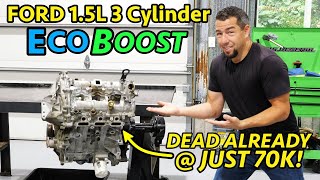
🎬 Watch: Complete teardown of the 1.5L 3-cylinder engineWarning: This 3-cylinder engine is NOT interchangeable with older 1.5L 4-cylinder "Sigma" engines used in Escapes prior to 2020, 🎬 See: The fatal flaw in early 1.5L EcoBoost engines nor is it compatible with newer 2025+ MPC engines. Always verify your vehicle's model year, AWD status, and VIN digit before purchasing a replacement.
Common Failure Symptoms
While some issues can be repaired, major internal damage often requires complete engine replacement. Be aware of these critical symptoms:
- A strong smell of gasoline or visible fuel leaks in the engine bay.
- Significant and rapid loss of engine oil or coolant.
- Engine overheating or frequent low coolant warnings.
- Milky, frothy oil on the dipstick or oil cap, indicating coolant is mixing with oil.
- Deep knocking or tapping sounds from inside the engine.
- Loss of compression, leading to a rough-running engine and loss of power.
- Visible cracks in the engine block or cylinder head.
Diagnostic Flowchart
Known Issues, Recalls, and Technical Service Bulletins (TSBs)

This 1.5L Dragon engine has been subject to several important recalls and service bulletins. A Technical Service Bulletin (TSB) is a document from Ford to its dealers with instructions for fixing a known problem.
Cracked Fuel Injectors and Fire Risk
This is the most severe and widespread issue, leading to multiple recalls. A fuel injector can crack, leaking gasoline and fuel vapor into the engine compartment near hot surfaces, which can cause an engine fire. Ford has issued several evolving recalls to address this.
- Vehicles Covered: 2020-2024 Ford Escape and Bronco Sport.
- Recall Numbers: NHTSA 22V-859 (Ford 22S73), NHTSA 24V-092 (Ford 24S16), NHTSA 25V-161, and NHTSA 25V467 (Ford 25S76).
- The Fix: The initial fix involves updating the Powertrain Control Module (PCM) software to detect a fuel leak, which then reduces engine power and lowers temperatures to prevent a fire. A physical drainage tube is also installed to divert fuel away from hot surfaces. When parts are available, the final remedy is replacing the fuel rail and injectors. Ford has also offered a 15-year/150,000-mile extended warranty for this specific issue.
Pro Tip: Before purchasing a used engine or vehicle, check its VIN on the NHTSA website to ensure all fuel injector recalls have been completed. An unrepaired vehicle poses a significant fire risk.
Cracked Engine Oil Separator
The engine oil separator housing can crack, causing a significant oil leak. If the leaking oil reaches a hot surface like the exhaust, it can result in an engine fire.
- Vehicles Covered: 2021-2022 Ford Escape and 2021-2022 Ford Bronco Sport.
- Recall Number: NHTSA 22V-191 (Ford 22S21).
- The Fix: Dealers will inspect the oil separator for cracks or leaks and replace it and its seals free of charge if needed.
Water Pump Coolant Leaks
These engines may develop coolant leaks from the water pump. This is often caused by contamination within the cooling system that damages the pump.
- Vehicles Covered: 2021-2024 Bronco Sport and Escape.
- Service Bulletin: TSB / SSM 52357.
- The Fix: To prevent the new pump from failing again, the procedure requires a full cooling system flush repeated 10 times before replacing the water pump. The system must then be carefully bled with a vacuum tool to avoid air pockets.
Engine Block Heater Overheating
If your vehicle is equipped with an engine block heater, the element can overheat and cause damage or a fire risk.
- Vehicles Covered: 2021-2022 Escape and Bronco Sport.
- Recall Number: NHTSA 25V-862 (Ford 25S86).
- The Fix: Replace the block heater element.
Other Notable Service Bulletins
| Issue / DTC | Service Bulletin | Models Covered | Summary |
|---|---|---|---|
| Catalytic Converter Failure (DTC P0420) | TSB 23-2259 | 2020-2023 | Requires diagnosing and replacing the catalytic converter. |
| Cylinder 1 Deactivation Solenoid (DTC P3402) | TSB / SSM 50382 | 2021-2022 | Requires replacing the cylinder deactivation solenoid (part H6BZ-6H082-A). |
| Vibration and/or Boom Noise | TSB / SSM 49930 | N/A | Considered a normal characteristic of the 3-cylinder engine firing frequency and cylinder deactivation at around 1500 RPM. |
| Drivetrain Shudder/Chatter | TSB 25-2627 | N/A | Occurs during low-speed turns and requires servicing the Rear Drive Unit (RDU) internal clutch pack. |
What Fails at Every Mileage Band
Pro Tip: The mileage bands below describe what typically fails on USED REPLACEMENT UNITS of that mileage. The checklists provided are things you must do WHILE INSTALLING the purchased used engine, not general maintenance for your current vehicle.
Under 60,000 Miles
Engines in this range are generally healthy, but safety recalls are the primary concern. Cracked fuel injectors and cracked engine oil separator housings are the most severe issues. Water pump failures are also reported, with leaks starting as early as 40,000 miles. Some engines have required replacement due to defects like coolant intrusion at mileages as low as 16,000 or 31,000 miles.
- ✓Do during install (required): Verify all safety recalls have been completed on the donor engine, especially the fuel injector and oil separator recalls.
- ✓Do during install (required): Replace all required consumables like oil, oil filter, spark plugs, and single-use Torque-to-Yield (TTY) bolts.
- ✓Do during install (recommended): Perform a full cooling system flush and refill with fresh Motorcraft Yellow Pre-Mixed Coolant to prevent premature water pump failure.
- ✓Cheap insurance while the engine is out: It is strongly recommended to preemptively replace the wet oil pump belt and its tensioner, as labor access is the primary cost driver for this critical part.
60,000 - 100,000 Miles
Water pump failure becomes much more common in this range. Turbocharger failure is also a significant risk; a seized turbo can force oil through the exhaust and result in complete engine failure. The wet oil pump belt is a major point of concern here. While Ford's official interval is higher, specialists recommend replacement between 80,000-100,000 miles due to the risk of catastrophic, un-warned failure caused by oil degradation or fuel dilution.
- ✓Do during install (required): Replace the wet oil pump belt (Ford J7BZ-6B651-A or JX6Z-6B651-B) and tensioner. This is the most critical preventative maintenance item during an engine swap.
- ✓Do during install (required): Install new spark plugs and replace the crankshaft pulley TTY bolt.
- ✓Do during install (recommended): Perform a complete service of all fluids (oil, coolant, PTU, RDU).
- ✓Cheap insurance while the engine is out: Replace the water pump as a preventative measure. Replace all seals and gaskets that are accessible with the engine out (front crank seal, valve cover gasket, intake manifold gaskets).
100,000 - 150,000 Miles
This mileage range is the upper limit for many original components. The original wet oil pump belt is living on borrowed time if not already replaced. General wear and tear on plastic cooling system components and hoses can lead to failures. Catalytic converter failure (DTC P0420) is also more likely to occur.
- ✓Do during install (required): Assume all items from the 60-100k mile band are mandatory if their replacement history is unknown.
- ✓Do during install (recommended): Critically inspect the turbocharger for shaft play, oil leaks, and wastegate function. Replacing a 100k+ mile turbo during the swap is a wise investment.
- ✓Do during install (recommended): Replace the cylinder deactivation solenoid (part H6BZ-6H082-A) if any related codes were present.
- ✓Cheap insurance while the engine is out: Replace the entire cooling system overhaul kit, including all major hoses, in addition to the water pump.
Over 150,000 Miles
Very few data points exist for this engine beyond 150,000 miles, suggesting it may be near the end of its typical service life without major component replacement. The wet oil pump belt has a recommended replacement interval from Ford at 150,000 miles, making it a non-negotiable service item. The cost to perform this service with the engine in the car can be prohibitively expensive, with one dealer quoting $6,300.
- ✓Do during install (required): A complete remanufacturing or replacement approach is advised. A used engine at this mileage is a significant gamble.
- ✓Do during install (required): If installing a used engine with this mileage, a full teardown, inspection, and replacement of all wear items is necessary. This includes the timing chain and guides, all bearings, seals, gaskets, water pump, and the wet oil pump belt.
- ✓Do during install (recommended): Assume the turbocharger, all injectors, and the high-pressure fuel pump are at the end of their service life and budget for their replacement.
Real Owner Experiences
The table below highlights real-world failures, mileages, and costs reported by owners of the 1.5L EcoBoost engine.
| Source | Mileage | What Happened | Cost |
|---|---|---|---|
| Reddit r/fordfusion | 16,000 & 31,000 | An owner reported their 2018 1.5L engine was replaced at 16,000 miles for a leak, and the replacement engine failed again at 31,000 miles. The repair was covered by warranty. | Warranty |
| BroncoSportForum.com | 20,000 | Insurance paid for a rebuilt engine after hydrolocking. | Not specified (covered by insurance) |
| BroncoSportForum.com | 23,000 | Owner of a 2021 Big Bend reported a bad battery at 18,000 miles but no other engine issues besides recalls. | Not Stated |
| Reddit r/fordfusion | ~35,000 | Owner reported their 1.5L EcoBoost engine "blew up". | Not Stated |
| BroncoSportForum.com | 62,700 | Dealer quoted for a new engine replacement due to seizure (water in oil) just out of warranty. Owner advised to seek used engine from a third-party shop. | $14,000 (Quoted) |
| YouTube (I Do Cars Teardown) | ~70,000 | Engine from a 2021 Escape was replaced due to an unspecified issue. Teardown revealed signs of lacking maintenance (varnish), but the core design was noted as an improvement over the predecessor 1.0L, with a timing chain instead of a wet timing belt. | Not Stated (Warranty) |
| BroncoSportForum.com | 74,000 | A seized turbocharger led to oil pressure buildup, blowing oil through the exhaust and causing catastrophic engine failure. | ~$12,000 (estimate) |
| Reddit r/fordescape | 95,000 | Owner of a Bronco Sport with the same engine reported a water pump replacement at 60,000 miles but no other issues. | Not Stated |
| Reddit (r/BroncoSport) | 99,000 | Dealer quoted $10,500. Found an independent shop to install an almost-new used engine. | Under $4,000 ($4,500 with 3-year warranty) |
| Reddit (r/fordescape) | 99,000 | Owner was seeking advice. Another user reported buying a used engine with 15k miles for $900 and paying an independent shop $2,500 for installation. | $3,400 (for the other user) |
| Reddit r/fordfusion | 107,000 | Owner of a similar 1.5L engine experienced coolant intrusion requiring a new engine, which was covered by a service contract. | Covered by service contract |
| Reddit r/BroncoSport | 110,000 | A 2021 Outer Banks owner crossed 110k miles with no engine issues reported, noting it was time for a spark plug job. | N/A |
| Reddit r/fordescape | 120,000 | Owner of a 2020 Escape 1.5L reported only minor issues: a burnt cylinder head temp sensor and a replaced purge valve. | ~$70 in parts |
| Reddit r/fordescape | 174,000 | A 2021 model owner reported the engine is 'solid' with regular 7,000-mile maintenance intervals. Only an O2 sensor and alternator have been replaced. | Not Stated |
| BobIsTheOilGuy Forums | 260,000 | An owner of a 2021 Escape 1.5L reported the original wet oil pump belt lasted 260,000 miles. When quoted $6,300 for a belt replacement, they opted to install a 10,000-mile used engine instead as it was a cheaper alternative. | Less than $6,300 |
Repair or Replace?

Deciding whether to repair your current engine or replace it with a used assembly comes down to the specific failure and the cost of labor.
- Cracked Fuel Injectors: Always repair. This is a known defect with a dedicated, free remedy from Ford (Recall 25S76) and a 15-year/150,000-mile extended warranty. Do not pay for this repair out-of-pocket.
- Engine Oil Separator Housing Crack: Always repair. This is a no-cost safety recall (NHTSA 22V-191).
- Water Coolant Pump Leaks: Repair makes sense if the engine has not overheated and there is no evidence of coolant mixing with oil. The repair typically costs $800 to $1,500.
- Wet Oil Pump Belt Failure: Almost never makes sense as a standalone repair on a high-mileage engine. The labor is so intensive that quotes range from $2,500 to $6,300. This repair only makes sense if done preemptively alongside other major engine-out service.
When Replacement is Smarter: Replacement with a low-mileage used engine is the more economical choice when facing catastrophic failure (seizure, internal damage), coolant intrusion, or when the cost of a single major repair (like a wet oil pump belt) exceeds 50-60% of the installed cost of a used engine. Given that independent shops can install a used engine for under $4,000, any single dealer quote approaching $8,000 to $14,000 makes replacement the clear winner.
Questions to Ask Your Installer
- Have you worked on the Ford 1.5L 'Dragon' 3-cylinder engine before?
- Will you be replacing the wet oil pump belt on the donor engine before installation? It's a critical 'while you're in there' item.
- Do you have the necessary Ford-specific timing tools (303-1635, 303-1643, 303-1649, 303-1645)?
- How will you handle the mandatory PATS immobilizer relearn, injector coding, and CKP sensor relearn? Do you have an IDS, FDRS, or capable FORScan setup?
- Will you be using a coolant vacuum filler to bleed the system and prevent air pockets?
- Are you replacing all required Torque-to-Yield (TTY) bolts, especially the crankshaft pulley bolt?
- Will you be transferring the original wiring harness to the donor engine to ensure compatibility?
Replacement Cost Estimates
Engine replacement is a major repair. Costs can vary based on your location, the shop's labor rate, and the type of replacement engine you choose. The estimates below are for the engine assembly itself and the labor to install it. Shop labor is estimated at 12 to 20 hours.
| Part or Service | Estimated Cost (USD) |
|---|---|
| Used OEM Assembly | $750 - $2,200 |
| Remanufactured Assembly | $2,900 - $4,500 |
| New OEM Assembly (Dealer Quoted) | $8,000 - $14,000 |
| Shop Labor for Installation | $1,500 - $4,000 |
What's Included in a Used Assembly?
When you buy a used engine, it's important to know what parts are typically included. A standard used assembly is a "long block," which includes the core internal components but not the accessories that bolt onto the outside.
- Usually Included: Cylinder block, cylinder head, crankshaft, pistons, rods, camshafts, valves, oil pan, valve cover, intake manifold, throttle body, timing cover, timing chain/gears, fuel injection system (direct and port fuel injectors, fuel rails, high-pressure fuel pump), and harmonic balancer.
- Usually NOT Included: A/C compressor, starter motor, alternator, power steering pump, and exhaust manifold.
Pro Tip: Always plan to transfer the accessories, wiring harness, and sensors from your original engine to the replacement unit. This helps avoid compatibility issues with your vehicle's computer systems.
Freight & Delivery Reality

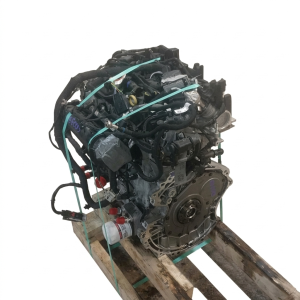
A used 1.5L EcoBoost engine is not a small parcel. Verified shipping data shows this assembly weighs approximately 375 lbs and measures roughly 40" x 32" x 36" before crating. It will ship as Less-Than-Truckload (LTL) freight on a wooden pallet.
Because of its size and weight, delivery requires a truck with a liftgate if you are shipping to a residential address or a shop without a loading dock. Industry best practice dictates that you must perform a pre-purchase verification interview with the seller to confirm the VIN, AWD fitment, and mileage. When the engine arrives, you must thoroughly inspect the pallet and the engine for any physical damage caused during transit before signing the delivery receipt.
Before the First Start: Priming and Fluids
A used engine loses its internal oil coating while sitting in storage. Starting a dry engine causes instant metal-to-metal damage. You must add fresh fluids and prime the oil system before letting the engine run.
Mandatory Fluids
Never reuse old oil or coolant. Fill your replacement engine with the exact Ford factory specifications:
- Engine Oil: Use SAE 5W-20 motor oil that meets Ford specification WSS-M2C960-A1. Always install a brand-new oil filter.
- Engine Coolant: Use Motorcraft Yellow Antifreeze/Coolant meeting Ford specification WSS-M97B57-A2.
Oil Priming Procedure
Priming means pumping oil through the engine before it actually starts and runs. Follow these steps to safely build oil pressure:
- Fill the engine with the correct amount of fresh oil and coolant.
- Disable the fuel system so the engine will not start. You can do this by removing the fuel pump fuse from the fuse box. Alternatively, use Ford's "Clear Flood Mode" by pressing the gas pedal all the way to the floor and holding it there.
- Turn the key or press the start button to crank the engine for 10 to 15 seconds. The engine will spin but should not start.
- Stop cranking and wait 30 seconds. This gives the starter motor time to cool down.
- Repeat the 10-15 second cranking process two more times. This pushes fresh oil into the bearings, turbocharger, and cylinder head.
- Put the fuel pump fuse back in (or release the gas pedal).
- Start the engine normally and check for any leaks.
Frequently Asked Questions (FAQ)
Do I need to reprogram the car's computer after installing a used engine?
Yes. This is a critical step. The Powertrain Control Module (PCM) requires several programming procedures, including marrying the engine's security system (known as PATS) to your keys, coding the fuel injectors with their specific calibration data (IQA Codes), performing a Crankshaft Position (CKP) Sensor Profile Relearn, and a Keep Alive Memory (KAM) Reset. A Ford-specific diagnostic tool (IDS, FDRS, or FORScan with OBDLink) is required for this work.
What is a "wet belt" and why is it important on this engine?
This engine uses a special "wet belt" to run its oil pump. The belt runs inside the engine and is submerged in oil. Using the wrong type or viscosity of engine oil can cause this belt to break down chemically and fail, leading to a sudden loss of oil pressure and catastrophic engine damage. It is strongly recommended to replace this belt and its tensioner whenever the engine is removed from the vehicle.
Can I install this engine myself?
This is an advanced to expert-level job. It requires specialized tools, including a camshaft and crankshaft timing kit (Ford 303-1635, 303-1643, 303-1649, 303-1645), a crankshaft pulley alignment tool, a fuel injector Teflon seal installer/sizer tool, and a coolant vacuum fill and bleed tool. Due to the complex computer programming and risk of damaging critical components, this repair is best left to a professional technician.
What fluids and consumables are required for installation?
You must use SAE 5W-20 engine oil meeting Ford specification WSS-M2C960-A1 and Motorcraft Yellow Pre-Mixed Coolant meeting Ford WSS-M97B57-A2. You will also need a new oil filter, Motorcraft SP-550-X spark plugs (gapped to 0.031 in), intake and valve cover gaskets, a front crankshaft seal, fuel injector Teflon seals, oil pan RTV sealant, and new Torque-to-Yield (TTY) bolts for the crankshaft pulley and flexplate.
Why is bleeding the coolant system so difficult on this engine?
The cooling system on the 1.5L Dragon engine is highly prone to trapping air pockets. If air remains in the system, it will cause immediate localized overheating and can destroy the new engine. You must use a vacuum filler tool and repeat the bleed cycle up to 10 times to ensure all air is removed.
Can I reuse my old fuel injectors on the new engine?
If you transfer your original direct injectors to the replacement engine, you must replace the Teflon seals and O-rings. A specific sizing tool must be used to install the Teflon seals properly. Failing to do so will result in fuel leaks and misfires.
Helpful Videos
Technical Specifications
OEM Part Numbers: H6BZ-6H082-A J7BZ-6B651-A JX6Z-6B651-B
Engine: 1.5L EcoBoost "Dragon"; Cylinders: 3 (Inline); Induction: Turbocharged; Fuel System: Direct & Port Injection; Associated Drivetrain: All-Wheel Drive (AWD); VIN Identifier (8th Digit): 6; Engine Codes: YZJA, Y1DA, YZDA; Oil Specification: SAE 5W-20 (WSS-M2C960-A1); Coolant Specification: Motorcraft Yellow Pre-Mixed (WSS-M97B57-A2); Spark Plugs: Motorcraft SP-550-X; Spark Plug Gap: 0.031 in; Shipping Weight: ~375 lbs; Shipping Dimensions: ~40" x 32" x 36"
We Have This Part in Stock

The information in this article is provided for general reference and educational purposes only. Vehicle specifications, procedures, and part compatibility can vary by production date, trim level, and region. Always consult your vehicle's factory service manual and verify part numbers before purchasing or performing repairs. Safety-critical components such as airbags, seat belts, and braking systems should be installed by a qualified professional.
- Ford ESCAPE:
- Ford BRONCO SPORT:
- 🎬 Helpful Videos
- 🛍️ Shop This Part
- Identifying Your 1.5L EcoBoost Engine
- Common Failure Symptoms
- Diagnostic Flowchart
- Known Issues, Recalls, and Technical Service Bulletins (TSBs)
- Cracked Fuel Injectors and Fire Risk
- Cracked Engine Oil Separator
- Water Pump Coolant Leaks
- Engine Block Heater Overheating
- Other Notable Service Bulletins
- What Fails at Every Mileage Band
- Under 60,000 Miles
- 60,000 - 100,000 Miles
- 100,000 - 150,000 Miles
- Over 150,000 Miles
- Real Owner Experiences
- Repair or Replace?
- Questions to Ask Your Installer
- Replacement Cost Estimates
- What's Included in a Used Assembly?
- Freight & Delivery Reality
- Before the First Start: Priming and Fluids
- Mandatory Fluids
- Oil Priming Procedure
- Frequently Asked Questions (FAQ)
- 🎟️ Get 5% Off