

2021-2024 Audi A4, A5 & allroad 2.0L EA888 Gen 4: Problems, Identification, and Used Replacement
Identify the DPAA/DPA evo4 engine, learn what causes catastrophic failures like spun bearings or overheating, and know when to swap in a used OEM replacement.
- The 12V Belt Starter Generator (BSG) is a severe and widespread failure point that can cause the vehicle to shut down while driving; Audi has extended its warranty to 7 years/unlimited mileage.
- Correct identification is critical: only a longitudinal EA888 Gen 4 engine with code DPAA or DPA from a 2021-2024 A4, A5, or allroad will fit. Engines from transverse models like the GTI or Q5 are not compatible.
- Professional installation is required due to the need for Audi-specific scan tools (ODIS/VCDS) for Component Protection adaptation, injector coding, and CKP relearn.
- Critical installation steps include vacuum-bleeding the cooling system to protect the BSG, priming the turbo, and recording injector codes before installation.
- When installing a used engine, it is wise to proactively replace common failure items like the water pump and thermostat assembly, PCV valve, and various seals to ensure long-term reliability.
Identifying the Correct EA888 Gen 4 Engine


The engine used in 2021–2024 Audi A4, A5, and allroad models is a specific version of the 2.0L turbocharged four-cylinder known as the EA888 Gen 4, or "evo4". This variant is designed for a longitudinal (front-to-back) layout and includes a 12-volt mild-hybrid (MHEV) system. This system uses a Belt Starter Generator (BSG) instead of a traditional alternator. Correctly identifying this engine is critical before purchasing a used replacement.
Vehicle Fitment Chart
| Model | Fitment Details |
|---|---|
| 2021–2024 Audi A4 | 2.0L, with the 5th digit of the VIN being 'A'. |
| 2021–2023 Audi A5 | 2.0L, with the 5th digit of the VIN being 'A'. |
| 2021–2024 Audi allroad | 2.0L, with the 5th digit of the VIN being 'A' or 'B' (Engine ID DPAA). |
How to Verify Your Engine Code
To confirm you have the correct engine, check for the engine code DPAA or DPA. This code is printed on a white paper barcode label, which is typically located on the front upper timing cover of the engine.
Pro Tip: Always verify both the 5th VIN digit on your vehicle's registration or dashboard and the engine code sticker on the engine itself. This two-step check ensures you are sourcing the correct part.
What Will Not Interchange
Many other Audi and Volkswagen models use similar 2.0L EA888 engines, but they are not direct replacements. Engines from a VW GTI, Audi A3, or Audi Q5 are designed for a transverse (side-to-side) mounting. These will have different mounting points, wiring harnesses, and computer calibrations. Using one of these variants will result in significant fitment and electronic issues. Only a longitudinal DPAA or DPA engine from the specified models and years will fit correctly.
Common Failure Symptoms

Engine failure in these models often presents with distinct electrical and mechanical symptoms. Recognizing them can help you determine if the engine assembly itself is the problem.
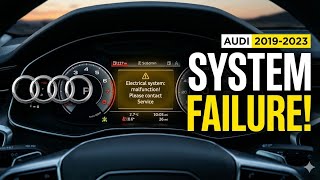
- "Electrical System Malfunction" Warning: This is the most common indicator of a failing Belt Starter Generator (BSG). The message may appear intermittently at first but often leads to a complete vehicle shutdown. 🎬 Watch: Audi BSG failure and electrical system malfunction explained
- Sudden Loss of Power: As the BSG fails, it can no longer charge the 12-volt battery. The vehicle's systems will shut down one by one, starting with non-essentials like navigation and climate control, eventually leading to the engine stalling.
- Coolant Leaks and Overheating: Puddles of coolant under the vehicle or a constantly running cooling fan are signs of a water pump leak. If ignored, this can lead to severe engine overheating and catastrophic damage.
- Check Engine Light: An illuminated Check Engine Light (MIL) can indicate various issues. A common minor fault is related to the EVAP system, which may trigger a P04F000 code.
Diagnostic Flowchart
Known Problems, Recalls, and Technical Service Bulletins (TSBs)
This EA888 Gen 4 engine has several well-documented issues that buyers should be aware of. Audi has addressed some of these with recalls and warranty extensions.
12V Belt Starter Generator (BSG) Failure
Warning: This is a severe and widespread issue. The BSG can fail without warning, causing the vehicle to lose all electrical power and shut down while driving.
The BSG, which functions as both the starter and alternator in the mild-hybrid system, is prone to internal failure. Moisture can enter the unit, causing a short circuit. Symptoms include an "Electrical system: malfunction!" warning on the dash. Audi has issued several actions to address this.
- Affected Years: 2021–2024
- Official Actions: Audi has extended the warranty on this component to 7 years/unlimited mileage. Recall 27H2 was issued for some earlier models where moisture ingress could cause a fire risk. TSB 2064560/3 and 2058831/11 provide diagnostic guidance for technicians when encountering related fault codes like U046900. Service Action 27BQ was also launched to replace defective starter-alternators that could inhibit start/stop functionality.
- Remedy: The BSG must be replaced. When installing a used engine, it is highly recommended to transfer the known-good BSG from the original engine or install a new unit. The vehicle's software must also be updated.
Primary Engine Water Pump & Thermostat Housing Leaks
Like previous EA888 generations, the Gen 4 continues to use a thermoplastic water pump and thermostat housing assembly. These components can become brittle over time, leading to cracks and coolant leaks. An unresolved leak will cause the engine to overheat, potentially resulting in a warped cylinder head or complete engine failure.
- Affected Years: 2021–2024
- Official Actions: A class-action lawsuit (Zhao, et al. v. Volkswagen Group of America, Inc.) covers premature water pump failures in many 2014-2021 VW and Audi vehicles with 2.0L engines. While this provides some coverage, complaints about failures on newer models persist.
- Remedy: If a leak is detected, the entire water pump and thermostat housing assembly should be replaced with a new, OE-spec part to prevent a recurrence.
EVAP System Purge Line Performance
A less severe but common issue is an illuminated Check Engine Light caused by a fault in the evaporative emissions (EVAP) system. This often relates to a loose connection or a minor leak in the system's plumbing.
- Affected Years: 2021–2024
- Official Actions: Audi issued TSB 2069834/3, which notes that fault code P04F000 (EVAP system high pressure purge line performance) may be stored. The bulletin guides technicians to check for loose connections on the vent pipe between the turbocharger and breather before replacing parts.
- Remedy: A thorough diagnosis to find the source of the small leak is required. Often, simply securing a loose pipe or replacing a seal resolves the issue.
Replacement Cost
The cost to replace this engine varies based on the type of part chosen and local labor rates. The labor for an engine swap typically ranges from 10 to 15 hours.
| Part Type | Estimated Cost (Part Only) |
|---|---|
| Used OEM | $3,700 - $4,100 |
| Remanufactured | $7,600 - $7,700 |
| New OEM | $7,500 - $8,800 |
| Shop Labor | $1,500 - $4,000+ |
Installation Essentials and Programming

Pro Tip: Installing this engine is a complex job best left to professional technicians with experience in modern Audi vehicles. Several steps are critical for a successful installation.
Required Parts and Fluids
Always use new gaskets, seals, and fluids during installation to ensure reliability.
Warning: Use Correct Engine Oil. This engine requires 5.5 quarts (5.2 liters) of synthetic oil meeting VW 508.00 specification (0W-20). Using other oil types can damage the engine.
- Coolant: Audi/VW G12evo, G12++, or G13 coolant, mixed 50/50 with distilled water.
- Gaskets and Seals: Always replace the turbocharger mounting gasket, oil/coolant line O-rings, intake manifold gasket, and exhaust manifold gasket.
- Spark Plugs & Filters: Install a new OE-spec oil filter and new OE-spec spark plugs (part number 06Q905601A or equivalent).
- Stretch Bolts: Critical bolts for the flywheel/flexplate, engine mounts, and exhaust downpipe are torque-to-yield (TTY) and must be replaced.
Special Tools Required
A successful swap requires specific equipment, including an engine hoist and load leveler, an engine support bar, a triple square (XZN) socket set, a Torx socket set, a torque wrench, a coolant vacuum refilling tool, and an Audi-compatible diagnostic scan tool (VCDS or ODIS).
Critical Installation Steps & 'Gotchas'
- Record Injector Codes: The 7-digit IMA calibration codes on the fuel injectors must be written down before the intake manifold is installed. They are needed for programming and are impossible to see afterward.
- Vacuum-Bleed Cooling System: The mild-hybrid BSG is liquid-cooled. The cooling system must be bled using a vacuum tool to eliminate air pockets, which can cause the BSG to overheat and fail immediately.
- Prime the Turbocharger: Before starting the engine for the first time, the transferred turbocharger must be manually primed with clean engine oil to prevent bearing failure.
- Beware Left-Handed Threads:
Warning: The central spool valve on the intake camshaft for the variable valve timing (VVT) system has a left-handed thread. Attempting to loosen it by turning counter-clockwise will break it.
- Service Position: To gain adequate access, the vehicle's entire front end must typically be placed into 'service position' or removed completely.
Required Programming
After installation, the vehicle's computer systems must be programmed for the new engine to run correctly. This requires Audi-specific diagnostic tools like ODIS (dealer tool) or a compatible professional scan tool.
- Component Protection: This is an anti-theft system that links the engine control unit (ECU) to the vehicle. It must be adapted by a dealer or authorized shop with an online connection to Audi's servers.
- Crankshaft Position (CKP) Relearn: This procedure synchronizes the new engine's CKP sensor with the ECU.
- Injector Coding: The 7-digit IMA codes you recorded earlier must be entered into the ECU to ensure proper fueling.
What Fails at Every Mileage Band
Pro Tip: The mileage bands below describe the typical wear and failure points of USED replacement units at that specific mileage. The checklists provided are things you should do WHILE INSTALLING the purchased engine to ensure longevity, not general maintenance for your current broken engine.
Under 60,000 Miles
Engines in this range are generally healthy, but the plastic primary engine water pump and thermostat housing are known weak points across all EA888 generations and can fail early. The 12V Belt Starter Generator (BSG) is also a critical failure point. Additionally, the Positive Crankcase Ventilation (PCV) valve can fail, leading to rough idle, whistling noises, and potential oil leaks.
- ✓Cheap insurance while the engine is out: New Water Pump & Thermostat Assembly. Given the high failure rate, installing a new, OE-quality assembly is cheap insurance while the engine is out, regardless of mileage.
- ✓Cheap insurance while the engine is out: New PCV Valve. This is an inexpensive part that is much easier to replace with the engine removed.
- ✓Cheap insurance while the engine is out: Inspect Turbocharger Wastegate. A quick inspection for excessive play is prudent.
60,000 - 100,000 Miles
As a direct-injection engine, carbon accumulation on the intake valves is inevitable and typically begins to cause noticeable symptoms like rough idle, hesitation, and reduced power in this mileage range. Water pump failure risk increases significantly if not already replaced. While the Gen 4 timing chain system is improved, stretch can begin to be measurable towards the upper end of this range, causing a rattling noise on cold starts.
- ✓Do during install (recommended): Intake Valve Cleaning (Walnut Blasting). It is almost certain that an engine in this mileage range has significant carbon buildup. Cleaning the valves while the engine is out is far easier than in the vehicle.
- ✓Do during install (recommended): New Spark Plugs & Ignition Coils. If service history is unknown, replacing these is wise.
- ✓Do during install (recommended): Inspect Timing Chain Stretch. Using a diagnostic tool (VCDS/OBDeleven), check the camshaft adaptation value (Block 93). A value approaching or exceeding -5 degrees indicates the chain and tensioners should be replaced.
100,000 - 150,000 Miles
This is the primary mileage band where timing chain replacement becomes a more common requirement. Stretch beyond the safe threshold of -5 degrees is likely. If not previously addressed, performance issues from carbon buildup will be very apparent. Oil leaks from a failed rear main seal become more common, and the turbocharger's lifespan can be limited, often related to the wastegate actuator.
- ✓Do during install (required): New Rear Main Seal. This seal is difficult to access with the engine installed. Replacing it during a swap is a critical preventative step to avoid future oil leaks.
- ✓Do during install (recommended): Timing Chain & Tensioner Replacement. It is highly recommended to replace the timing chain, tensioners, and guides as a preventative measure for any engine with over 100,000 miles, as failure is catastrophic.
- ✓Do during install (recommended): New Engine Mounts. The original mounts are likely worn or failing by this mileage.
150,000+ Miles
At this mileage, any original component is a candidate for failure. If the timing chain has not been replaced, the risk of it stretching, jumping a tooth, or the tensioner failing is extremely high, which will cause catastrophic engine damage.
- ✓Do during install (required): Full Engine Reseal. Assume all gaskets and seals (valve cover, oil pan, front/rear main seals) are at the end of their life. A complete reseal is recommended.
- ✓Do during install (recommended): Turbocharger Inspection/Replacement. Thoroughly inspect the turbo for shaft play and wastegate function. Budgeting for a new or remanufactured turbocharger is a realistic consideration.
Real Owner Experiences
The following table highlights real-world failures and repair costs reported by owners of vehicles equipped with the EA888 Gen 4 engine.
| Source | Mileage | What Happened | Cost |
|---|---|---|---|
| 52,000 miles | Owner reported the water pump on their EA888 Gen 4 failed and required replacement. | Not specified | |
| GOLFMK7 Forum | 80,000 miles | Owner experienced repeated misfires which were ultimately diagnosed as significant carbon buildup on the intake valves, requiring cleaning. | $1,055+tax |
| AudiWorld Forums | 70,000-80,000 miles | A 2017 A4 owner reported a "drive system malfunction" that was traced to a turbo connection issue. The water pump was also replaced under warranty around this time. | Not specified |
| 122,000 miles | Owner of a tuned 2019 VW GLI (same engine family) performed preventative maintenance including walnut blasting, new OEM injectors, and a new PCV valve. | Not specified | |
| AudiWorld Forums | 100,000 miles | Owner of a 2017 model had the thermostat/water pump replaced and also required new motor mounts. | Not specified |
| 168,000 miles | Owner of a 2018+ VW Atlas with the EA888 engine (Gen3/4) reported the engine is still going strong, with only a water pump replacement needed during its life. | Not specified | |
| CarBuzz | 246,000 miles | A teardown of a high-mileage EA888 Gen 3 engine (from a Golf R) that failed showed the final cause was likely related to bearing wear after a very long service life. The turbo and other components were noted to be in surprisingly good condition. | Engine replacement |
| AudiWorld Forums | 73,000 miles | Dealer recommended full engine replacement for a piston issue (code P0333). Audi Platinum Warranty would only cover up to the car's value ($23,000), leaving the owner with a $7,000 out-of-pocket expense. | $7,000 |
| 40,000 miles | Owner received a quote for $8,600 for a used engine (40k miles) replacement including labor, tax, and a 3-year warranty from an independent shop. | $8,600 | |
| AudiWorld Forums | 103,000 miles | Owner was quoted $18,000 by an Audi dealer for an engine assembly replacement due to a spun main bearing. | $18,000 |
| 60,000 miles | After a generator unit failure and other issues, the engine failed. An extended warranty was unwilling to cover the full cost. Audi offered a 'goodwill' discount, leaving the owner to pay $8,000 out of a total cost that was reportedly as high as $42,000. | $8,000 |
Repair or Replace?
Deciding whether to repair your current engine or replace it with a used unit depends entirely on the nature of the failure.
- 12V Belt Starter Generator (BSG) Failure: This repair is almost always the correct choice, as the BSG is an external component and does not require engine replacement. Audi has extended the warranty to 7 years/unlimited mileage for this part. If out of warranty, a proactive replacement at an independent shop can cost around $1,600, while a dealership repair after failure can range from $2,500 to $3,200.
- Primary Engine Water Pump & Thermostat Housing Leaks: If the engine has not been severely overheated due to the coolant leak, replacing the water pump and thermostat assembly is the standard repair. An independent shop may charge between $900 and $1,200, while a dealership can charge up to $1,600. This is a common failure, and replacing the assembly is far more economical than replacing the entire engine.
When Replacement is Smarter: Engine replacement becomes necessary in cases of catastrophic internal failure, such as a spun main bearing, piston damage, or severe overheating that has led to a cracked block or warped cylinder head. If repair costs, such as a full engine rebuild, approach or exceed the cost of a low-mileage used engine (typically $3,700 - $4,100 plus labor), replacement is the more sensible option.
Questions to Ask Your Installer
- Have you worked on the Audi EA888 Gen 4 'evo4' engine before?
- Are you equipped with an Audi-compatible diagnostic scan tool (like ODIS or VCDS) required for programming?
- Does your quote include performing the mandatory Crankshaft Position (CKP) Relearn, fuel injector coding, and Component Protection adaptation?
- Will you be transferring the old engine harness or using the one on the donor engine? Can you verify compatibility?
- Does your process include vacuum-bleeding the cooling system to prevent air pockets that can damage the Belt Starter Generator (BSG)?
- Are you aware of the left-handed thread on the central spool valve for the variable valve timing?
- Will you be priming the turbocharger with oil before the first start?
- Does your quote include all required consumables like VW 508.00 spec oil, new torque-to-yield bolts, and all necessary gaskets and seals?
Freight & Delivery Reality

A complete 2.0L EA888 Gen 4 engine assembly is a heavy, bulky item. It weighs approximately 425 lbs and measures roughly 40" x 36" x 38" before crating. Because of its size and weight, it ships as LTL (Less-Than-Truckload) freight on a pallet, not as a standard parcel.
When ordering a used engine, ensure your delivery location can accommodate a freight truck. If you are having it delivered to a residential address or a shop without a loading dock, you must request a liftgate service to safely lower the pallet to the ground. Always inspect the engine thoroughly for any shipping damage before signing the delivery receipt. As an industry best practice, perform a pre-purchase verification interview with the seller: confirm the 5th digit of the donor VIN is 'A' (or 'B' for allroad) and that the engine code 'DPAA' or 'DPA' is clearly visible on the white barcode label on the front upper timing cover.
Frequently Asked Questions
Can I use an engine from a VW GTI or Audi Q5?
No. While those engines are also from the EA888 family, they are built for transverse (sideways) applications. This engine for the A4/A5/allroad is a longitudinal (front-to-back) design with different mounts, accessories, and electronics. They are not interchangeable.
Is the turbocharger included with a used engine?
Typically, no. Used engines are sold as a "long block," which includes the engine block, cylinder head, and internal components. The turbocharger, alternator/BSG, A/C compressor, and wiring harness are usually not included and must be transferred from your original engine.
What happens if I don't program the engine after installation?
The vehicle will likely not start. Audi's Component Protection system will prevent the engine from running until it is correctly adapted to the vehicle's immobilizer system by an authorized technician using ODIS or a compatible tool.
What type of oil does the EA888 Gen 4 require?
This engine requires exactly 5.5 quarts (5.2 liters) of synthetic oil that meets the strict VW 508.00 specification, which is a 0W-20 weight oil. Using standard 5W-30 or 5W-40 will cause internal damage.
Why did my Belt Starter Generator (BSG) fail and is it covered?
The BSG is prone to internal failure, often caused by moisture ingress that creates a short circuit. Audi has recognized this widespread issue and extended the warranty on the BSG component to 7 years/unlimited mileage for affected 2021-2024 models.
How do I check for timing chain stretch?
You can check for timing chain stretch using a diagnostic scan tool like VCDS or OBDeleven. Look at the camshaft adaptation value in Block 93. If the value is approaching or exceeds -5 degrees, the timing chain and tensioners are worn and should be replaced immediately.
Helpful Videos

Technical Specifications
OEM Part Numbers: 06Q905601A
Engine Name: 2.0L EA888 Gen 4 'evo4'; Engine Codes: DPAA, DPA; Layout: Longitudinal; Hybrid System: 12-volt mild-hybrid (MHEV); Alternator Type: Belt Starter Generator (BSG); Oil Type: VW 508.00 specification (0W-20); Oil Capacity: 5.5 quarts (5.2 liters); Coolant Type: G12evo, G12++, or G13; Weight: Approx. 425 lbs
We Have This Part in Stock


The information in this article is provided for general reference and educational purposes only. Vehicle specifications, procedures, and part compatibility can vary by production date, trim level, and region. Always consult your vehicle's factory service manual and verify part numbers before purchasing or performing repairs. Safety-critical components such as airbags, seat belts, and braking systems should be installed by a qualified professional.
- Audi A4:
- Audi A5:
- Audi allroad:
- 🎬 Helpful Videos
- 🛍️ Shop This Part
- Identifying the Correct EA888 Gen 4 Engine
- Vehicle Fitment Chart
- How to Verify Your Engine Code
- What Will Not Interchange
- Common Failure Symptoms
- Diagnostic Flowchart
- Known Problems, Recalls, and Technical Service Bulletins (TSBs)
- 12V Belt Starter Generator (BSG) Failure
- Primary Engine Water Pump & Thermostat Housing Leaks
- EVAP System Purge Line Performance
- Replacement Cost
- Installation Essentials and Programming
- Required Parts and Fluids
- Special Tools Required
- Critical Installation Steps & 'Gotchas'
- Required Programming
- What Fails at Every Mileage Band
- Under 60,000 Miles
- 60,000 - 100,000 Miles
- 100,000 - 150,000 Miles
- 150,000+ Miles
- Real Owner Experiences
- Repair or Replace?
- Questions to Ask Your Installer
- Freight & Delivery Reality
- Frequently Asked Questions
- 🎟️ Get 5% Off