

1996 Nissan Maxima ECU: A Guide to Part Numbers, Emissions, and Replacement
This guide details the critical compatibility factors, common failure symptoms, and replacement procedures for the 1996 Nissan Maxima Engine Control Unit.
- You MUST match the part number on your original ECU exactly. There are many variations based on transmission, emissions, and trim.
- Verify if your car is a California (CARB) or Federal (EPA) emissions model by checking the under-hood sticker and get the corresponding ECU.
- The 1996 Maxima ECU generally does not require immobilizer key programming, making a swap with a matching part number plug-and-play.
- A failing ECU often causes multiple, unrelated diagnostic codes to appear simultaneously, along with stalling or no-start issues.
- The ECU is located in the center console near the floor and can be replaced by a DIYer in about an hour with basic tools.
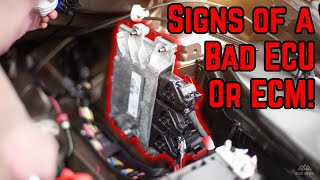
Symptoms of a Failing 1996 Maxima ECU 🎬 Watch this overview of common bad ECU symptoms

When the ECU begins to fail, it can cause a wide range of confusing and intermittent problems. Because the ECU controls so many different systems, symptoms can often mimic other failing parts. One of the most common indicators of a potential ECU problem is the appearance of multiple, seemingly unrelated diagnostic trouble codes at the same time.
- Check Engine Light: An illuminated Check Engine Light is a primary symptom. Codes pointing to an internal memory error (like P0605) or serial communication failure (P0600) are strong indicators of ECU failure.
- Engine Performance Issues: You may experience random engine misfires (P0300), a rough or high idle, stalling, hesitation, and general power loss.
- No-Start or Intermittent Start: A completely dead ECU can prevent the engine from starting at all. A failing unit might cause the car to start sometimes but not others.
- Poor Fuel Economy: If the ECU isn't correctly managing the fuel and air mixture, a sudden drop in gas mileage can occur.
- Communication Failure: In severe cases, a diagnostic scan tool may not be able to communicate with the ECU at all, making it impossible to retrieve trouble codes.
Buying a Used 1996 Maxima ECU: A Buyer's Guide


Purchasing a used Engine Control Unit for a 1996 Maxima requires careful attention to detail. Due to the high number of variations, compatibility is the biggest challenge. Using the wrong ECU can result in a no-start condition, poor performance, or a persistent Check Engine Light.
The Golden Rule: Match Part Numbers EXACTLY
The single most important rule is to match the part number on your original ECU with the part number on the replacement unit. There are numerous ECU versions for the 1996 Maxima, and they are not interchangeable. You will find the part numbers on a sticker on the outside of the metal ECU case.
- Hitachi Part Number: This number typically starts with "A18-" (e.g., A18-C84 EY0).
- Nissan Part Number: This is a 10-digit number, often starting with "23710-" (e.g., 23710-54U11).
Both numbers should be cross-referenced to ensure a perfect match.
Compatibility Checklist
In addition to the part number, you must match the ECU to your vehicle's specific configuration:
- Transmission: ECUs are specific to either Automatic or Manual transmissions.
- Emissions: You must use an ECU that matches your vehicle's emissions system—either Federal (EPA) or California (CARB). A California-spec car has stricter emissions controls and requires a California-spec ECU. You can find this information on the Vehicle Emission Control Information sticker under the hood.
- Trim and Options: Some ECU versions are tied to specific trim levels (GXE, SE) or even options like power seats. This is why matching the exact part number is critical, as it accounts for these minor but important variations.
Warning: While some forum users have had success swapping ECUs between 1995 and 1996 models, it is not recommended due to subtle differences in programming. To avoid issues, stick to an ECU from a 1996 Maxima that has the exact same part number as your original.
Physical Inspection
When buying a used ECU, inspect it for:
- Corrosion: Check the case and connector pins for any signs of rust or water damage.
- Signs of Tampering: Look for broken seals or marks on the case that indicate it has been opened before.
- Burnt Smell: A burnt electronic smell from the unit or its connectors is a major red flag.
Programming and Immobilizer Information
The 1996 Nissan Maxima does not typically feature the full Nissan Anti-Theft System (NATS) that requires key programming, which became more common in later model years like 1999. For a 1996 model, if you install a replacement ECU with the exact same part number, it is generally considered a "plug and play" installation. However, after installation, the ECU may need to go through a "relearn" procedure to calibrate itself to the engine's idle and fuel settings. Some sellers of refurbished ECUs provide them pre-programmed to your vehicle's VIN, which can simplify this process.
Known Issues, TSBs, and Recalls
There are no major recalls for the 1996 Maxima's ECU. However, Nissan has issued several Technical Service Bulletins (TSBs) related to ECU diagnostics and emissions readiness.
- NTB97-024 & NTB98-011: These bulletins address procedures for dealing with stored trouble codes in the ECM.
- NTB98-053: This covers issues related to the rear oxygen sensor voltage monitoring by the ECU.
- System Readiness Test (SRT): A Nissan bulletin explains that after an ECU is replaced or the battery is disconnected, the car must be driven in a specific pattern to allow the ECU to complete its self-diagnostics for emissions testing. Using the wrong ECU part number will prevent the SRT from ever completing.
Replacement Cost Breakdown
The cost to replace a 1996 Maxima ECU can vary significantly depending on the source of the part.
| Part Source | Estimated Cost |
|---|---|
| New OEM (Dealer) | $1,000 - $1,500+ |
| Remanufactured | $180 - $350 |
| Used OEM (Salvage) | $75 - $150 |
| Shop Labor | $116 - $170 (approx. 0.7-1.0 hours) |
ECU Location and Replacement

The ECU in a 1996 Maxima is located in the center of the dashboard, down by the floor. It is mounted behind plastic trim panels near the gas pedal and passenger footwell area.
Replacement is a straightforward but somewhat awkward job that takes about 30-60 minutes.
- Disconnect the negative battery terminal.
- Remove the plastic trim panels on both sides of the center console in the driver and passenger footwells.
- Unbolt and disconnect the main wiring harness connector from the ECU.
- Remove the four screws holding the ECU bracket in place. These can be difficult to access, and a small right-angle screwdriver or pliers may be needed.
- Slide the old ECU out and install the new one, making sure it is the correct part number.
- Reconnect everything in reverse order.
Pro Tip: After installing the replacement ECU, you can manually reset it. On the side of the ECU, there is a small diagnostic screw. With the key in the 'ON' position (engine off), turn the screw fully clockwise, wait two seconds, and turn it fully counter-clockwise. This clears any stored codes and resets the module.
🎬 See how to manually check and clear Maxima ECU codesFrequently Asked Questions (FAQ)
Do I need to program a replacement ECU for my 1996 Maxima?
Generally, no. The 1996 model year does not have the complex NATS immobilizer system found in later models. If you use a replacement ECU with the exact same part number as your original, it should be plug-and-play. A short "relearn" period of driving may be required for the ECU to adjust idle and fuel trims.
Where is the ECU located?
The ECU is located behind the center console, near the floor. You can access it by removing the plastic kick panels in the driver's and passenger's footwells.
Can I use an ECU from a different year Maxima, like a 1995 or 1997?
It is strongly advised not to. While some ECUs from 1995 may seem to work, there are programming differences that can cause error codes or performance issues. ECUs from 1997-1999 are not compatible. Always match the part number from your original 1996 ECU.
What's the difference between a Federal and California emissions ECU?
A California (CARB) emissions ECU is programmed to manage stricter emissions control equipment and monitor for different parameters than a Federal (EPA) ECU. Using a Federal ECU in a California-spec car (or a state that follows CARB rules) will cause it to fail an emissions test. Check the sticker under your hood to see which system your car has.
Helpful Videos
Technical Specifications
OEM Part Numbers: A18-C84 EX8 A18-C84 EY0 A18-C85 EN8 A18-C85 EX9 A18-E65 EZ7 MEC36-240 23710-56U60 23710-54U01 23710-54U03 23710-54U11 23710-54U13 23710-54U14 23710-54U15 23710-54U16 23710-56U62
Manufactured by Hitachi. Operates on the vehicle's 12V electrical system. Controls engine functions based on inputs from various sensors.

The information in this article is provided for general reference and educational purposes only. Vehicle specifications, procedures, and part compatibility can vary by production date, trim level, and region. Always consult your vehicle's factory service manual and verify part numbers before purchasing or performing repairs. Safety-critical components such as airbags, seat belts, and braking systems should be installed by a qualified professional.
- Nissan Maxima:
- 🎬 Helpful Videos
- Symptoms of a Failing 1996 Maxima ECU
- Buying a Used 1996 Maxima ECU: A Buyer's Guide
- The Golden Rule: Match Part Numbers EXACTLY
- Compatibility Checklist
- Physical Inspection
- Programming and Immobilizer Information
- Known Issues, TSBs, and Recalls
- Replacement Cost Breakdown
- ECU Location and Replacement
- Frequently Asked Questions (FAQ)
- 🎟️ Get 5% Off