

2008-2013 BMW M3 Driveshaft: Decoding DCT vs. Manual and Vibration Fixes
Don't get stuck with the wrong part—this guide covers the critical length difference, common failure points, and how to inspect a used M3 driveshaft.
- The most critical step is verifying the transmission type; the 1433mm shaft is for manual cars and the 1456mm shaft is for DCT cars. They are not interchangeable.
- Common failure symptoms include vibrations from the center console, clunking noises when shifting, and shuddering under acceleration.
- When buying used, inspect the center support bearing rubber for tears and the U-joint for any play, as these are the most common failure points.
- A complete driveshaft failure can cause a loss of power and significant secondary damage, so address symptoms early.
The Single Most Important Check: Manual vs. DCT

Warning: The driveshafts for the 6-speed manual transmission (6MT) and the 7-speed Dual-Clutch Transmission (DCT) are NOT interchangeable. They have different lengths and part numbers. Installing the wrong one will not work and can cause significant damage.
This is the most common and costly mistake buyers make. Before purchasing, you must verify which transmission your car has and ensure you are buying the corresponding driveshaft.
| Transmission Type | Required Driveshaft Length | Common OEM Part Number |
|---|---|---|
| 6-Speed Manual (6MT) | 1433mm | 26102283660 |
| 7-Speed DCT | 1456mm | 26102283665 |
The DCT transmission is physically shorter, requiring a longer driveshaft to cover the distance to the differential. Always confirm the part number and, if possible, measure the physical length of a used shaft before buying.
Symptoms of a Failing Driveshaft

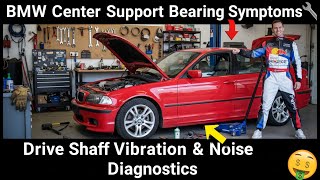
Driveshaft issues on the E9x M3 often start subtly and worsen over time. 🎬 Watch this guide on diagnosing center support bearing vibration and noise The most common culprits are not the shaft itself, but the supporting components like the center support bearing (CSB), the giubo, or the U-joint/CV joint. Here are the key symptoms to watch for:
- Vibrations: This is the most common sign. You may feel a vibration through the floor, center console, or armrest that increases with speed or under acceleration. A vibration that occurs only at specific speeds can point to a balance issue or a failing center support bearing.
- Clunking or Thumping Noises: A “clunk” or “thud” when you shift gears, accelerate from a stop, or get on/off the throttle often points to a worn giubo (flex disc) or excessive play in the U-joint.
- "Cowbell" or Squeaking Noise: Many owners report a metallic ringing or squeaking noise, often described as a "cowbell," at low speeds or during deceleration. This is frequently linked to a failing center support bearing or a dry/worn U-joint.
- Shuddering on Acceleration: A shudder or jolt when you accelerate hard can be caused by a failing center support bearing or a worn giubo that can no longer properly absorb the torque.
- Grinding or Howling: A constant grinding, whirring, or howling noise from under the car that changes with vehicle speed can indicate a worn-out bearing inside the center support or a failing CV joint at the differential end.
Buying a Used E9x M3 Driveshaft: What to Inspect

A used OEM driveshaft from a low-mileage vehicle can be an excellent value, often performing better than a cheap aftermarket alternative. However, a thorough inspection is crucial. Here’s what to check:
- Verify Transmission Type: First and foremost, confirm the part number and length (1433mm for Manual, 1456mm for DCT) to ensure it matches your car.
- Inspect the Center Support Bearing (CSB): This is a very common failure point. Check the rubber support surrounding the bearing. It should be intact, without any major cracks, tears, or separation. Try to move the bearing itself; a little bit of play might be normal, but excessive movement or a gritty, rough feeling when you spin it indicates failure.
- Check the Giubo (Flex Disc): The giubo is the rubber disc at the transmission end. Inspect it closely for cracks, especially around the bolt holes. Look for any signs of bulging, distortion, or delamination. A healthy giubo is firm but flexible; a failing one will look dry-rotted and cracked.
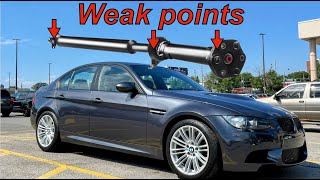
- Examine the U-Joint and CV Joint: The E9x M3 driveshaft has a universal joint (U-joint) near the center. Try to twist and move the joint by hand. There should be no discernible play or clunking. The rear of the shaft has a Constant Velocity (CV) joint covered by a rubber boot. Ensure the boot is not torn or leaking grease. A stiff or binding CV joint is a sign of internal failure.
- Check for Physical Damage: Look down the entire length of the shaft for dents, deep rust, or any signs of impact. A dented tube can easily throw the shaft out of balance, causing vibrations that are impossible to fix.
- Ask About Mileage: Whenever possible, choose a driveshaft from a vehicle with lower mileage. Components like bearings and joints have a finite lifespan.
Pro Tip: Many symptoms of a bad driveshaft can also be caused by a failing giubo or center support bearing alone. On the E9x M3, the center support bearing can be replaced separately, which is a much cheaper repair than replacing the entire driveshaft assembly.
Known Issues, TSBs, and Recalls
While the 2008-2013 E9x M3 has not been subject to a specific driveshaft recall, later model M3 and M4 vehicles (2016-2017) were recalled for a driveshaft flange that could separate over time (NHTSA Campaign Number 18V713). The symptoms listed in that recall—noise and vibration from underneath the vehicle, followed by a potential loss of power—are similar to general driveshaft failure symptoms. There are no widespread Technical Service Bulletins (TSBs) for the E9x M3 driveshaft, but failure of the center support bearing and giubo are well-documented issues in owner forums.
Replacement Overview & Difficulty
Replacing the driveshaft on an E9x M3 is a moderately difficult job that is feasible for an experienced DIY mechanic with the right tools.
- Difficulty: 4 out of 5
- Primary Steps: The process involves safely lifting the vehicle, removing the full exhaust system, and dropping several heat shields to gain access. The driveshaft is then unbolted from the transmission's giubo and the rear differential flange, and the center support bearing is unbolted from the chassis.
- Special Tools: You will need a good set of metric sockets, wrenches, and E-Torx sockets. A torque wrench is essential for correctly tightening the giubo and flange bolts.
- Critical Step: Before removing the old driveshaft, it's good practice to mark its orientation relative to the differential flange. If you are separating the two halves of the driveshaft (e.g., to replace the CSB), you MUST mark their alignment to each other. Failure to reassemble the shaft in the same orientation can cause severe balance issues and vibrations. 🎬 Watch how to fix driveshaft vibrations on an E90 M3
Cost Comparison
Prices can vary significantly based on supplier and condition. These are typical estimates:
| Part Type | Estimated Cost |
|---|---|
| New OEM | $1,750 - $2,350 |
| New Aftermarket | $700 - $1,700 (Standard or Carbon Fiber) |
| Used OEM | $275 - $550 |
| Remanufactured/Rebuilt | $525 - $650 (with core charge) |
| Shop Labor | $300 - $500 |
Frequently Asked Questions
Can I just replace the center support bearing instead of the whole driveshaft?
Yes. If the driveshaft tube, U-joint, and CV joint are in good condition, you can replace just the center support bearing (CSB). This requires separating the two halves of the driveshaft, which can be done by a DIYer with patience or by a machine shop. This is a much more cost-effective repair if the CSB is the only failed component.
What is a giubo and should I replace it with the driveshaft?
A giubo (pronounced 'gwee-bo'), or flex disc, is a rubber coupling that connects the driveshaft to the transmission output flange. Its job is to absorb driveline shock and vibrations. It is highly recommended to replace the giubo whenever you replace the driveshaft, as it is a common wear item and you will already have everything disassembled.
Is an aftermarket carbon fiber driveshaft worth it?
For most street-driven cars, a new or good used OEM driveshaft is sufficient. Carbon fiber driveshafts offer weight savings and potentially smoother power delivery but are significantly more expensive and can sometimes introduce their own noise, vibration, and harshness (NVH) issues. They are typically considered a performance upgrade for track-focused cars.
What happens if I don't fix a bad driveshaft?
Ignoring the symptoms of a failing driveshaft is dangerous. Initially, vibrations will get worse, making the car unpleasant to drive. Over time, a failing joint or bearing can seize or break apart. A complete failure of the driveshaft will result in a total loss of power to the wheels and can cause the shaft to flail around under the car, potentially damaging the exhaust, fuel lines, brake lines, and transmission case.
Helpful Videos
Technical Specifications
OEM Part Numbers: 26102283660 26-10-2-283-660 2283660 26102283665 26-10-2-283-665 2283665
Manual Transmission (6MT) Length: 1433mm. Dual-Clutch Transmission (DCT) Length: 1456mm.

The information in this article is provided for general reference and educational purposes only. Vehicle specifications, procedures, and part compatibility can vary by production date, trim level, and region. Always consult your vehicle's factory service manual and verify part numbers before purchasing or performing repairs. Safety-critical components such as airbags, seat belts, and braking systems should be installed by a qualified professional.
- BMW M3: