

2025 Subaru Forester Front Axle Shafts: Understanding Clicks, Vibrations, and Replacement
This guide covers the symptoms of a failing front CV axle on the 2025 Forester, how to inspect a used part, and why choosing the right replacement is critical for this new generation.
- The 2025 Forester is a new generation; front axle shafts from older models will not fit.
- A clicking noise on turns is the classic sign of a bad outer CV joint, while vibration on acceleration often points to a bad inner joint.
- Carefully inspect the rubber boots on used axles; a torn boot is the most common reason for failure and means the joint is compromised.
- For Subarus, a quality inspected used OEM axle is often a more reliable choice than a new, cheap aftermarket axle, which can cause vibrations.
A Note on Terminology: Drive Shaft vs. Axle Shaft
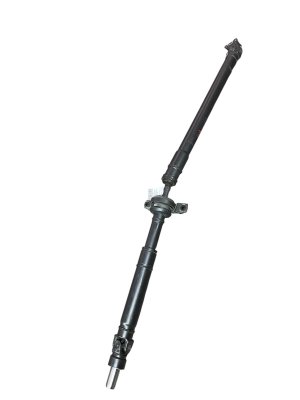
While sometimes called a 'front drive shaft,' the part connecting your 2025 Forester's front differential to the wheels is technically a front CV axle shaft or half-shaft. The main 'driveshaft' (or propeller shaft) is the single, long shaft that sends power to the rear differential. This article focuses exclusively on the front left and right CV axle shafts.
Symptoms of a Failing Front Axle Shaft
As the 2025 Forester is a new model, widespread failure data is not yet available. However, CV axle failures have consistent, universal symptoms. Watch for these signs:
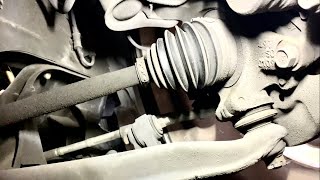
- Clicking or Popping Noise When Turning: This is the most classic symptom of a worn outer CV joint. The noise is most obvious in tight, low-speed turns, like in a parking lot. It's caused by excessive play in the worn-out ball-and-cage mechanism inside the joint. To diagnose, find an empty lot, roll your window down, and make tight circles in both directions. The noise will typically be more pronounced on the side with the bad axle. 🎬 Watch: How to diagnose a bad Subaru CV axle
- Vibration or Shudder During Acceleration: A vibration that you feel through the floor or seat, which gets worse as you accelerate, often points to a problem with the inner CV joint. This happens because the inner joint, which is designed to plunge in and out as the suspension moves, has developed excessive play. 🎬 See how to diagnose and fix acceleration shudder
- Grease on the Inside of the Wheel: The CV joints are packed with thick grease and sealed by flexible rubber boots. If you see dark, heavy grease splattered on your inner wheel, brake components, or suspension, it's a sure sign a CV boot has torn. Once the boot fails, grease escapes and contaminants like dirt and water get in, rapidly destroying the joint.
- Clunking Sound When Shifting: A 'clunk' or 'thud' when shifting from Drive to Reverse or on initial acceleration can be a sign of a severely worn joint with significant play.
Known Issues, Recalls, and TSBs for Subaru Forester Axles
As of mid-2026, there are no active recalls or Technical Service Bulletins (TSBs) specifically for the front axle shafts on the 2025 Subaru Forester. Searches of the National Highway Traffic Safety Administration (NHTSA) database show recalls for the 2025 model related to wheels, child seat anchors, and the moonroof, but none for the drivetrain.
However, it is important to be aware of issues from the immediately preceding generation, as they provide context on potential concerns:
- NHTSA Recall 23V-754 (2023-2024 Forester): Certain prior-year models were recalled because the front axle shaft's outer race could crack due to an improper manufacturing heat-treatment process. This could lead to a sudden loss of power.
- TSB 03-91-23R (2019-2023 Forester): Subaru issued a service bulletin to address a clicking or cracking sound during slow, full-lock turns. The fix involves a redesigned, more durable front axle shaft (part number 28321SJ010). This bulletin notes that axles do not need to be replaced in pairs.
Pro Tip: The 2025 Forester marks the start of a new generation and its parts are not expected to be compatible with earlier models. Always verify fitment using a Vehicle Identification Number (VIN).
Buying a Used 2025 Forester Front Axle Shaft: What to Check
For a new vehicle like the 2025 Forester, used axle shafts will almost exclusively come from very low-mileage vehicles involved in collisions. This can make them an excellent value, offering a nearly-new OEM part for a fraction of the price, provided you inspect it carefully.
Many Subaru owners and mechanics report that cheap aftermarket axles can cause vibrations and have a short service life. For a component so critical to the AWD system's performance, a quality used OEM axle is often a more reliable choice than a new, non-OEM part.
Inspection Checklist:
- Inspect the CV Boots: This is the most critical check. The accordion-like rubber boots must be perfect. Squeeze and flex them, looking for any cracks, pinholes, or tears. A compromised boot means the joint is contaminated and should be rejected.
- Check for Leaks: Look for any greasy residue around the boot clamps. This indicates a leak, even if the boot isn't fully torn.
- Feel for Play: Hold the shaft and try to move the inner and outer joints. There should be no significant clicking or clunking. The joint should move smoothly through its range of motion but feel tight, without excessive looseness or play.
- Examine the Splines: Check the splines on both ends of the axle. They should be clean, sharp, and free of any damage from accident impact or improper removal.
- Check for Bends: Roll the axle on a flat surface to ensure the center bar is straight and wasn't bent in a collision.
Replacement Cost Comparison
Prices can vary by region and supplier. The following are estimates to help you understand the value of a used OEM part.
| Part Type | Estimated Cost |
|---|---|
| New OEM | $400 - $550 |
| New Aftermarket | $70 - $160 |
| Used OEM | $75 - $150 |
| Shop Labor | $150 - $350 |
Installation Overview & Difficulty
- Difficulty: 3/5 (Intermediate)
- Estimated Time: 1.5 hours per side
- DIY Feasible: Yes, for those with mechanical experience and the right tools.
Replacing a front CV axle is a common repair but requires some specific tools. The basic process involves safely lifting and supporting the vehicle, removing the wheel, and then detaching suspension components like the ball joint or tie rod end to allow enough room to remove the axle. The large axle nut is often very tight and requires a breaker bar and the correct socket (typically 32mm for Subarus) to remove. The inner end of the axle must be carefully popped out of the differential. Installation is the reverse of removal, and it is critical to use a torque wrench to tighten the axle nut to the manufacturer's specification (historically around 162 ft-lbs for Foresters) and stake the nut to prevent it from loosening.
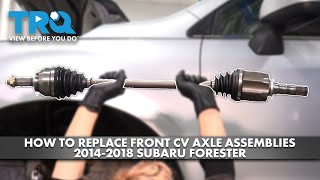
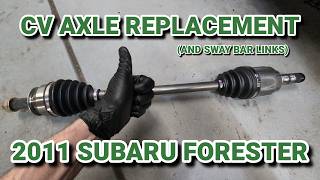
🎬 Watch: Step-by-step Subaru front CV axle replacementWarning: Never let the axle hang by the inner joint when removing it, as this can damage the joint or the differential seal. Always support the axle during removal and installation.
Frequently Asked Questions (FAQ)
Can I drive with a clicking CV axle?
You can, but it's not recommended. A clicking joint is a worn joint. While it may click for thousands of miles, it can also fail suddenly and completely, which would leave the vehicle stranded and could potentially cause a loss of control. It is best to replace it as soon as possible.
Do I need to replace front axles in pairs?
No. You only need to replace the axle that has failed. Subaru's own service bulletin for a similar issue on older models confirms they do not need to be replaced in pairs. However, if one has failed due to high mileage, the other may not be far behind.
Will a front axle from a 2024 or older Forester fit my 2025 model?
No. The 2025 model year is the first year of the sixth-generation Forester. Drivetrain and suspension components were updated, and parts from the previous generation (2019-2024) are not expected to fit.
Is it better to replace the whole axle or just the torn boot?
Replacing the entire axle assembly is almost always the better option. If the boot is torn, the joint is already contaminated and its lifespan is compromised. The labor to replace just the boot is significant, and for a similar cost, you can often get a complete new aftermarket or good used OEM axle assembly.
Helpful Videos
Technical Specifications
OEM Part Numbers: 28321SJ010
The previous generation (2019-2023) used part number 28321SJ010 as an updated, more durable design. It is likely the 2025 model uses this part or a successor. Axle nut torque is critical and is approximately 162 ft-lbs on prior models.
We Have This Part in Stock

The information in this article is provided for general reference and educational purposes only. Vehicle specifications, procedures, and part compatibility can vary by production date, trim level, and region. Always consult your vehicle's factory service manual and verify part numbers before purchasing or performing repairs. Safety-critical components such as airbags, seat belts, and braking systems should be installed by a qualified professional.
- Subaru Forester:
- 🎬 Helpful Videos
- 🛍️ Shop This Part
- A Note on Terminology: Drive Shaft vs. Axle Shaft
- Symptoms of a Failing Front Axle Shaft
- Known Issues, Recalls, and TSBs for Subaru Forester Axles
- Buying a Used 2025 Forester Front Axle Shaft: What to Check
- Inspection Checklist:
- Replacement Cost Comparison
- Installation Overview & Difficulty
- Frequently Asked Questions (FAQ)
- 🎟️ Get 5% Off