

1995-2002 Lincoln Continental Window Regulator: Fixing Common Cable and Clip Failures
Learn to diagnose a failing front window regulator, what to inspect on a used part, and how to replace it in your 1995-2002 Continental.
- The most common failure points on the 1995-2002 Continental's window regulator are the steel cable fraying and the plastic guide clips breaking.
- When buying a used regulator, the most important inspection is to check the cables for any signs of fraying or kinking and to ensure all plastic parts are free of cracks.
- The original regulators are held in by rivets that must be drilled out; the replacement will be installed with bolts and nuts.
- The motor is often reusable, but many replacement regulators come as a complete assembly, which can be a worthwhile preventative measure.
Symptoms of a Failing Window Regulator

A bad window regulator in your Lincoln Continental will usually give you clear warning signs. Because it's a mechanical part with moving components, failure often involves distinct sounds and behaviors.
- Grinding or Crunching Noises: This is a classic sign of a failing cable-driven regulator. The steel cable may be fraying, and the sound is the damaged cable bunching up or grinding against the pulleys as the window moves.
- Window Drops Into the Door: If the window suddenly falls into the door, it means the cable has snapped or the clips holding the glass to the regulator have broken completely.
- Slow or Jerky Operation: A window that struggles to move, moves in a jerky motion, or is noticeably slower than it used to be can indicate a binding cable, a failing motor, or debris in the window tracks.
- Clicking Sound, But No Movement: If you press the window switch and hear a clicking sound from the door but the window doesn't move, the problem is likely the regulator assembly. If you hear no sound at all, the issue is more likely the switch, wiring, or the motor itself.
- Crooked Window: If the window tilts forward or backward as it goes up or down, it means one of the regulator's lift points or guide rails has broken, causing the glass to become misaligned.
Diagnosing the Problem: Regulator vs. Motor

Before buying parts, it's important to determine if the regulator, the motor, or an electrical issue is the culprit.
- Listen to the Sounds: As mentioned, grinding or popping sounds strongly suggest a mechanical regulator failure. A humming sound from the motor with no window movement could mean the motor is working but the regulator is stripped or broken. No sound at all points towards an electrical issue (fuse, switch) or a dead motor.
- The "Helping Hand" Test: With a friend pressing the "up" button, try to manually pull the window glass up. If you can move it up and down by hand with little resistance, the regulator's lifting mechanism is definitely broken. If it moves with assistance, the motor may be weak, but the regulator could also be binding.
- Door Panel Inspection: The most definitive test is to remove the interior door panel. With the components visible, you can operate the switch and watch for snapped cables, broken plastic guides, or a motor that spins while the regulator mechanism does nothing.
Pro Tip: If the window works intermittently, check the switch first. Try swapping the driver's side switch with the passenger side switch if possible, or test the switch with a multimeter. It's an easier fix than a full regulator replacement.
Buying a Used Front Window Regulator

For a vehicle of this age, a quality used OEM window regulator is often a smart and economical choice. Aftermarket parts can vary in quality, while a good used original part was built to Ford's factory standards. Here’s what to inspect before you buy:
- Inspect the Cables: This is the most critical check. Look at the steel cables from every angle. Reject any regulator with signs of fraying, kinks, rust, or broken strands. The cable should be taut and properly wound around the main pulley.
- Check All Plastic Components: Carefully examine all plastic guides, pulleys, and especially the clips that attach to the window glass. These parts can become brittle with age. Look for any cracks, stress marks, or broken pieces.
- Verify the Motor (If Included): Most used regulators are sold with the motor attached. If possible, bring a 12V power source (like a small jump pack or battery) and test the motor by briefly applying power to its electrical connector pins.
- Confirm the Correct Side: The driver's side (left) and passenger's side (right) regulators are mirror images of each other and are not interchangeable. Ensure you are buying the correct part for the door you are repairing.
Known Issues, Recalls, and TSBs
A search of the National Highway Traffic Safety Administration (NHTSA) database and other public records shows no specific recalls or widespread Technical Service Bulletins (TSBs) for the window regulators on the 1995-2002 Lincoln Continental. Failures on these vehicles are generally due to normal wear and tear over time, which is common for cable-style window regulators of this era across many makes and models.
Replacement Overview & Difficulty
Replacing the front window regulator is a moderately difficult job that a patient DIY mechanic can accomplish. The process involves removing the door panel, 🎬 Watch this step-by-step Lincoln door panel removal video carefully peeling back the weather barrier, securing the window glass, and then unbolting the old regulator assembly. 🎬 See how to replace a Lincoln power window regulator The original regulators are often secured with rivets that must be drilled out. Replacement units, both new and used, are typically installed with bolts and nuts.
- Difficulty Rating: 3 out of 5
- Estimated Time: 1.5 - 2.5 hours
- DIY Feasible: Yes, for those comfortable with removing door panels and using basic hand tools and a drill.
Warning: The window glass is heavy and can be damaged if dropped. Always secure the glass in the full 'up' position with strong tape (like painter's or duct tape) before unbolting it from the regulator.
Cost Comparison
Prices can vary based on supplier and condition. The original OEM regulator is discontinued, so new OEM is generally not an option.
| Part Type | Estimated Price Range |
|---|---|
| New OEM | Discontinued |
| New Aftermarket (Regulator & Motor Assembly) | $60 - $115 |
| Used OEM (Regulator & Motor Assembly) | $40 - $85 |
| Shop Labor Cost | $172 - $252 |
Technical Specifications & Part Numbers
These part numbers are for the regulator assembly without the motor. The motor is typically a separate part but is often included with aftermarket or used assemblies.
- Front Right (Passenger Side): F50Y-5423208-A, F5OY-5423208-A
- Front Left (Driver Side): F50Y-5423209-A, F50Y5423209A
- Motorcraft Part Number: WLR-125 (This may apply to one or both sides, verify application)
Frequently Asked Questions (FAQ)
Can I just replace the broken cable or plastic clip?
While some individual components might be available, it is generally not recommended. Replacing just the cable is a complex and difficult task. It is almost always easier and more reliable to replace the entire regulator assembly.
Do I need to replace the motor at the same time?
Not necessarily. If your motor is still functioning correctly (i.e., it makes noise and tries to work when you press the switch), you can often reuse it with the new regulator. However, many aftermarket and used regulators come as a complete assembly with the motor, which can simplify installation. Given the age of the vehicle, replacing both at the same time can prevent a future failure of the old motor.
Are any special tools required for the job?
You will need basic hand tools, a drill with a bit to remove the factory rivets (a 5/16" or similar size often works), and a trim panel removal tool is highly recommended to avoid damaging the door panel clips. You will also need new nuts and bolts to install the replacement regulator.
Is the front regulator the same as the rear one?
No, the front and rear window regulators are different parts and are not interchangeable. The same is true for the left and right sides.
Helpful Videos
![How To Replace Power Window Regulator 98-02 Lincoln Town Car [PART 1]](https://img.youtube.com/vi/6ObHQTBxkUQ/mqdefault.jpg)
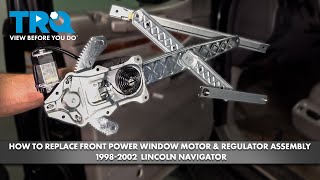

Technical Specifications
OEM Part Numbers: F50Y-5423208-A (Front Right) F5OY-5423208-A (Front Right) F50Y-5423209-A (Front Left) F50Y5423209A (Front Left) WLR-125 (Motorcraft)
Cable-driven power window regulator. Original installation uses rivets, which are replaced with bolts during service.
We Have This Part in Stock



The information in this article is provided for general reference and educational purposes only. Vehicle specifications, procedures, and part compatibility can vary by production date, trim level, and region. Always consult your vehicle's factory service manual and verify part numbers before purchasing or performing repairs. Safety-critical components such as airbags, seat belts, and braking systems should be installed by a qualified professional.
- Lincoln Continental:
- 🎬 Helpful Videos
- 🛍️ Shop This Part
- Symptoms of a Failing Window Regulator
- Diagnosing the Problem: Regulator vs. Motor
- Buying a Used Front Window Regulator
- Known Issues, Recalls, and TSBs
- Replacement Overview & Difficulty
- Cost Comparison
- Technical Specifications & Part Numbers
- Frequently Asked Questions (FAQ)
- 🎟️ Get 5% Off