

1991-1996 Dodge Stealth Window Regulator: A Guide to Noises, Failures, and Replacement
Your definitive guide to diagnosing common failures, choosing the right used part, and understanding the critical 1996 mid-year production change.
- For 1996 models, you MUST verify your vehicle's production date (on the door jamb sticker) to choose the correct regulator; the design changed in March 1996.
- Common failure symptoms include grinding noises, a crooked window, or the window dropping into the door.
- Most replacement regulators are sold without the motor; you will likely need to transfer your old motor to the new assembly.
- A used OEM regulator is often a better long-term value than a cheap new aftermarket part, provided you inspect it for frayed cables and cracked pulleys.
Symptoms of a Failing Window Regulator

A failing window regulator in a Dodge Stealth or its Mitsubishi 3000GT counterpart typically gives several warning signs before it completely breaks. Identifying these symptoms early can help you distinguish between a bad regulator, a failing motor, or a simple switch issue.
- Grinding, Clicking, or Popping Noises: This is the most common symptom. When you press the window switch, you may hear grinding or clicking sounds from inside the door. This often indicates a frayed cable or broken plastic gear/pulley inside the regulator assembly.
- Slow or Erratic Window Speed: If the window moves much slower than it used to, or seems to speed up and slow down as it moves, it's a sign of a problem. This can be caused by a dying motor or by a bent or binding regulator creating extra resistance.
- Crooked Window: The window may tilt forward or backward as it goes up or down. This usually means one of the regulator's guide rails or lift points has broken, causing the glass to become misaligned.
- Window Drops Into the Door: In a catastrophic failure, the cable can snap or the glass can detach from the regulator, causing the window to fall completely inside the door. You might hear a loud pop followed by the sound of the glass hitting the bottom of thedoor.
- Window Won't Stay Up: You might be able to raise the window, but it slowly slides back down on its own. This indicates the mechanism can no longer hold the weight of the glass.
- Window is Stuck: If you hear the motor whirring but the window doesn't move, the regulator is likely broken. If you hear nothing at all, the problem is more likely the switch or the motor itself.
Pro Tip: Have a helper press the window switch while you listen with your ear against the door panel. If you hear the motor trying to work, the regulator is almost certainly the culprit. If you hear only a faint click or nothing at all, test the switch and motor before buying a regulator.
Known Issues, TSBs, and Recalls

While there are no official safety recalls from the NHTSA for the window regulators on the 1991-1996 Dodge Stealth, there are well-documented issues and a critical mid-year production change to be aware of.
The Critical 1996 Mid-Year Change
The most significant issue for buyers is a design change that occurred in early 1996. The mounting points for the window regulator assembly are different between early and late production models.
- Early Style: Fits vehicles with a production date from 1991 through February 1996.
- Late Style: Fits vehicles with a production date from March 1996 onward.
Warning: An early-style regulator will not bolt into a late-style door, and vice-versa, without significant modification. Always check your vehicle's production date, which can be found on the sticker inside the driver's door jamb, before purchasing a replacement part.
Common Failure Point: Teflon Pulley Bracket
A common point of failure on the original regulators is the upper Teflon pulley bracket. This plastic piece can become brittle with age and bend or break under the tension of the cables, causing them to bind. Some owners have successfully repaired this by fabricating a metal backing plate to reinforce the bracket, but this is a DIY-intensive repair. When inspecting a used part, pay close attention to this area for any signs of stress or cracking.
Buying a Used Front Door Window Regulator

Given the high cost of new OEM regulators, a quality used OEM part is often the best value. Aftermarket regulators are available, but their long-term durability can be questionable compared to the original factory part. Here’s what to look for when buying used.
What to Physically Inspect
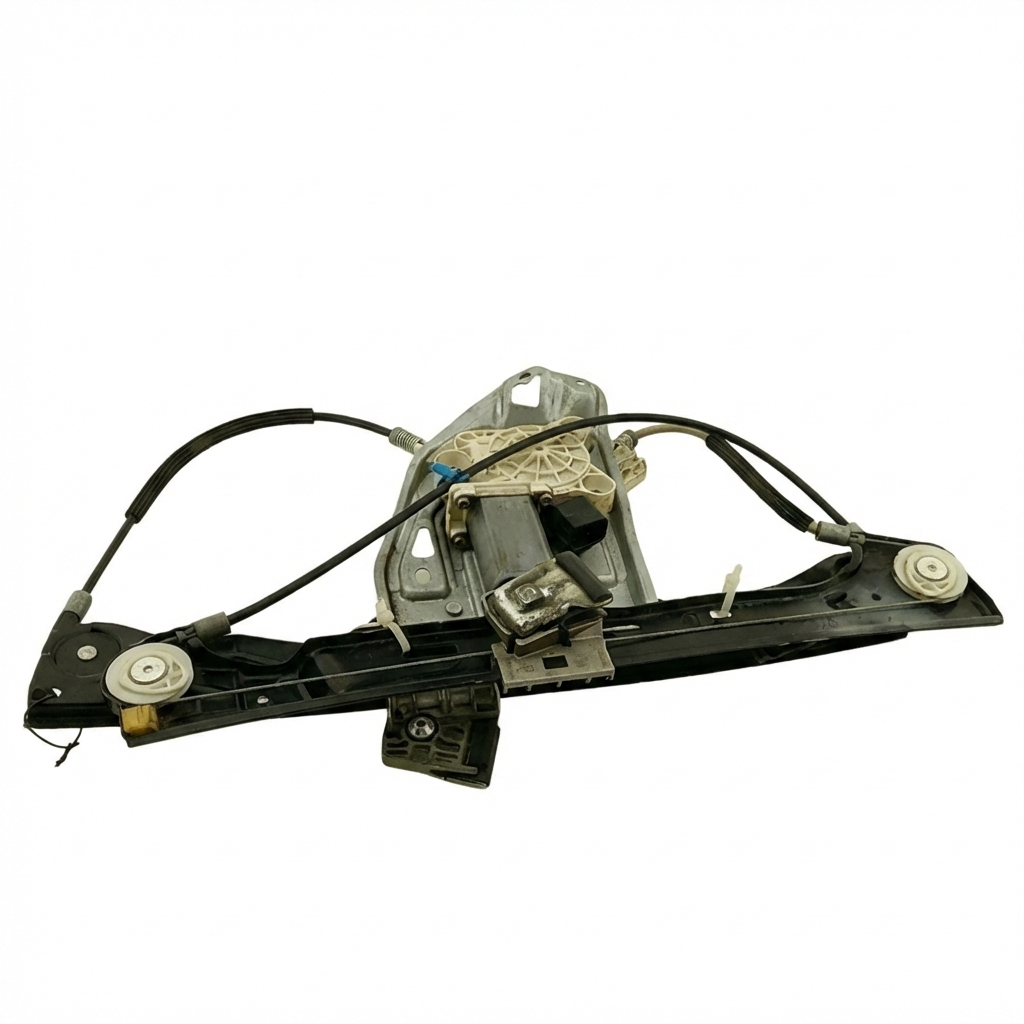
- Check the Cables: Inspect the steel cables for any signs of fraying, kinks, or rust. A frayed cable is a regulator that is about to fail.
- Inspect the Pulleys: Check all plastic pulleys, especially the upper pulley bracket mentioned in the 'Known Issues' section. Ensure they are not cracked, bent, or broken and that they spin freely.
- Examine the Main Rail: Look at the main track the window slides on. Ensure it is straight and free of deep gouges or rust.
- Confirm Motor is (or is not) Included: Most regulators are sold without the motor. Confirm with the seller whether the motor is part of the sale. If you are reusing your old motor, this is not an issue.
Compatibility Verification
- Check Left vs. Right: The driver (left) and passenger (right) side regulators are mirror images and are not interchangeable. The OEM part number for the driver's side is typically MB641281, and the passenger's side is MB641282.
- Verify the 1996 Production Date: If you own a 1996 model, this is the most important step. Check your door jamb sticker for the production month and year. If it is before 03/96, you need the 'early style' part. If it is 03/96 or later, you need the 'late style'.
Cost Breakdown
Prices can vary based on supplier, condition, and whether the motor is included. Here are some typical price ranges to expect.
| Part Type | Estimated Cost |
|---|---|
| New OEM | $450 - $1000+ (often discontinued or very limited stock) |
| New Aftermarket | $55 - $150 |
| Used OEM | $75 - $200 (depending on condition and motor inclusion) |
| Shop Labor | $150 - $300 |
Replacement Overview & Difficulty

Replacing the window regulator is a moderately difficult job that a DIYer with some experience can handle. The main challenges are removing the interior door panel without breaking any clips and carefully handling the heavy window glass.
- Difficulty Rating: 3 out of 5
- Estimated Time: 1.5 - 2.5 hours
The basic steps involve:
- Removing the interior door panel by locating and removing all screws and clips.
- Carefully peeling back the plastic vapor barrier to access the inside of the door.
- Temporarily securing the window glass in the 'up' position with strong tape or a wedge.
- Disconnecting the window glass from the regulator's guide rail (usually two bolts).
- Unplugging the window motor's electrical connector.
- Unbolting the regulator assembly from the door frame (typically 4-6 bolts).
- Maneuvering the old regulator out of the access hole in the door.
- If necessary, transferring the motor from the old regulator to the new one.
- Installation is the reverse of removal.
Frequently Asked Questions (FAQ)
Do I need to replace the window motor at the same time?
Not necessarily. If your window failed with grinding noises but the motor still sounded strong, you can usually reuse your existing motor. Most replacement regulators are sold without the motor. However, if the window was moving very slowly or stopped working entirely with no noise, the motor could be the cause or could have been strained by the failing regulator. If your budget allows, replacing both as an assembly can save future labor.
How do I know if I have an 'early' or 'late' 1996 Dodge Stealth?
Open your driver's side door and look for the vehicle identification sticker on the door jamb. The production date will be printed on this sticker, usually in a MM/YY format. A date of 02/96 or earlier requires the 'early style' regulator. A date of 03/96 or later requires the 'late style' regulator.
Is the driver's side regulator the same as the passenger's side?
No, they are not interchangeable. They are mirror images of each other. Be sure to order the correct side for your repair. The driver's side is Left (LH) and the passenger's side is Right (RH).
Can I just repair my broken regulator instead of replacing it?
In some specific cases, yes. If the only failure is the upper Teflon pulley bracket bending, it is possible to fabricate a reinforcement plate to fix it. However, this requires metalworking skills and tools. If the cable has snapped or frayed, replacement of the entire regulator assembly is the only practical and reliable solution.
Technical Specifications
OEM Part Numbers: MB641281 (Front Left, 1991-Feb 1996) CW608833 (Front Left, 1991-Feb 1996) MB641282 (Front Right, 1991-Feb 1996) CW608834 (Front Right, 1991-Feb 1996) MB927551 MB927553 MB927594 MR280053
Scissor-type with cable drive mechanism. Designed for power window systems only. Two primary versions exist: Early Style (1991-Feb 1996) and Late Style (Mar 1996-1999), which have different mounting points.
We Have This Part in Stock

The information in this article is provided for general reference and educational purposes only. Vehicle specifications, procedures, and part compatibility can vary by production date, trim level, and region. Always consult your vehicle's factory service manual and verify part numbers before purchasing or performing repairs. Safety-critical components such as airbags, seat belts, and braking systems should be installed by a qualified professional.
- Dodge Stealth:
- 🛍️ Shop This Part
- Symptoms of a Failing Window Regulator
- Known Issues, TSBs, and Recalls
- The Critical 1996 Mid-Year Change
- Common Failure Point: Teflon Pulley Bracket
- Buying a Used Front Door Window Regulator
- What to Physically Inspect
- Compatibility Verification
- Cost Breakdown
- Replacement Overview & Difficulty
- Frequently Asked Questions (FAQ)
- 🎟️ Get 5% Off