

2007-2015 Mazda CX-9 Brake Guide: Rotors, Calipers, and Power Booster Issues
This guide covers common brake problems, from typical wear to the well-known power booster failure, helping you diagnose issues and find the right parts for your 2007-2015 Mazda CX-9.
- A hard pedal with a hissing sound is likely a failed power brake booster, a known issue covered by a past warranty extension (SSP 93) on 2007-2013 models.
- All 2007-2015 CX-9s use 320mm (12.6") front rotors. Verify this size, as shared-platform Ford/Lincoln models used different sizes.
- Vibration when braking is almost always due to warped rotors, a common issue on this heavy SUV.
- Always replace rotors in pairs and install new pads at the same time to ensure safe, balanced braking.
Symptoms of a Failing Disc Brake System

Brake problems can manifest in several ways. Paying attention to new sounds, smells, or changes in pedal feel can help you diagnose an issue before it becomes a critical failure.
Grinding, Squealing, or Clicking Noises
A high-pitched squeal is often the first sign that your brake pads are worn out. This sound comes from a small metal tab called a wear indicator, which contacts the rotor when the pad material is low. If ignored, this can lead to a loud grinding noise, which means the pad's metal backing plate is scraping against the rotor, causing significant damage.
Vibration or Pulsing in the Brake Pedal
If you feel a pulsing or shaking in the brake pedal or steering wheel when you apply the brakes, it's a classic symptom of warped rotors. When rotors overheat, their surface can become uneven. As the pads press against this uneven surface, it creates a noticeable vibration. This is a common complaint on the heavy CX-9.
Spongy or Hard Brake Pedal
A brake pedal that feels soft, spongy, or goes to the floor can indicate air in the hydraulic lines or a failing master cylinder. Conversely, a pedal that is very hard to press is a primary symptom of a failing power brake booster, a known issue on these vehicles. You might also hear a hissing sound from the pedal area as the booster's internal diaphragm leaks vacuum.
Vehicle Pulling to One Side
If your CX-9 pulls to the left or right during braking, it often points to a problem with a brake caliper. A caliper piston can get stuck (seized), causing it to either not apply pressure or not release it. This results in uneven braking force and can cause accelerated wear on one side.
Known Issues, TSBs, and Recalls for 2007-2015 Mazda CX-9 Brakes

While there are no open recalls specifically for the standard brake components like rotors or pads on this generation of CX-9, there is a very well-documented issue with the power brake booster.
Power Brake Booster Failure (SSP 93)
Mazda issued a Special Service Program (SSP 93) extending the warranty for the power brake booster on 2007-2013 CX-9 models. The internal diaphragm of the booster could deteriorate, especially in high-temperature climates, causing a vacuum leak.
- Symptoms: A brake pedal that is harder than usual to press and a hissing sound from the driver's footwell when the brake is applied.
- Resolution: Mazda dealers were instructed to replace the faulty power brake unit with an improved part. While the original warranty extension has expired, it's a critical issue to be aware of when diagnosing brake problems or purchasing a used CX-9.
Other Technical Service Bulletins (TSBs)
Mazda has released several TSBs related to general brake service, such as addressing brake noise, judder, or fluid seepage from the master cylinder cap, but none point to a widespread defect with the core brake kit components.
Buying a Used Disc Brake Kit: What to Inspect

When buying used brake components, careful inspection is crucial for safety. The term "kit" can be misleading; typically, you will purchase components like a pair of rotors or a single caliper. Never use old brake pads.
Warning: Always replace brake pads with a new set when installing used or new rotors. Always replace rotors in pairs (both front or both rear) to ensure even braking performance.
Inspecting Used Brake Rotors
- Surface Condition: Look for a smooth, even surface. Reject any rotors with deep grooves, cracks, or significant rust pitting.
- Warping: Place the rotor on a perfectly flat surface to check for warping. Any visible wobble or gap indicates the rotor is not true and will cause pedal pulsation.
- Thickness: Rotors have a minimum thickness specification stamped on them (e.g., 'MIN TH 26mm'). While you may not have a micrometer, a visual inspection can tell you if the rotor looks overly worn or has a large 'lip' at the outer edge. A significant lip suggests it's near the end of its service life.
Inspecting Used Brake Calipers
- Leaks: Check for any signs of brake fluid leaks, especially around the piston boot and the bleeder screw.
- Piston and Guide Pins: The rubber boot around the piston should be intact, with no tears. Ensure the guide pins (which the caliper slides on) move freely. A seized guide pin is a common cause of uneven pad wear.
- Physical Damage: Inspect the caliper body for any cracks or damage from a previous accident.
Compatibility Check: The 320mm Rotor Rule
All 2007-2015 Mazda CX-9 models use a 12.6-inch (320mm) diameter front brake rotor. This is a critical measurement. These brake components are also shared with some Ford Edge and Lincoln MKX models, which were offered with different brake sizes. Before purchasing, always verify the 320mm diameter to ensure compatibility.
Cost Comparison: New vs. Used vs. Aftermarket
Prices can vary significantly based on brand and location. This table provides an estimated cost for a pair of front rotors and a set of front pads.
| Component | New OEM | New Aftermarket | Used OEM |
|---|---|---|---|
| Front Brake Rotors (Pair) | $340 - $400 | $100 - $250 | $50 - $100 |
| Front Brake Pads (Set) | $80 - $120 | $30 - $70 | Not Recommended |
| Shop Labor (Pads & Rotors) | $170 - $350 | ||
Replacement Guide & Difficulty
- Difficulty: 2 out of 5. Replacing brake pads and rotors is a common DIY task for those with basic mechanical skills and tools.
- Time: 1.5 - 2.5 hours for front or rear axle.
Pro Tip: After installing new pads and rotors, it's important to 'bed them in.' This involves a series of controlled stops to properly transfer a layer of friction material from the pads to the rotors, ensuring smooth, quiet, and powerful braking. Follow the procedure provided by the pad manufacturer.
Key Replacement Steps
- Safely lift and support the vehicle on jack stands and remove the wheel.
- Remove the two caliper guide pins (or slider bolts), typically 14mm or 17mm, and hang the caliper securely with a hook. Do not let it hang by the brake hose.
- Remove the two larger bolts holding the caliper mounting bracket, typically 19mm.
- Slide the old rotor off the hub. If it's stuck, a few taps with a hammer may be needed.
- Thoroughly clean the wheel hub surface with a wire brush to remove all rust and debris. This is critical to prevent rotor runout and vibration.
- Install the new rotor, and reassemble in reverse order. Clean the new rotor with brake cleaner to remove any oils from manufacturing.
- Use a C-clamp or piston compression tool to push the caliper piston back into its bore to make room for the new, thicker pads.
- Apply a thin layer of brake grease to the caliper slide pins and the edges of the brake pads where they contact the bracket. 🎬 Watch: Step-by-step front brake replacement guide
Important Torque Specs
- Caliper Bracket Bolts (Front): ~110 ft-lbs (149 Nm)
- Caliper Guide Pin Bolts (Front): ~85 ft-lbs (115 Nm)
- Wheel Lug Nuts: ~90 ft-lbs (122 Nm)
Note: Always verify torque specs with a reliable service manual for your specific vehicle.
Technical Specifications & Part Numbers
| Part | Specification |
|---|---|
| Front Rotor Diameter | 12.6 in / 320 mm |
| Front Rotor Thickness (New) | 28 mm |
| Front Rotor Minimum Thickness | 26 mm |
| Rear Rotor Diameter | 12.8 in / 325 mm |
| Lug Pattern | 5 x 114.3 mm |
OEM Part Numbers (Front Rotor)
These part numbers are often interchangeable. Always confirm fitment with the seller using your vehicle's VIN.
- TD13-33-25X (Mazda)
- EH14-33-25X (Mazda)
- EH14-33-25XA (Mazda)
- L232-33-25XA (Mazda)
- L232-33-25XB (Mazda)
- TD1-33-325X (Ford)
Frequently Asked Questions (FAQ)
Do I have to replace rotors and pads at the same time?
It is highly recommended. Installing new pads on old, worn rotors can lead to noise, poor performance, and reduced pad life. Most shops will insist on replacing them together.
What is 'bedding in' the brakes and is it necessary?
Bedding-in is a process of controlled stops that transfers an even layer of friction material from the new pads onto the new rotors. This is crucial for optimal braking performance, preventing noise, and avoiding judder from uneven pad deposits. Yes, it is necessary for most new brake sets.
Is it true my Mazda CX-9 has the same brakes as a Ford Edge?
Yes, the first-generation Mazda CX-9 was built on a Ford platform and shares many components, including brake parts, with the Ford Edge and Lincoln MKX of the same era. However, those Ford/Lincoln models had multiple brake size options, so you must confirm the 320mm front rotor size for your CX-9.
Can I replace just one rotor if the other seems fine?
No. Brakes, especially rotors, must always be replaced in pairs on the same axle (both front or both rear). Replacing only one can cause a dangerous braking imbalance, making the vehicle pull to one side during a stop.
Helpful Videos
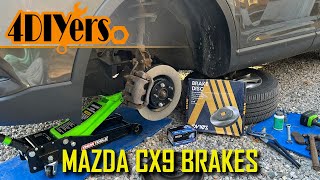

Technical Specifications
OEM Part Numbers: TD13-33-25X EH14-33-25X EH14-33-25XA L232-33-25XA L232-33-25XB TD1-33-325X
Front Rotor Diameter: 320mm (12.6 inches). Rear Rotor Diameter: 325mm. Bolt Pattern: 5x114.3mm.
We Have This Part in Stock


The information in this article is provided for general reference and educational purposes only. Vehicle specifications, procedures, and part compatibility can vary by production date, trim level, and region. Always consult your vehicle's factory service manual and verify part numbers before purchasing or performing repairs. Safety-critical components such as airbags, seat belts, and braking systems should be installed by a qualified professional.
- Mazda CX-9:
- 🎬 Helpful Videos
- 🛍️ Shop This Part
- Symptoms of a Failing Disc Brake System
- Grinding, Squealing, or Clicking Noises
- Vibration or Pulsing in the Brake Pedal
- Spongy or Hard Brake Pedal
- Vehicle Pulling to One Side
- Known Issues, TSBs, and Recalls for 2007-2015 Mazda CX-9 Brakes
- Power Brake Booster Failure (SSP 93)
- Other Technical Service Bulletins (TSBs)
- Buying a Used Disc Brake Kit: What to Inspect
- Inspecting Used Brake Rotors
- Inspecting Used Brake Calipers
- Compatibility Check: The 320mm Rotor Rule
- Cost Comparison: New vs. Used vs. Aftermarket
- Replacement Guide & Difficulty
- Key Replacement Steps
- Important Torque Specs
- Technical Specifications & Part Numbers
- OEM Part Numbers (Front Rotor)
- Frequently Asked Questions (FAQ)
- 🎟️ Get 5% Off