

1990-1992 Miata & Protege 4WD Differential Case: Noises, Leaks, and Compatibility
Your definitive guide to diagnosing, inspecting, and replacing the rear differential case on the 1.6L Mazda MX-5 Miata and 4WD Mazda Protege.
- This differential case fits both the 1990-92 1.6L Miata and the 1990-92 4WD Protege.
- Crucially, you must identify if you need an open differential or a Viscous LSD (VLSD); they use the same housing but have different internals and can be identified by the shape of the axle stub 'ears'.
- The 1.6L differential is known to be a weak point; upgrading to a 1.8L unit from a later Miata is a common, durable fix, but requires the 1.8L driveshaft and axles.
- Whining noises that change with vehicle speed are the most common symptom of a failing differential, usually indicating worn gears.
Vehicle Compatibility: 1990-1992 Mazda MX-5 Miata & 1990-1992 Mazda Protege 4WD


The rear differential assembly in the 1990-1992 Mazda MX-5 Miata (with the 1.6L engine) was derived from the Mazda 323 GTX, a rally-inspired all-wheel-drive car. This shared heritage means the rear differential case is also used on the 1990-1992 Mazda Protege 4WD models. While the external housing is the same, the internal components can differ, which is a critical point for buyers.
These early Miata and Protege 4WD models use a smaller differential with a 6-inch ring gear. This unit is known to be less robust than the larger 7-inch differential introduced in the 1994 Miata. For the 1990-1993 model years, all manual transmission Miatas came with a 4.30:1 gear ratio.
Open vs. Viscous Limited-Slip Differential (VLSD)
From the factory, the 1.6L Miata was available with two types of differentials:
- Open Differential: This was the standard fitment. It's simple and reliable for daily driving but will send power to the wheel with the least traction, which is not ideal for performance driving.
- Viscous Limited-Slip Differential (VLSD): This was an optional upgrade. It uses a sealed fluid unit to transfer some power to the wheel with more grip, improving traction during acceleration and in slippery conditions. However, these units are known to be fragile and can wear out, effectively behaving like an open differential over time.
Pro Tip: You can often identify a 1.6L VLSD externally. The axle stubs (the parts the axles bolt to) on a VLSD have unevenly shaped 'ears' or lobes, while an open differential has uniform, symmetrical ears. Some VLSD units also came with a finned rear cover for better cooling, though some open differentials had this as well.
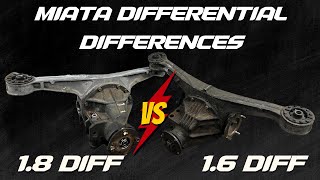
🎬 Watch this guide to compare different Miata differential typesSymptoms of a Failing Differential

Differential failures are rarely sudden. They usually start with subtle noises that get worse over time. Ignoring these signs can lead to a complete failure, which can be dangerous and expensive.
- Whining or Howling Noise: This is the most common symptom. The noise will typically change pitch and volume with vehicle speed, not engine speed. It may be more noticeable during acceleration or deceleration. This is often caused by worn ring and pinion gears.
- Rumbling or Grumbling: A rumbling or grumbling sound that changes with wheel speed often points to worn carrier bearings or wheel bearings. If the noise gets louder when turning one direction, it can help isolate which side bearing is failing.
- Clunking or Banging: A clunk when you shift from drive to reverse, or when you get on or off the gas, can indicate excessive backlash (play) in the gears or worn U-joints in the driveshaft.
- Vibrations: Vibrations that increase with speed can be caused by worn bearings or an out-of-balance driveshaft connected to the differential.
- Fluid Leaks: Leaks from the axle seals, the front pinion seal, or the rear cover gasket are a clear sign of a problem. Low fluid level will quickly lead to overheating and catastrophic failure.
- Burning Smell: A strong, burnt smell from the rear of the car indicates the differential is severely overheating due to low fluid or extreme use. The gear oil may look dark and gritty. 🎬 Watch a mechanic diagnose Miata driveline noises step-by-step
Known Issues, Recalls, and TSBs
For the 1990-1992 Mazda MX-5 Miata and Protege, there are no specific NHTSA recalls or widespread Technical Service Bulletins (TSBs) related to the differential case itself. The recalls issued for these vehicles pertain to other areas, such as aftermarket lights or accessory hardtop hoists.
The most significant known issue is the relative weakness of the 6-inch differential assembly, which can fail even under stock power levels, especially with aggressive driving or high mileage. The VLSD units are particularly known for wearing out and losing their limited-slip capability.
Buying a Used Differential Case: What to Inspect

A used OEM differential is often the most cost-effective solution. Given the age of these vehicles, new units are often discontinued or prohibitively expensive. Here’s what to check before buying a recycled part:
- Identify the Type: First, confirm if you need an open or VLSD unit. Check the axle stubs for the tell-tale ear shape as described above.
- Check for Cracks: Carefully inspect the entire cast iron housing for cracks. Pay close attention to the mounting points where it bolts to the subframe and the bearing caps.
- Spin the Input Flange: The flange where the driveshaft connects should spin smoothly, without grinding or notchiness. A little resistance is normal, but it shouldn't feel rough.
- Check for Play (Backlash): While holding the axles still, try to rotate the input flange back and forth. A very small amount of movement is normal, but excessive play (more than a few degrees of rotation) suggests worn internal gears.
- Look for Leaks: Check for signs of old fluid leaks around the pinion seal (at the front), the axle seals (on the sides), and the rear cover. Staining indicates the seals are bad and will need to be replaced.
- Drain the Fluid (If Possible): If the seller allows, drain a small amount of gear oil. Milky or sludgy fluid indicates water contamination. A large amount of metal shavings (more than a fine paste on the magnetic drain plug) points to severe internal wear.
- Verify Compatibility: Ensure the unit is from a 1990-1993 1.6L Miata or a 1990-1992 4WD Protege. Differentials from later 1.8L Miatas are a popular upgrade but require swapping the driveshaft and axles as well.
Warning: The initial data for this part contained conflicting information about compatibility. Research confirms the same case is used for both open and viscous limited-slip (VLSD) differentials in the 1.6L Miata, but the internal carriers are different. It is crucial to visually verify which type you are buying.
Cost of a Replacement Differential (1990-1992)
| Part Type | Estimated Cost |
|---|---|
| New OEM | $1,500+ (if available, often discontinued) |
| New Aftermarket | Not commonly available as a complete assembly. |
| Used OEM | $150 - $500 (depending on type and condition) |
| Shop Labor | $300 - $600 |
Replacement Difficulty & Procedure Overview
Replacing the differential is a significant job, best suited for experienced DIY mechanics or a professional shop.
- Difficulty: 4 out of 5
- Estimated Time: 3-5 hours
General Steps:
- Safely raise and support the rear of the vehicle on jack stands.
- Remove the rear wheels.
- Drain the differential fluid.
- Disconnect the rear portion of the exhaust for clearance.
- Unbolt the driveshaft from the differential input flange and tie it out of the way.
- Unbolt the axles from the differential stub shafts.
- Support the differential with a jack, then unbolt it from the rear subframe. The differential is connected to the transmission via a large aluminum brace called the Power Plant Frame (PPF), which will also need to be unbolted at the differential.
- Carefully lower the heavy differential assembly from the car.
- Installation is the reverse of removal. It's critical to replace axle seals, the pinion seal, and use a new gasket or sealant for the cover. The PPF has a specific alignment procedure that must be followed to avoid drivetrain vibration.
Frequently Asked Questions (FAQ)
How do I tell if my 1991 Miata has an open diff or a VLSD?
The most reliable way is to look at the axle stubs where the axles bolt to the differential. If the 'ears' on the stubs are symmetrical and uniform, it's an open differential. If they are irregularly shaped, it's a VLSD. You can also try lifting the rear of the car and spinning one wheel. On a healthy VLSD, the other wheel should spin in the same direction. On an open diff, it will spin in the opposite direction. However, a worn-out VLSD may act like an open diff.
Can I swap a stronger 1.8L Miata differential into my 1.6L car?
Yes, this is a very common and highly recommended upgrade. However, it is not a direct bolt-in. To install a 1.8L differential (from a 1994-2005 Miata) into a 1.6L car, you must also use the corresponding 1.8L driveshaft and 1.8L half-shafts (axles). The 1.6L components will not fit the larger 1.8L differential.
What kind of gear oil should I use?
For both the open and VLSD 1.6L differentials, a high-quality API GL-5 75W-90 or 80W-90 gear oil is recommended. If you have a VLSD, make sure the oil is safe for use with viscous limited-slip units; some oils contain friction modifiers for clutch-type LSDs that are not necessary or beneficial for a VLSD.
Is a little bit of whine normal for an old Miata differential?
While many high-mileage Miatas exhibit some level of gear whine, it is not 'normal' in the sense that it indicates a perfectly healthy unit. It is a sign of wear on the ring and pinion gears. If the noise is faint and not getting worse, many owners choose to live with it. However, if it is loud, changes suddenly, or is accompanied by other symptoms like clunking or grinding, it should be inspected immediately.
Helpful Videos
Technical Specifications
OEM Part Numbers: T005-27-231 T00527231 T016-27-200B T01627200B T020-27-100M
Ring Gear Diameter: 6 inches. Standard Gear Ratio (Manual Transmission): 4.30:1.

The information in this article is provided for general reference and educational purposes only. Vehicle specifications, procedures, and part compatibility can vary by production date, trim level, and region. Always consult your vehicle's factory service manual and verify part numbers before purchasing or performing repairs. Safety-critical components such as airbags, seat belts, and braking systems should be installed by a qualified professional.
- Mazda MX-5 Miata:
- Mazda Protege:
- 🎬 Helpful Videos
- Vehicle Compatibility: 1990-1992 Mazda MX-5 Miata & 1990-1992 Mazda Protege 4WD
- Open vs. Viscous Limited-Slip Differential (VLSD)
- Symptoms of a Failing Differential
- Known Issues, Recalls, and TSBs
- Buying a Used Differential Case: What to Inspect
- Cost of a Replacement Differential (1990-1992)
- Replacement Difficulty & Procedure Overview
- Frequently Asked Questions (FAQ)
- 🎟️ Get 5% Off