

2017-2025 Honda CR-V: Solving 'Collision System Problem' & Replacing Radar Sensors
This guide deciphers the common 'Collision Mitigation System Problem' and 'Blind Spot Information System Problem' warnings, covering the front and rear radar sensors.
- Any replacement sensor, whether new or used, absolutely requires professional calibration with specialized tools to function correctly and safely.
- The most common symptoms are dashboard warnings like 'Collision Mitigation System Problem', which can be caused by anything from a dirty sensor to a weak battery or an actual failed part.
- A major NHTSA investigation is underway for 'phantom braking' on 2017-2022 CR-Vs, where the car brakes suddenly for no reason.
- Always match OEM part numbers exactly when buying a used sensor, as parts that look identical may not be compatible across different years or trim levels.
Symptoms of a Failing Collision Avoidance Sensor


Failure in the Honda CR-V's advanced driver-assistance systems (ADAS) almost always begins with a warning message on the driver information interface. While the sensors themselves are generally reliable, they are sensitive to damage, misalignment, and even simple obstructions.
- Dashboard Warning Lights: The most common symptom is a persistent warning message. You will typically see "Collision Mitigation System Problem," "Adaptive Cruise Control Problem," or "Blind Spot Information System Problem." Often, multiple warnings will appear at once, as several safety features rely on the same sensor data.
- Phantom Braking: A widely reported issue involves the Collision Mitigation Braking System (CMBS) applying the brakes suddenly and unexpectedly when there is no obstacle. This has prompted a large-scale NHTSA investigation into nearly 3 million Honda vehicles, including the 2017-2022 CR-V.
- System Unavailability: The systems may simply turn off and become unavailable for use. For example, you may be unable to engage Adaptive Cruise Control, or the blind spot indicator lights in the mirrors will never illuminate.
- False Alerts: The system may provide frequent, unnecessary collision warnings or blind spot alerts, even when no other vehicles are present.
Pro Tip: Before assuming a sensor has failed, thoroughly clean the front grille emblem and the rear bumper corners. Dirt, snow, ice, or even a heavy layer of wax can block the radar signals and trigger a warning message. Also, a weak or dying 12-volt battery is a known cause of random electronic glitches, including ADAS warnings, due to voltage fluctuations.
Known Issues, TSBs, and Recalls

NHTSA Investigation into Phantom Braking
The National Highway Traffic Safety Administration (NHTSA) has upgraded a probe to an Engineering Analysis (a more serious step) concerning unexpected automatic emergency braking in 2017-2022 Honda CR-V and Accord models. The investigation was launched after receiving over 1,200 complaints, including reports of crashes and injuries, related to the CMBS activating without any actual obstruction. This indicates a potential widespread issue with the system's logic or sensor calibration, rather than isolated hardware failures.
Seat Weight Sensor Recall (Not a Radar Sensor)
Many 2017-2022 CR-Vs are part of a major recall (NHTSA ID: 26V332000) for a faulty front passenger seat weight sensor. This sensor can crack and short circuit, potentially causing the airbag to deploy improperly in a crash. While this is a critical safety recall, it is important to note that this part is located in the seat cushion and is not the same as the collision avoidance radar sensors in the grille or bumper.
Buying a Used Collision Avoidance Sensor
Given the high cost of new OEM radar sensors, a used, recycled OEM part is an excellent value. However, these are sensitive electronic components, and careful purchasing is key.
- Match Part Numbers Exactly: This is the most critical step. Honda used many different part numbers throughout this generation, sometimes for the same location (e.g., left rear). A sensor from a different year or trim level may look identical but will not communicate with your vehicle's control modules. Always verify the number on your original part before buying a replacement.
- Physical Inspection: When you receive the used sensor, inspect it carefully. Look for cracks in the plastic housing, damage to the electrical connector pins, and any signs of deep scratches or gouges on the face of the sensor. Do not accept a part with bent or broken mounting brackets, as this indicates it was likely damaged in a collision and may be internally misaligned.
- Ask About the Donor Vehicle: If possible, find out the mileage of the vehicle the part came from. While these sensors don't have mechanical wear parts, choosing one from a lower-mileage vehicle is always preferable.
- Why Used OEM is a Smart Choice: For a safety-critical part like a radar sensor, a recycled OEM unit that has been proven to work is often more reliable than a new, cheap aftermarket alternative. Aftermarket sensors may have different software or hardware tolerances, leading to calibration failures or poor performance.
Warning: Any replacement radar sensor—new or used—will require professional calibration to function. Do not assume it is a simple "plug-and-play" part. Factor the cost of calibration into your budget.
Replacement and Calibration
Difficulty: 4 out of 5. While physically swapping the sensor is straightforward for a mechanic, the mandatory calibration process requires specialized equipment and software that most DIYers do not have.
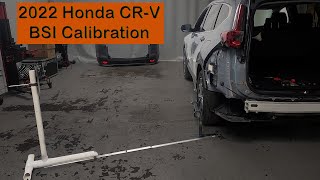
Front Radar (CMBS/ACC): Replacing the front radar involves removing the front grille or bumper cover. After installation, the sensor must be aimed. This can be a static calibration, which uses a specialized stand with a radar reflector target placed at a precise distance and height in front of the vehicle, or a dynamic calibration, which involves driving the vehicle at certain speeds on well-marked roads while the system self-adjusts. A dealer or qualified ADAS shop uses a diagnostic tool like the Honda i-HDS to initiate and verify the procedure. 🎬 Watch this demonstration of Honda front radar camera calibration Some newer models may even require a live internet connection during the dynamic calibration process.
Rear Radars (BSI): These sensors are located behind the rear bumper cover, which must be removed for access. Like the front radar, these also require a specific aiming procedure after installation to ensure they are monitoring the correct zones. This also requires specialized targets and diagnostic software.
Warning: Skipping calibration will result in the system not working and persistent warning lights. More dangerously, an improperly calibrated sensor could fail to detect an obstacle or could cause the vehicle to brake unexpectedly, increasing the risk of a crash.
Cost Comparison
Prices for collision avoidance sensors can vary dramatically. The high cost of new OEM parts makes tested, used OEM sensors a very attractive option.
| Part Type | Estimated Cost |
|---|---|
| New OEM (Front Radar) | $1,500 - $2,500+ |
| New OEM (Rear BSI Sensor) | $700 - $1,100 per side |
| New Aftermarket | $850+ (Limited availability) |
| Used OEM | $70 - $400 |
| Shop Labor (Replacement & Calibration) | $250 - $600+ |
Part Number and Location Guide

The following is a list of known OEM part numbers. This list is not exhaustive, and part numbers are often superseded. Always confirm the part number on your specific vehicle before ordering.
| Part Number | Location | Notes |
|---|---|---|
| 36801-TLA-A06 / 36801-TNY-A03 | Front Grille | Forward radar for ACC/CMBS, fits various 2017-2022 models. | 🎬 Watch a full CR-V radar calibration step-by-step
| 8S303-3A0-A15 / 8S303-3D4-A14 | Front Grille | Forward radar for later model years (approx. 2023-2025). |
| 36930-TLA-A21 / 36930-TLA-A22 | Rear Bumper, Right (Passenger) | Blind Spot Information (BSI) sensor for 2020-2022 models. |
| 36936-TLA-A21 / 36936-TLA-A22 | Rear Bumper, Left (Driver) | BSI sensor. Note that 36936-TLA-A22 replaces A21. |
| 8S411-3A0-A21 | Rear Bumper, Left | BSI sensor for Hybrid models, approx. 2023-2025. Replaces 8S411-3A0-A13. |
Frequently Asked Questions (FAQ)
Can I drive my CR-V with a collision avoidance system problem?
Yes, but with caution. When a warning light is on, the associated safety features like automatic emergency braking, adaptive cruise control, and blind spot monitoring are disabled. The vehicle's normal braking and steering will function, but you will not have the electronic safety net. Drive with increased awareness.
Why did my collision warning light come on for no reason?
The most common cause is a blocked sensor. Heavy rain, snow, ice, mud, or even bugs on the front grille emblem or rear bumper can temporarily disable the system. Try cleaning the sensor areas and restarting the car. A weak car battery can also cause false warnings.
Can I replace a collision avoidance sensor myself?
Physically replacing the sensor is possible for an experienced DIY mechanic, as it involves removing the bumper or grille. However, the mandatory calibration after installation requires expensive, specialized tools and software that only dealerships and qualified ADAS repair shops have. For this reason, it is not considered a feasible DIY job for most people.
Does a used radar sensor need to be calibrated?
Yes. Any time a sensor is removed and reinstalled or replaced, its alignment relative to the vehicle's frame is changed. The system must be recalibrated to ensure it is aimed correctly and can accurately judge distances and locations of other vehicles. There is no way to avoid this step.
Helpful Videos

Technical Specifications
OEM Part Numbers: 36160-TPG-A01 36163-TPG-A02 36930-TLA-A02 36930-TLA-A21 36930TLAA21 36931-TLA-A22 36931TLAA01 36931TLAA21 36935-TLA-A02 36936-TLA-A01 36936-TLA-A21 36936-TLA-A22 8S4103A0A21 8S411-3A0-A13 8S411-3A0-A21 8S411-3A0-K91 36801-TLA-A06 36801-TNY-A03 8S303-3A0-A15 8S303-3D4-A14
The Honda Sensing system utilizes millimeter-wave radar sensors. The forward radar is for Collision Mitigation Braking System (CMBS) and Adaptive Cruise Control (ACC). The rear corner radars are for the Blind Spot Information (BSI) system.
We Have This Part in Stock



The information in this article is provided for general reference and educational purposes only. Vehicle specifications, procedures, and part compatibility can vary by production date, trim level, and region. Always consult your vehicle's factory service manual and verify part numbers before purchasing or performing repairs. Safety-critical components such as airbags, seat belts, and braking systems should be installed by a qualified professional.
- Honda CR-V:
- 🎬 Helpful Videos
- 🛍️ Shop This Part
- Symptoms of a Failing Collision Avoidance Sensor
- Known Issues, TSBs, and Recalls
- NHTSA Investigation into Phantom Braking
- Seat Weight Sensor Recall (Not a Radar Sensor)
- Buying a Used Collision Avoidance Sensor
- Replacement and Calibration
- Cost Comparison
- Part Number and Location Guide
- Frequently Asked Questions (FAQ)
- 🎟️ Get 5% Off