

BMW Driver Assistance Malfunction: 2010-2024 Blind Spot Radar Sensor Guide for X3, X5, 3-Series & More
This guide covers the common failures, replacement costs, and critical calibration needs for the blind spot radar sensors on many popular F-Chassis and G-Chassis BMW models.
- Replacement is NOT plug-and-play. The sensor MUST be professionally coded and calibrated with special equipment (like BMW ISTA) after installation, costing an additional $250-$800+.
- The most common symptom of failure is a 'Lane change warning malfunction' message on the iDrive screen and the mirror warning lights not working.
- Failure is often caused by minor rear-end impacts, water intrusion into the sensor's electronics, or internal failure.
- Buying a used OEM sensor can save over $1,000, but you must verify the exact part number and budget for the mandatory calibration cost.
Understanding Blind Spot Sensor Failure in Your BMW

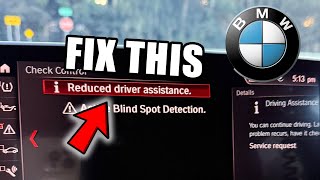
A 'Lane Change Warning Malfunction' or 🎬 Watch: How to fix the Reduced Driver Assistance warning 'Driver Assistance Restricted' message on your iDrive screen is a common issue for owners of many 2010-2024 BMW models, including the X3, X4, X5, X6, 2, 3, 5, and 7 Series. This error typically points to a problem with one of the rear corner-mounted radar sensors. These sensors are critical for your vehicle's active safety systems, but they are exposed to potential damage from minor impacts, road debris, and water intrusion.
This guide will walk you through the symptoms, diagnostic steps, and replacement process, with a special focus on the critical, non-negotiable step of sensor calibration.
F-Chassis vs. G-Chassis Systems: A Key Difference
Before diagnosing, it's important to understand which system your BMW uses. The chassis code (the first three characters of your VIN, e.g., 'WBAF25...' or '5UXG01...') is key.
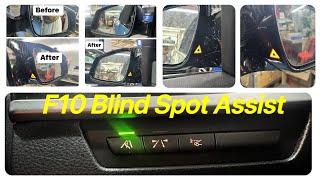
- F-Chassis (Approx. 2010-2019): Models like the F25 X3, F26 X4, F15 X5, and F10 5-Series typically use a Master and Slave sensor setup. The right (passenger side) sensor often acts 🎬 See this F10 Lane Change Warning system overview as the 'master' module, processing data and communicating with the car, while the left (driver side) sensor is the 'slave' that reports to the master. When replacing these, it is crucial to get the correct master or slave unit.
- G-Chassis (Approx. 2016-2024): Newer models like the G01 X3, G02 X4, G20 3-Series, and G30 5-Series use a more integrated network of short-range radar sensors. Instead of a simple master/slave pair for the blind spot system, these vehicles have multiple radar units (often at all four corners) that are part of the larger Advanced Driver Assistance System (ADAS) network.
Most Common Symptoms of Failure

A failing blind spot radar sensor usually makes itself known immediately. Look for these signs:
- iDrive Warning Message: The most common symptom is a 'Lane change warning malfunction,' 'Driver Assistance Restricted,' or similar message appearing on the instrument cluster or main display.
- Inoperative Mirror Lights: The yellow warning triangles in your side mirrors will not illuminate when cars are in your blind spot.
- System Deactivates While Driving: The system may seem to work for a few minutes after starting the car, but then it will fail and display the malfunction message, often once you exceed a certain speed (e.g., 20 km/h).
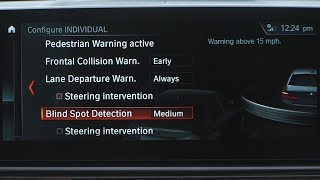
- False Warnings (Less Common): In some cases, a faulty or misaligned sensor can cause the warning triangle to illuminate or flash when no vehicle is present. 🎬 Watch: How BMW's blind spot detection system works
Pro Tip: Before assuming the sensor has failed, thoroughly wash the rear bumper, especially the corners. Heavy dirt, snow, or ice can block the radar signal and cause a temporary error. Also, BMWs are very sensitive to battery health; a weak or aging battery can cause random electronic faults, including driver assistance errors. If your battery is over four years old, have it tested.
Known Issues, TSBs, and Recalls

Technical Service Bulletin (TSB) B662416: False Warnings
For some G12 7-Series models, BMW issued a TSB for false blind spot warnings where the mirror light activates without a car being present. The cause was identified as incorrect scattering of radar waves off the bumper. The fix involves installing a special 'HC2 sensor shield' on the sensor itself. While this TSB is specific to the 7-Series, the principle could apply to other G-chassis models experiencing similar false alerts.
Water Intrusion
The sensors are located in a vulnerable area behind the rear wheels, where they are constantly exposed to water spray. Over time, moisture can penetrate the sensor's housing or electrical connector, causing corrosion and failure. Some repair procedures for other vehicles involve applying a bead of silicone sealant around the connector and housing seam as a preventive measure.
Minor Impact Damage
These sensors are precisely aligned. Even a minor bumper impact that leaves no visible mark can be enough to knock a sensor out of alignment, triggering a malfunction warning. In these cases, the sensor itself may be fine, but it will require professional recalibration.
Buying a Used Collision Avoidance Sensor
Given that a new OEM sensor can cost over $1,200, a used OEM sensor is a smart, cost-effective choice. However, there are critical factors to consider to avoid buying a bad part.
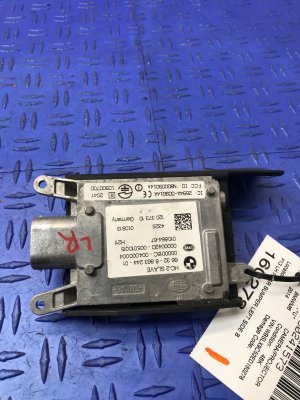
- Verify the Part Number: This is the most important step. Match the part number from your old sensor exactly. For F-Chassis vehicles, be absolutely sure you are buying the correct 'Master' or 'Slave' unit as they are not interchangeable. Sellers often list compatible part numbers and supersessions.
- Physical Inspection: When you receive the part, inspect it carefully. Look for any cracks in the black plastic housing. Check the electrical connector pins to ensure they are straight, clean, and free of any green or white corrosion.
- Ask About the Donor Vehicle: If possible, find out if the donor car had a front or side impact. A part from a car with a clean rear end is always preferable.
- Budget for Calibration: A used sensor is NOT plug-and-play. It will not work until it is professionally coded and calibrated to your car. You MUST factor in this significant additional cost ($250-$800+) when deciding to buy a used part.
- Why Used OEM is Better: For complex electronics like this, a used OEM sensor that has been tested is superior to a cheap, new aftermarket part. Aftermarket sensors may not communicate correctly with your BMW's highly integrated systems, leading to persistent errors. True direct-fit aftermarket replacement sensors for this system are not common; most aftermarket options are complete, standalone kits that are not integrated with the car's iDrive or steering wheel feedback.
Replacement and Calibration Guide

Physically swapping the sensor is a moderately difficult job, but the final calibration step requires expensive, specialized equipment.
- Difficulty: 3/5 (for physical replacement); 5/5 (for required calibration)
- Estimated Time: 1.5 - 2.5 hours for replacement, plus 1-2 hours for calibration.
- DIY Feasible: The physical replacement is possible for an experienced DIYer, but the mandatory calibration is not.
Step 1: Rear Bumper Removal
To access the sensors, the rear bumper cover must be removed. This typically involves:
- Removing screws inside the wheel wells.
- Removing plastic rivets and fasteners along the bottom edge of the bumper and in the trunk area.
- Carefully unsnapping the sides of the bumper from the retaining brackets below the taillights.
- Disconnecting the wiring harnesses for parking sensors and lights before fully removing the bumper.
Step 2: Sensor Replacement
The radar sensors are bolted to brackets on the car's body in the rear corners. Simply unbolt the old sensor, disconnect its electrical plug, and install the new one in its place.
Step 3: Professional Calibration (Mandatory)
Warning: The vehicle is drivable after sensor replacement, but the blind spot system will remain inactive and show a malfunction until this step is completed. Do not skip it.
The car must be taken to a BMW dealer or a qualified independent shop that has ADAS calibration equipment and a subscription to BMW's ISTA software. The technician will perform two actions:
- Coding: The new sensor's identity is programmed to your car's Vehicle Order (VO) so it can communicate on the network.
- Calibration (Aiming): The technician uses special targets placed at precise distances and angles behind the car. The software then adjusts the sensor's digital viewpoint to ensure it is aimed correctly. This ensures the system accurately detects vehicles and doesn't produce false alarms.
Cost Comparison
The mandatory calibration is a major part of the total repair cost. Be sure to get quotes for both the part/labor and the calibration service.
| Item | Estimated Cost |
|---|---|
| New OEM Sensor | $1,200 - $1,600 |
| New Aftermarket Sensor | Not generally available as a direct replacement. Full kits cost $250-$500+. |
| Used OEM Sensor | $75 - $450 |
| Shop Labor (Bumper R&R) | $200 - $400 (Approx. 2 hours) |
| Shop Labor (Calibration) | $250 - $800+ |
| Total Used OEM Repair (Est.) | $525 - $1,650 |
| Total New OEM Repair (Est.) | $1,650 - $2,800+ |
Frequently Asked Questions (FAQ)
Why is calibration so important after replacing a sensor?
Calibration is essential because the sensor needs to be precisely aimed to function correctly and safely. It tells the sensor where 'straight ahead' is relative to the car's centerline. Without proper calibration, the system won't know where to 'look,' and it will remain disabled as a safety precaution.
Can I perform the calibration myself?
No, this is not a DIY task. ADAS calibration requires expensive, specialized equipment including target stands, and access to BMW's proprietary ISTA diagnostic software. It must be done by a trained technician in a controlled environment.
My blind spot warning failed after a minor bumper tap. Do I need a new sensor?
Not necessarily. The impact may have simply knocked the sensor out of alignment. In this case, the sensor itself might be undamaged, but it will require professional recalibration to fix the error. A diagnostic scan is the first step to determine if the sensor is communicating or has internal faults.
What is the difference between a 'Master' and 'Slave' sensor on F-chassis cars?
In the older F-chassis system, the 'Master' sensor (usually on the right/passenger side) acts as the main control unit for the blind spot system. The 'Slave' sensor (left/driver side) reports its data to the Master, which then communicates with the rest of the car. They have different part numbers and are not interchangeable.
Can I use a sensor from an X5 in my 3-Series?
Possibly, but only if the OEM part number is an exact match or listed as a compatible superseded number. Many F-chassis and G-chassis vehicles share sensors, but you must verify compatibility by part number, not just by the model it came from.
Helpful Videos
Technical Specifications
OEM Part Numbers: 66326873351 6873351 66326873352 6873352 66326877835 6877835 66326872645 6872645 66326872646 6872646 66326865884 6865884 66326867157 6867157 66326885041 66325A60304 66325B551E4
24 GHz or 77/79 GHz rear corner-mounted radar sensor. Communicates via vehicle's LIN bus system. Requires vehicle-specific coding and ADAS calibration after installation.
We Have This Part in Stock




The information in this article is provided for general reference and educational purposes only. Vehicle specifications, procedures, and part compatibility can vary by production date, trim level, and region. Always consult your vehicle's factory service manual and verify part numbers before purchasing or performing repairs. Safety-critical components such as airbags, seat belts, and braking systems should be installed by a qualified professional.
- BMW X3:
- BMW X4:
- BMW X5:
- BMW 5 Series:
- BMW X6:
- BMW 7 Series:
- BMW 3 Series:
- BMW 740i:
- BMW 2 Series:
- BMW M3:
- 🎬 Helpful Videos
- 🛍️ Shop This Part
- Understanding Blind Spot Sensor Failure in Your BMW
- F-Chassis vs. G-Chassis Systems: A Key Difference
- Most Common Symptoms of Failure
- Known Issues, TSBs, and Recalls
- Buying a Used Collision Avoidance Sensor
- Replacement and Calibration Guide
- Cost Comparison
- Frequently Asked Questions (FAQ)
- 🎟️ Get 5% Off