

2002-2005 Freelander V6 Ignition Coils: Solving the Front vs. Rear Confusion
This guide clarifies the critical differences between the front and rear bank ignition coils on the 2.5L V6 engine, helping you diagnose failures and buy the correct used part.
- The 2.5L V6 uses two different coils: 'short' coils (NEC000110L) for the front bank and 'long' coils (NEC101010L) for the rear bank. You must verify which one you need before buying.
- Replacing the three front coils is a simple DIY job (1/5 difficulty), while replacing the three rear coils is very difficult (4/5 difficulty) as it requires removing the intake manifold.
- Leaking valve cover gaskets are a common cause of coil failure. If you find oil in the spark plug well, you must also replace the gasket.
- A flashing check engine light indicates a severe misfire that can quickly destroy your catalytic converter, a much more expensive repair.
Symptoms of a Failing Ignition Coil

When an ignition coil starts to fail on your Freelander's V6, the signs are usually obvious. Because each cylinder has its own coil, a single failure will cause a distinct and consistent problem. Look for these common symptoms:
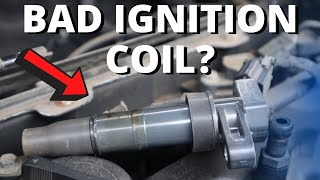
🎬 Watch this overview of common bad ignition coil symptoms- Engine Misfires: This is the most common symptom. The engine will feel like it's stumbling, hesitating, or shaking, especially when idling or accelerating.
- Check Engine Light: A failing coil will almost always trigger the check engine light. An OBD-II scanner will typically show a specific misfire code, such as P0301 for cylinder 1, P0302 for cylinder 2, and so on up to P0306. A general P0300 code indicates a random or multiple-cylinder misfire.
- Reduced Power and Poor Acceleration: With one of the six cylinders not firing correctly, your vehicle will feel noticeably sluggish and weak.
- Worse Fuel Economy: When a cylinder misfires, unburnt fuel may be dumped into the exhaust system. Your engine's computer tries to compensate, but the result is wasted gas and more frequent trips to the pump.
- Difficulty Starting: While less common if only one coil has failed, multiple weak coils can make it harder to start the engine.
Pro Tip: A persistent misfire can damage your catalytic converter, which is an expensive repair. It's best to address a flashing check engine light and misfire symptoms as soon as possible.
Known Issues for 2002-2005 Freelander V6 Coils

The most significant issue for this vehicle isn't the quality of the coils themselves, but the confusion surrounding the different parts required for the front and rear cylinder banks. This is the #1 mistake buyers make.
The Critical 'Short' vs. 'Long' Coil Difference
The 2.5L KV6 engine is mounted transversely (sideways) in the Freelander. This creates a 'front' bank of cylinders (closest to the radiator) and a 'rear' bank (closest to the firewall). Due to engine design and clearance, they use two physically different ignition coils:
- Front Bank (Cylinders 2, 4, 6): This bank uses the 'short' boot ignition coils. The most common part number for this coil is NEC000110L. These are extremely easy to access and replace.
- Rear Bank (Cylinders 1, 3, 5): This bank uses the 'long' boot ignition coils. A common part number for this coil is NEC101010L. These coils are much more difficult to access, as they are located underneath the upper intake manifold.
Warning: The part numbers NEC000070 and NEC000070L are often associated with this engine but can be ambiguous in listings. Always confirm whether you are buying a 'short' or 'long' coil based on visual comparison or the specific bank you are working on. Do not rely on part numbers alone.
Other Common Problems
- Oil Contamination: A leaking valve cover gasket can allow engine oil to seep into the spark plug wells. This oil will soak the coil boot, causing it to swell and degrade, eventually destroying the ignition coil. If you find oil when you pull a coil, you must replace the valve cover gasket to prevent repeat failures.
- Heat Failure: The rear bank of coils is especially prone to failure from sustained heat, as they are tucked under the intake manifold with less airflow.
Buying a Used 2002-2005 Freelander Ignition Coil

A used OEM coil is often a better choice than a cheap new aftermarket part, as the original coils (often made by Champion or BMW suppliers) have superior internal electronics and materials. Here’s what to check before buying:
- Identify the Correct Type: First, determine if you need a 'short' front coil or a 'long' rear coil. The only way to be 100% sure is to remove the failed coil from your vehicle and match it visually. Do not order a part until you have the old one in your hand.
- Inspect the Plastic Housing: Look for any fine cracks, melting, or white/black 'carbon tracking' marks. These are signs of electrical arcing and mean the coil is bad.
- Check the Rubber Boot: The boot should be flexible and clean. If it's swollen, gummy, or soaked in oil, it's a sign it was exposed to a valve cover leak and should be avoided.
- Examine the Connector: The electrical connector pins should be clean and free of any green or white corrosion. The plastic locking tab should be intact.
- Verify Part Numbers: If possible, match the OEM part number printed on the coil. Key numbers to look for are NEC000110L (short) and NEC101010L (long).
Replacement Overview & Difficulty

The difficulty of this job depends entirely on which coil has failed.
- Front Coils (Cylinders 2, 4, 6): This is a very easy job. Difficulty: 1/5. It involves removing the plastic engine cover, unplugging the electrical connector, removing a single 8mm bolt, and pulling the coil straight out. The entire process for one coil can take less than 15 minutes. 🎬 Watch how to remove and test Freelander coil packs and spark plugs
- Rear Coils (Cylinders 1, 3, 5): This is a much more involved job. Difficulty: 4/5. To access the rear coils, the entire upper intake manifold (plenum) must be removed. This is not a simple task for a beginner and requires replacing the intake manifold gaskets at the same time. This job can take 2-4 hours for an experienced mechanic.
Pro Tip: While you are replacing the coils, it is highly recommended to also replace the spark plugs. Furthermore, if one coil has failed due to age, the others are likely not far behind. Many owners choose to replace all three coils on a bank at the same time to avoid future repeat repairs, especially on the difficult-to-access rear bank.
Cost Comparison
| Part Type | Price Range (Per Coil) | Notes |
|---|---|---|
| New OEM | $90 - $120 | Genuine Land Rover or Champion-branded part from a dealership. |
| New Aftermarket | $35 - $70 | Prices vary widely by brand. Quality can be inconsistent. |
| Used OEM | $20 - $50 | A cost-effective option that retains original equipment quality. |
| Shop Labor (Front Coil) | $75 - $100 | Typically a minimum one-hour diagnostic/labor charge. |
| Shop Labor (Rear Coils) | $250 - $500+ | Labor is significantly higher due to the need to remove the intake manifold. |
Recalls and Technical Service Bulletins (TSBs)
As of this writing, there are no specific NHTSA recalls for ignition coils on the 2002-2005 Land Rover Freelander. However, TSB #08142007 was issued on August 14, 2007, for customers experiencing a check engine light (MIL) or a no-start condition, which can be related to ignition system faults. Always check for the latest recall information using your vehicle's VIN.
Frequently Asked Questions (FAQ)
Can I replace just one bad ignition coil?
Yes, you can replace just the single failed coil. This is a common repair, especially for the easily accessible front bank. However, if the coils are original and high-mileage, it's wise to consider replacing them as a set (or at least in a bank of three) to prevent another failure soon after.
Why are the front and rear coils different on the Freelander V6?
The front and rear coils are different lengths to accommodate the physical packaging of the 2.5L KV6 engine. The rear bank, tucked under the intake manifold, requires a longer coil and boot assembly (NEC101010L) to reach the spark plugs, while the more open front bank uses a shorter design (NEC000110L).
What else should I replace when doing the rear ignition coils?
Because you must remove the upper intake manifold to access the rear coils, it is essential to replace the intake manifold gaskets. This is also the perfect time to replace all three rear spark plugs and coils at once to avoid having to do the labor-intensive job again in the near future.
How do I find out which cylinder is misfiring?
The easiest way is to use an OBD-II code reader. It will give you a code from P0301 to P0306, where the last digit indicates the misfiring cylinder number. If you don't have a scanner, you can perform a 'swap test': swap the suspect coil with a known good coil from another cylinder. If the misfire code follows the coil to the new cylinder, you've confirmed the coil is bad.
Helpful Videos
Technical Specifications
OEM Part Numbers: C1676 12131404309 12131703228 12131748018 12137599219 12139067830 NEC000070 NEC000070L NEC000110 NEC000110L NEC101000 NEC101000L NEC101010L NEC101010
System Type: Coil-on-Plug (COP). Connector: 3-Pin. Two distinct physical types: 'Short' boot for front bank (cylinders 2, 4, 6) and 'Long' boot for rear bank (cylinders 1, 3, 5).

The information in this article is provided for general reference and educational purposes only. Vehicle specifications, procedures, and part compatibility can vary by production date, trim level, and region. Always consult your vehicle's factory service manual and verify part numbers before purchasing or performing repairs. Safety-critical components such as airbags, seat belts, and braking systems should be installed by a qualified professional.
- Land Rover Freelander:
- 🎬 Helpful Videos
- Symptoms of a Failing Ignition Coil
- Known Issues for 2002-2005 Freelander V6 Coils
- The Critical 'Short' vs. 'Long' Coil Difference
- Other Common Problems
- Buying a Used 2002-2005 Freelander Ignition Coil
- Replacement Overview & Difficulty
- Cost Comparison
- Recalls and Technical Service Bulletins (TSBs)
- Frequently Asked Questions (FAQ)
- 🎟️ Get 5% Off