

2019-2023 Mazda 3 Front Bumper: Decoding Sedan, Hatchback, and Sensor Variants
This guide explains the critical differences in front bumpers for the 4th Gen Mazda 3, helping you buy the right part and avoid costly sensor-related mistakes.
- Before buying, you must verify your Mazda 3's body style (Sedan/Hatchback), build location (VIN starts with 'J' for Japan or '3' for Mexico), and sensor package.
- The grille finish (gloss vs. matte black) is a key visual indicator for the presence of advanced safety systems like Lane Keep Assist, and these versions are not interchangeable.
- When buying used, prioritize checking for intact mounting tabs and avoiding parts with previous filler repairs, as this can affect fitment and sensor performance.
- Replacing the bumper may require ADAS sensor recalibration by a professional, which can be a significant hidden cost.
Key Bumper Variations for 2019-2023 Mazda 3


Choosing the correct front bumper for a 4th Generation Mazda 3 is complex. There are three major variations you must identify before purchasing a replacement. Ordering the wrong bumper will result in fitment issues, non-functional safety systems, and additional costs.
Warning: Before you buy, you MUST confirm your vehicle's body style, build location, and sensor package. These are not interchangeable.
1. Body Style: Sedan vs. Hatchback
The front bumpers for the Sedan and Hatchback models are shaped differently and have unique mounting points. They are not cross-compatible.
- Sedan Bumper: Designed to flow with the Sedan's specific body lines.
- Hatchback Bumper: Features different contours to match the more aggressive front fascia of the Hatchback.
2. Build Location: Japan vs. Mexico
The 2019-2023 Mazda 3 was produced in two different factories, and this affects the front bumper assembly. While they look nearly identical, bumpers for Japan-built and Mexico-built cars use different mounting brackets and retainers. Using a bumper from a car with a different build origin may result in poor fitment and alignment issues.
- How to check: Look at the first character of your Vehicle Identification Number (VIN). A 'J' indicates it was built in Japan, while a '3' indicates it was built in Mexico.
3. Sensor & Grille Configuration
The equipment level of your Mazda 3 determines which sensors are housed in the bumper. This is the most common and costly mistake buyers make.
- Lane Keep Assist (LKA) / Smart Brake System (SBS): Vehicles with these features have a different grille and sensor mounts. The easiest way to identify this is by the grille finish. Higher-trim models with these systems typically feature a gloss black grille.
- Base Models: Models without these advanced safety features usually have a matte or standard black grille and lack the specific sensor brackets behind the bumper cover.
- Parking Sensors: Some trims are equipped with ultrasonic parking sensors, which require corresponding holes in the bumper cover. A bumper without these holes cannot be easily modified, and a bumper with them will have unsightly empty holes if your car doesn't have the sensors.
Symptoms of a Failing or Damaged Bumper Assembly

Beyond obvious collision damage, other issues can arise from a compromised front bumper.
- Visible Damage: Cracks, deep scuffs, punctures, or broken tabs are the most common signs of failure.
- Poor Panel Alignment: A large or uneven gap between the bumper and the headlights, hood, or fenders can indicate broken mounting tabs or a bent bumper reinforcement bar.
- Dashboard Warning Lights: If your vehicle is equipped with ADAS, damage to the bumper can misalign or harm the sensors within. This can trigger warning lights for the Smart Brake System (SBS), Lane Keep Assist (LKA), or parking sensors.
- Wind Noise: A loose or improperly fitted bumper can catch air at speed, leading to unusual whistling or rushing sounds from the front of the car.
Known Issues, TSBs, and Recalls

As of this writing, there are no recalls or widespread Technical Service Bulletins (TSBs) directly related to the front bumper structure itself for the 2019-2023 Mazda 3. However, there are related items to be aware of:
- Smart Brake System (SBS) Recall (NHTSA #20V487): Some 2019-2020 models were recalled because the SBS could falsely detect an obstacle and apply the brakes unexpectedly. This is a software and sensor issue, not a bumper fault, but highlights the sensitivity of the systems housed within the bumper.
- Rattle from Passenger Dash (TSB #S2201BRX): Some owners report a rattle from the passenger side of the dashboard, which can be mistaken for a loose bumper component. This is often related to the passenger airbag module and is covered by a TSB.
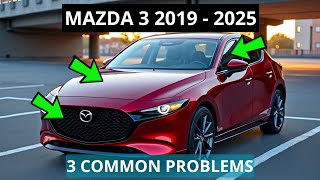
- Subframe Bolt Rust (TSB #02-003/24): A TSB was issued for rusting subframe bolts that can cause a loud banging or rattling noise from the front end when going over bumps. This sound could be misdiagnosed as a loose bumper or undertray. 🎬 Watch: Overview of common 4th Gen Mazda 3 problems
Buying a Used 2019-2023 Mazda 3 Front Bumper

A used OEM bumper is often a better choice than a new aftermarket one due to superior fit, material quality, and sensor compatibility. Here’s what to check:
Pro Tip: Before you start shopping, take photos of your car's VIN (for build location), front grille (for LKA/SBS), and any parking sensors. This will be your reference to ensure you buy the correct part.
Inspection Checklist:
- Verify the Part's Origin: First, confirm the donor vehicle matches your car's body style (Sedan/Hatch) and build location (Japan/Mexico).
- Check All Mounting Tabs: Carefully inspect all tabs along the top (where it meets the grille and headlights), sides (where it meets the fenders), and bottom. These are often thin and break easily. A bumper with broken tabs will never align correctly.
- Look for Previous Repairs: Check the backside of the bumper for signs of plastic welding, fillers (like Bondo), or excess glue. A repaired bumper may not have the correct structural integrity, and thick paint or filler can interfere with ADAS sensor readings.
- Inspect Sensor Brackets: If your car has LKA or parking sensors, ensure the corresponding mounting brackets on the inside of the bumper are intact and not cracked or modified.
- Confirm Grille and Sensor Holes: Double-check that the grille type (gloss/matte) and the presence (or absence) of parking sensor holes match your vehicle's requirements.
Replacement Overview
Replacing the front bumper on a 4th Gen Mazda 3 is a manageable DIY project for those with basic mechanical skills.
- Difficulty: 3 out of 5
- Time: 1.5 - 2.5 hours
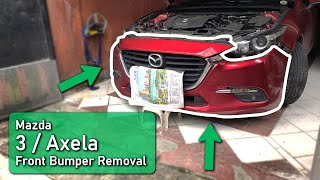
- Tools: 8mm and 10mm sockets, Phillips screwdriver, plastic trim removal tools, flathead screwdriver. 🎬 Watch: DIY step-by-step Mazda 3 front bumper removal
The general process involves removing a series of plastic clips and screws from the top, bottom, and inside the wheel wells. After fasteners are removed, the bumper sides are carefully popped out of the retaining clips under the headlights. If you have fog lights or sensors, their electrical connectors must be disconnected before the bumper can be fully removed.
🎬 See another helpful video on removing the front bumperADAS Recalibration: Mazda states that if the front bumper area containing the radar sensor is damaged or replaced, the sensor may need to be replaced and/or recalibrated by a qualified dealer or shop. While a simple removal and reinstallation for access might not require it, replacing the bumper due to an impact makes recalibration a strong possibility to ensure safety systems function correctly. This can add significant cost to the repair.
Cost Comparison
Prices can vary based on condition, configuration, and location. These are general estimates.
| Part Type | Estimated Cost | Notes |
|---|---|---|
| New OEM (Unpainted) | $380 - $580 | Price from Mazda dealership parts counters. Requires painting. |
| New OEM (Pre-Painted) | $1,050 - $1,200 | Offered by third-party services that paint a new OEM part to match your VIN. |
| New Aftermarket (Unpainted) | $180 - $300 | Fitment and quality can be inconsistent. May not be suitable for vehicles with ADAS sensors. |
| Used OEM | $200 - $500 | Best value. Price depends on condition and whether it's already the correct color. |
| Shop Labor (Installation) | $200 - $400 | Does not include painting or ADAS calibration. |
| Shop Labor (Paint) | $300 - $600 | Cost to paint a new unpainted bumper. |
| ADAS Calibration | $250 - $700 | If required. Typically must be done at a dealer or specialized shop. |
Frequently Asked Questions
How do I know if my Mazda 3 was built in Japan or Mexico?
Check the first digit of your car's 17-digit VIN. If it starts with a 'J', it was assembled in Japan. If it starts with a '3', it was assembled in Mexico. This is crucial for ensuring part compatibility.
Can I install a bumper with parking sensor holes on my car that doesn't have them?
You can, but you will have empty holes where the sensors would be. It is better to find a bumper cover that matches your car's original specifications without the sensor holes.
Do I need to get my sensors recalibrated after replacing the front bumper?
According to Mazda's official position, if the bumper is replaced, especially due to damage, recalibration of the forward-facing radar and other ADAS sensors is recommended to ensure they function correctly. Failure to do so could compromise the safety systems. Always consult with a professional technician.
Can I just upgrade my base model to the gloss black grille from a premium model?
While it may be physically possible, it is not a simple swap. The grilles are often integrated with the bumper assembly and designed for different sensor packages. Attempting this swap may be more complex and expensive than anticipated and is not a direct fit.
Will a used bumper match my car's paint color perfectly?
Probably not. Even if you find a bumper from a car with the same paint code, factors like sun exposure, age, and batch variations mean the color may be slightly different. For a perfect match, the new or used bumper will likely need to be professionally painted and blended with the adjacent panels.
Helpful Videos

Technical Specifications
OEM Part Numbers: BCJH-50-031-BB BCJH-50-070A BCJH-50-070B BCKA-50-031-BB BCKA-50-031A-BB BCKA-50-031E-BB BCKB-50-031-BB BCKB-50-031D-BB BCKB-50-031E-BB BCKN-50-031-BB BCKN-50-031D-BB BDTS-50-031E-BB
Variations exist for Sedan/Hatchback, Japan/Mexico build, and with/without provisions for Lane Keep Assist and parking sensors.

The information in this article is provided for general reference and educational purposes only. Vehicle specifications, procedures, and part compatibility can vary by production date, trim level, and region. Always consult your vehicle's factory service manual and verify part numbers before purchasing or performing repairs. Safety-critical components such as airbags, seat belts, and braking systems should be installed by a qualified professional.
- Mazda 3:
- 🎬 Helpful Videos
- Key Bumper Variations for 2019-2023 Mazda 3
- 1. Body Style: Sedan vs. Hatchback
- 2. Build Location: Japan vs. Mexico
- 3. Sensor & Grille Configuration
- Symptoms of a Failing or Damaged Bumper Assembly
- Known Issues, TSBs, and Recalls
- Buying a Used 2019-2023 Mazda 3 Front Bumper
- Inspection Checklist:
- Replacement Overview
- Cost Comparison
- Frequently Asked Questions
- 🎟️ Get 5% Off