

2018-2020 Jaguar F-TYPE Battery Junction Block: Solving Power Loss and Electrical Faults
This guide covers the common failure points, part number variations, and critical diagnostic steps for the battery junction block on 2.0L, V6, and V8 F-TYPE models.
- Fitment is critical. Multiple part numbers exist. You MUST match the number on your original part before buying a replacement.
- Many F-TYPE electrical issues are caused by a weak battery, not a faulty junction block. Fully charge and test your battery first.
- The junction block itself does not need programming, but a Battery Monitoring System (BMS) reset is recommended after installation to prevent charging problems.
- A key failure mode is an internally cracked mega fuse, which can cause intermittent power loss but may not be visibly broken.
Function and Location
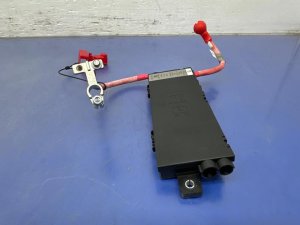
The battery junction block is the main hub for distributing power from the battery to the rest of the vehicle. Located in the trunk under the floor panel, it is typically a black plastic housing connected to the positive battery terminal. Its primary job is to protect major electrical circuits. A failure here can mimic a dead battery, but the symptoms are often more erratic.
Known Issues and Vehicle-Specific Problems
While the junction block itself can fail, many electrical issues on the F-TYPE are related to the battery's state of charge. These cars are extremely sensitive to low voltage, and a weak battery can cause a wide range of bizarre electrical problems that may be mistaken for a faulty component.
- Parasitic Drain: A common issue is a parasitic battery drain that occurs when one of the vehicle's electronic modules fails to go to sleep. This has been frequently reported after using an OBD-II diagnostic scanner, which can keep the system 'awake' and drain the battery over a few days.
- Internal Fuse Failure: A Technical Service Bulletin (TSB) applicable to many vehicles describes how internal vibrations can cause the metal element inside a mega fuse to crack. This failure is not visible from the outside, and the fuse may even test good with a continuity tester, but it will fail under load, causing sudden, intermittent power loss.
- Water Intrusion: At least one owner has reported finding their 'Starter Junction Box' full of water, leading to corrosion and complete electrical failure. Given its location in the trunk, any water leaks in the rear of the vehicle can put this component at risk.
Pro Tip: Before suspecting the junction block, ensure your battery is fully charged with a quality charger and has been load-tested. Many electrical gremlins on the F-TYPE disappear with a healthy, fully charged battery.
Symptoms of a Failing Battery Junction Block
When this part fails, the symptoms are often related to a major loss of power. You might experience:
- Complete No-Start, No-Power: The vehicle is completely dead, as if the battery were disconnected.
- Intermittent Power Loss: The car may lose all power and then suddenly get it back. This can happen while driving or when trying to start the engine.
- Flickering Lights and Gauges: Unstable power from a failing fuse can cause the dashboard lights and interior/exterior lights to flicker or dim.
- Multiple, Unrelated Warning Lights: A sudden drop in system voltage can cause various modules to report errors, lighting up the dashboard like a Christmas tree.
- Clicking Sounds: A rapid clicking from relays can occur as they cycle on and off due to an unstable power supply.
- Engine Cranks Weakly or Not at All: Even with a known-good battery, the starter may not get enough power to turn the engine over.
Buying a Used Battery Cable Junction Block
A used OEM junction block is a reliable and cost-effective replacement. Aftermarket versions are not common for this part, and a used original part ensures perfect fitment and OEM quality. When inspecting a used part, look for the following:
- Verify the Part Number: This is the most critical step. Several different junction blocks were used on the F-TYPE, varying by model year and body style (coupe vs. convertible). The initial warning about 2.0L vs 3.0L engines may be an oversimplification, as some parts catalogs show the same part number used across all engines for a given body style. Always match the part number on your original block (e.g., JX5314516AC, T2R24240, T2R18892) to the replacement part.
- Check for Corrosion: Inspect all metal studs, nuts, and connection points for any signs of green or white corrosion. Corrosion creates resistance and can cause the same problems as a failed fuse.
- Look for Physical Damage: Check the plastic housing for cracks, melting, or scorch marks. Any sign of heat damage indicates a previous short circuit, and the part should be avoided.
- Intact Connectors: Ensure all plastic connector housings and locking tabs are intact and not brittle.
Cost Breakdown
| Part Type | Estimated Cost |
|---|---|
| New OEM | $380 - $450 |
| New Aftermarket | Not Generally Available |
| Used OEM | $50 - $150 |
| Shop Labor | $100 - $200 |
Programming & Installation Notes
The junction block itself does not require any programming or flashing. It is a direct-swap component. However, the procedure involves disconnecting the battery, which can require some follow-up steps.
- Battery Disconnection: Always disconnect the negative battery terminal first. Be aware that on the F-TYPE, the trunk is electronically operated. If you disconnect the battery and close the trunk, you will be locked out. Prop the trunk lid open or use the emergency release pass-through if your vehicle has one.
- Battery Monitoring System (BMS) Reset: The F-TYPE uses a BMS with a sensor on the negative battery terminal to monitor battery health and control charging. After disconnecting power for a repair or replacing the battery, it is highly recommended to perform a BMS reset using a compatible diagnostic tool (like iCarsoft for Jaguar). This tells the system to re-learn the battery's parameters and can prevent future 'Charging System Fault' messages or drain issues.
- Window and Module Reset: After reconnecting the battery, you will likely need to reset the one-touch auto-up window function. To do this, simply run each window all the way down, then all the way up, holding the switch for a few seconds in the up position until you hear a faint click.
Frequently Asked Questions (FAQ)
Do I need to program a new battery junction block?
No, the junction block itself is a non-programmable part. However, it is best practice to perform a Battery Monitoring System (BMS) reset after the repair to ensure the vehicle's charging system functions correctly.
Can a bad junction block drain my battery?
A bad fuse within the block will not drain the battery; it will simply interrupt the circuit. However, corrosion or water damage creating a short circuit within the block could potentially cause a drain. More commonly, battery drain issues on the F-TYPE are caused by other modules not entering sleep mode.
Why does my car have no power even with a good battery?
This is a classic symptom of a failed main fuse inside the battery junction block. The fuse acts as a bridge between the battery and the rest of the car's electrical system. If it fails, power cannot be distributed, even if the battery is fully charged.
Is this a DIY-friendly repair?
Yes, for a mechanic with basic experience. The part is easily accessible in the trunk. The replacement involves unbolting a few cables and the housing itself. The main challenges are ensuring you have the correct replacement part and taking precautions not to lock yourself out of the trunk.
Technical Specifications
OEM Part Numbers: JX5314516AC T2R18892 T2R24240 EX5314A076
Contains multiple high-amperage mega fuses for main circuit protection.
We Have This Part in Stock

The information in this article is provided for general reference and educational purposes only. Vehicle specifications, procedures, and part compatibility can vary by production date, trim level, and region. Always consult your vehicle's factory service manual and verify part numbers before purchasing or performing repairs. Safety-critical components such as airbags, seat belts, and braking systems should be installed by a qualified professional.
- Jaguar F-TYPE: