

1997-2003 BMW 540i Axle Shafts: Decoding Automatic, Manual & Sport Model Differences
This guide clarifies the critical differences in axle shafts for automatic, manual, and Sport package E39 540i models to ensure you get the right part the first time.
- Fitment is critical and complex; verify if you need an axle for a standard automatic, manual, or Sport package automatic, as the inner flange diameters (94mm vs 102mm) differ.
- When buying a used axle, the condition of the rubber CV boots is the most important factor. Any tear means the joint is compromised.
- The large 36mm axle nut is a one-time-use part and MUST be replaced with a new one during installation to prevent catastrophic failure.
- A clicking noise when turning is the classic sign of a bad outer CV joint, while vibration under acceleration often points to a bad inner joint.
Variant Differences: The Key to Compatibility

Choosing the correct axle shaft for a 1997-2003 BMW 540i is more complicated than for many other vehicles. The correct part depends on the car's transmission type (automatic or manual) and, in some cases, specific option packages. The primary physical difference is the diameter of the flange that bolts to the differential. Using the wrong axle will result in it not fitting.
Warning: Before ordering, you must verify your vehicle's transmission and, if possible, measure the bolt-circle diameter of your existing axle's inner flange. This is the most common point of error for this part.
Here is a breakdown of the known variations:
- 540i with Automatic Transmission (Standard): These models typically use axles with a 94mm inner flange that mates to a differential with a 2.81 gear ratio.
- 540i with Automatic Transmission and Sport Package (S204A): These vehicles came with a 3.15 gear ratio differential and use larger, heavy-duty axles with a 102mm inner flange. 🎬 See how E39 axle and diff upgrades work. The part number for these specific axles is often cited as 33207508137.
- 540i with Manual Transmission: These models generally use axles designed for the 2.81 gear ratio differential, which typically corresponds to the 94mm flange size.
The M5 model uses different axles entirely and they are not interchangeable with 540i parts.
Symptoms of a Failing Axle Shaft

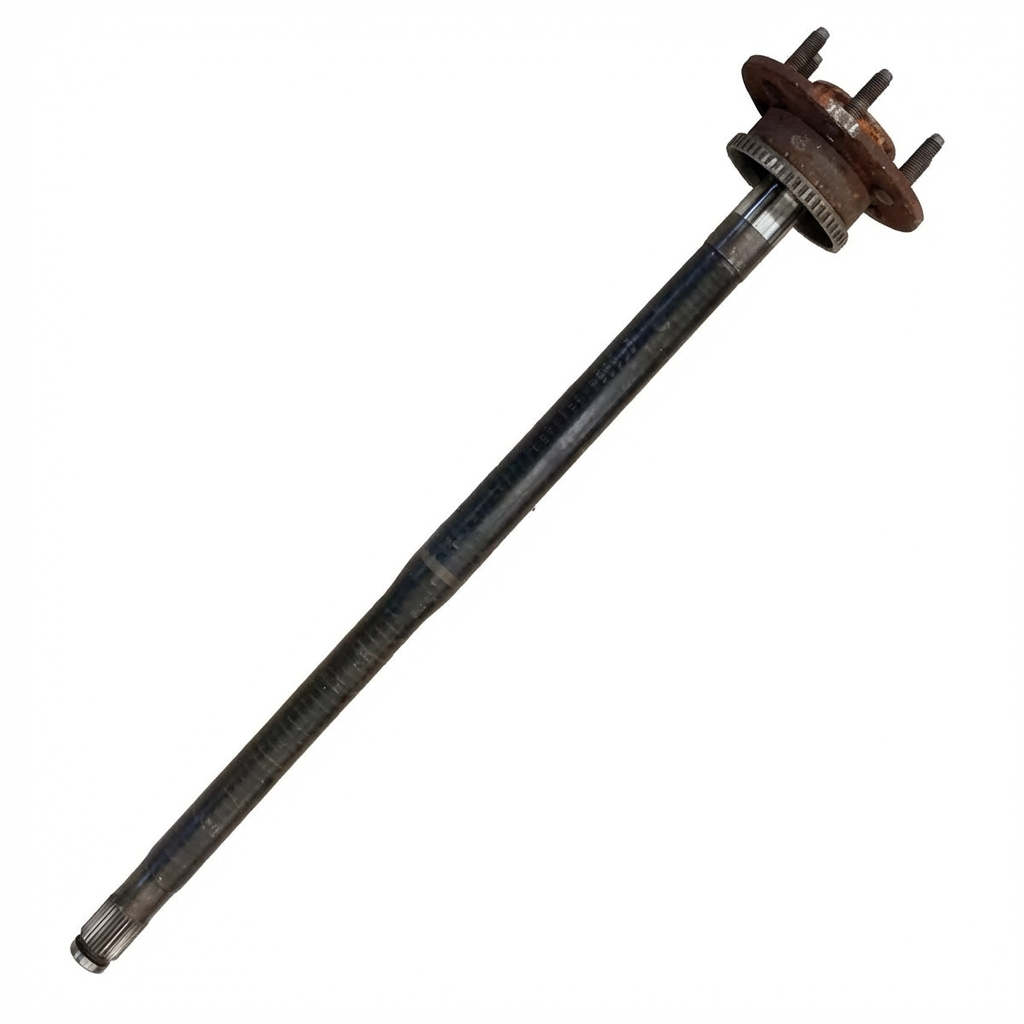
Axle shaft failure usually begins with the CV joints. The most common cause is a torn or damaged CV boot, which allows the lubricating grease to escape and dirt and moisture to enter, quickly destroying the joint.
- Clicking or Popping Noise When Turning: This is the classic sign of a worn outer CV joint. The sound is most noticeable during sharp, low-speed turns, like in a parking lot.
- Clunking on Acceleration or Deceleration: A clunking sound when you get on or off the gas, or when shifting between Drive and Reverse, can indicate excessive play in the inner or outer CV joints.
- Vibration While Driving: A vibration that increases with speed can be caused by a worn inner CV joint or a bent axle shaft. This may be more noticeable under acceleration.
- Grease on Inner Wheel or Undercarriage: If you see dark, thick grease splattered on the inside of your wheel, on the brake components, or on the suspension, it's a clear sign that a CV boot has torn. This is a warning that the joint will fail soon if not addressed.
Pro Tip: To diagnose, safely raise the rear of the vehicle. With the transmission in neutral, rotate the axle by hand and feel for any notchiness or binding in the joints. Try to twist the shaft back and forth; excessive rotational play indicates wear. Carefully inspect the rubber boots for any cracks, tears, or loose clamps.
Buying a Used Axle Shaft for a BMW 540i

A high-quality, low-mileage used OEM axle is often a better choice than a new, cheap aftermarket part. Original BMW axles are made from high-quality steel and are well-balanced. Many aftermarket options can introduce vibrations or fail prematurely. Here’s what to look for:
- Confirm Fitment Above All Else: Double-check the part number and flange size required for your specific 540i (Automatic, Manual, or Sport). If buying locally, bring a tape measure to verify the flange diameter.
- Inspect the CV Boots: This is the most critical inspection point. The rubber boots must be perfectly intact. Squeeze them to check for hidden cracks. If a boot is torn, assume the CV joint is contaminated and will fail. While boot kits are available, the labor is intensive and the joint may already be damaged.
- Check the Joints for Smoothness: Hold the axle and move both the inner and outer joints through their full range of motion. They should feel smooth and consistent, with no grinding, notchiness, or tight spots.
- Look for Shaft Damage: Inspect the shaft itself for any signs of being bent, dented, or heavily corroded. A bent shaft will cause immediate vibration.
- Check for Play: Hold one end of the axle firmly and try to move the other end. There should be very little in-and-out (plunging) play in the inner joint and almost no rotational play. Any significant clunking is a red flag.
Rebuild vs. Replace
For the E39, rebuilding an axle is possible but has limitations. The inner CV joint can be replaced as a separate component. However, the outer CV joint is permanently attached to the shaft and cannot be replaced separately; if the outer joint is bad, the entire axle shaft must be replaced. Given the labor involved in rebuilding and the availability of complete used assemblies, most owners and shops opt to replace the entire shaft. Rebuilding only makes sense if you are simply replacing a torn boot on an otherwise healthy joint.
🎬 Watch this step-by-step E39 axle rebuild video.Replacement Overview and Torque Specs

Replacing the axle shaft is a feasible DIY job for an experienced mechanic with the right tools. The process involves removing the wheel, brake caliper, and rotor to access the large central axle nut.
- Safely raise and support the vehicle.
- Remove the wheel.
- Use a chisel or punch to unstake the large axle nut.
- With the car on the ground or an assistant holding the brakes, use a 36mm 12-point socket and a large breaker bar to remove the axle nut. It is extremely tight.
- Raise the vehicle again. Remove the six E12 Torx bolts holding the inner CV joint to the differential flange. You will need to rotate the axle to access all of them.
- Push the axle out of the wheel hub and remove it from the car. 🎬 Watch a full E39 axle replacement tutorial.
Warning: The large 36mm axle nut is a one-time-use, self-locking nut and must be replaced with a new one upon installation. Reusing the old nut can lead to it backing off, causing catastrophic failure of the wheel bearing and hub assembly.
| Fastener | Torque Spec | Notes |
|---|---|---|
| Rear Axle Nut (36mm) | 221 lb-ft (300 Nm) | Must use a new nut. After torquing, stake the nut into the axle groove. |
| Inner Flange Bolts (E12) | 52 Nm (approx. 38 lb-ft) | Recommended to use new bolts. Apply thread locker. |
| Wheel Lug Bolts | 120 Nm (88 lb-ft) | Tighten in a star pattern. |
Known Issues, Recalls, and TSBs
There are no specific recalls or Technical Service Bulletins (TSBs) from BMW directly addressing the axle shafts for the 1997-2003 540i. Failures are typically age- and wear-related, most often stemming from torn CV boots. The vehicle is subject to the widespread Takata airbag recall, and owners should ensure this has been addressed.
Cost Comparison
| Part/Service | Estimated Cost |
|---|---|
| New OEM (BMW) | $650 - $900+ |
| New Aftermarket | $100 - $300 |
| Used OEM | $75 - $250 |
| Shop Labor (per side) | $140 - $250 |
Frequently Asked Questions
Can I just replace the torn CV boot?
Yes, you can replace just the boot if you catch the tear very early before dirt and water have contaminated the joint's grease. However, it is a labor-intensive job that requires removing the axle from the car and disassembling the inner CV joint. If the joint is already making noise, replacing the boot will not fix it.
Are the left and right axle shafts the same?
Yes, for the E39 540i, the left and right rear axle shafts are typically the same part and are interchangeable, provided you have the correct part for your transmission/differential combination.
My car vibrates at high speed. Is it the axle?
It could be, especially if the vibration is more noticeable during acceleration. However, high-speed vibrations are more commonly caused by an unbalanced wheel/tire, a bent wheel, or a failing driveshaft center support bearing or guibo (flex disc). A thorough inspection is needed to pinpoint the cause.
How do I measure the axle flange?
The flange measurement refers to the diameter of the bolt circle on the inner CV joint where it attaches to the differential. The easiest way to measure is to go from the center of one bolt hole directly across to the center of the opposing bolt hole.
Helpful Videos

Technical Specifications
OEM Part Numbers: 1229513 33201229377 33201229380 33201229513 33207507614 33207508137 33211229377 33211229748 33211229749 7507614 7508137
Inner Flange Bolt Circle Diameter: 94mm (Standard Auto/Manual) or 102mm (Sport Auto). Axle Nut Size: 36mm 12-point. Inner Flange Bolts: E12 External Torx.
We Have This Part in Stock

The information in this article is provided for general reference and educational purposes only. Vehicle specifications, procedures, and part compatibility can vary by production date, trim level, and region. Always consult your vehicle's factory service manual and verify part numbers before purchasing or performing repairs. Safety-critical components such as airbags, seat belts, and braking systems should be installed by a qualified professional.
- BMW 540i:
- 🎬 Helpful Videos
- 🛍️ Shop This Part
- Variant Differences: The Key to Compatibility
- Symptoms of a Failing Axle Shaft
- Buying a Used Axle Shaft for a BMW 540i
- Rebuild vs. Replace
- Replacement Overview and Torque Specs
- Known Issues, Recalls, and TSBs
- Cost Comparison
- Frequently Asked Questions
- 🎟️ Get 5% Off