

Subaru Forester & Impreza Alternator Guide (2004-2018): Whining Noises, Misfire Codes, and Replacement
A definitive guide to diagnosing, buying, and replacing the alternator on 2.5L non-turbo, 2.5L turbo, and 2.0L turbo Subaru Forester and Impreza models.
- Compatibility is critical: Turbo (XT/WRX/STI) and non-turbo models use different alternators that are not interchangeable. Verify your engine type before buying.
- A whining noise that changes pitch with engine RPM is the classic sign of a failing alternator bearing.
- On 2014-2016 Foresters, a bad alternator can cause a false P0300 misfire code. The fix requires replacing both the alternator and the belt tensioner.
- You can test your alternator in minutes with a multimeter; you should see 14.2-14.7 volts at the battery with the engine running.
Critical Compatibility Warnings: Read This First!

The alternators for the 2006-2018 Subaru Forester and 2004-2012 Subaru Impreza are NOT one-size-fits-all. Fitment depends entirely on the model year, generation, and engine type (specifically, non-turbo vs. turbo). Using the wrong alternator can lead to charging problems, damage to your vehicle's electrical system, or it may not physically bolt on. The initial buyer warnings you may have seen are often conflicting because they apply to different, specific versions of these cars.
Warning: The most common mistake is trying to fit an alternator from a non-turbo 2.5L engine onto a turbo (XT, WRX, STI) model, or vice-versa. These parts have different amperage ratings and are not interchangeable. Always verify the original part number on your old alternator or confirm fitment using your vehicle's VIN.
| Vehicle & Years | Engine | Common Alternator Notes |
|---|---|---|
| Forester (SG) 2006-2008 |
2.5L Non-Turbo (EJ25) | Uses a 90-amp alternator. Part numbers like 23700AA380 and 23700AA420 are common for this application. |
| Forester XT (SG/SH) 2006-2010 |
2.5L Turbo (EJ25T) | Uses a higher output 110-amp alternator. Look for part numbers like 23700AA540 or its replacement, 23700AA541. |
| Forester (SH) 2009-2010 |
2.5L Non-Turbo (EJ25) | Continues to use a 90-amp alternator, similar to the SG generation. |
| Forester (SH) 2011-2013 |
2.5L Non-Turbo (FB25) | Switched to the newer FB-series engine. Uses a 110-amp alternator, part number 23700AA680 or similar. Not interchangeable with earlier EJ-engine models. |
| Forester (SJ) 2014-2018 |
2.5L Non-Turbo (FB25) | Subject to a Technical Service Bulletin (TSB) for false misfire codes. See 'Known Issues' section below. |
| Forester XT (SJ) 2014-2018 |
2.0L Turbo (FA20DIT) | Uses a different alternator specific to the 2.0L direct-injection turbo engine. Do not use parts intended for 2.5L models. |
| Impreza / Outback Sport 2004-2011 |
2.5L Non-Turbo (EJ25) | Fitment is similar to the Forester of the same era. Typically a 90-amp unit. |
| Impreza WRX / STI 2004-2012 |
2.5L Turbo (EJ25T) | Requires the 110-amp alternator. Part number 23700AA541 (and its successors like 23700AA5418A) is specified for STI models. |
Symptoms of a Failing Subaru Alternator

When an alternator begins to fail, it gives several clear warning signs. Ignoring them will eventually lead to a dead battery and a car that won't start.
- Whining or Grinding Noise: The most common symptom is a high-pitched whine or a grinding sound coming from the engine bay that rises and falls with engine RPM. This is the sound of the internal bearings wearing out. A squealing sound, 🎬 Watch: Diagnose engine whining noises and replace drive belts by contrast, is more often a loose or worn drive belt.
- Battery Warning Light: A dashboard light shaped like a battery is a direct indicator of a charging system problem. This means the battery is not being recharged by the alternator.
- Dim or Flickering Lights: Headlights and dashboard lights may appear dim, yellowish, or flicker, especially when the engine is at idle. They might brighten when you rev the engine.
- Strange Electrical Problems: You might notice power windows moving slowly, the radio cutting out, or other electrical accessories acting erratically as they are starved for consistent power.
- Dead Battery or Stalling: A failing alternator can't keep the battery charged, leading to a no-start condition. A classic test is to jump-start the car; if it dies immediately after the jumper cables are removed, the alternator is almost certainly bad.
- Burning Smell: A smell like burnt rubber or hot electrical wires can mean the alternator is overheating or its belt is slipping and burning.
How to Diagnose a Bad Alternator in 5 Minutes

You can definitively test your alternator with a simple tool called a multimeter. It's an inexpensive device that measures voltage.
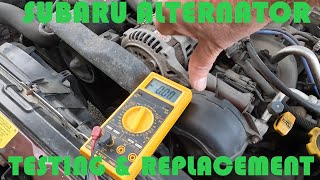
🎬 See this video on testing and replacing a Subaru alternator- Test Battery Voltage (Engine Off): Set your multimeter to DC volts. With the engine off, touch the red probe to the positive (+) battery terminal and the black probe to the negative (-) terminal. A healthy, fully charged battery should read between 12.4 and 12.7 volts.
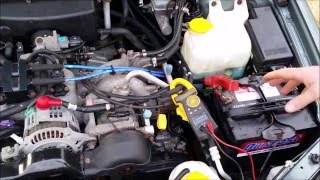
- Test Charging Voltage (Engine Running): Start the engine and let it idle. Measure the voltage across the battery terminals again. A healthy alternator should be putting out between 14.2 and 14.7 volts to charge the battery.
If the reading is below 13 volts or close to the initial battery voltage, the alternator is not charging. If the reading is significantly higher (e.g., over 15 volts), the internal voltage regulator has failed, which can overcharge and damage your battery.
Known Issues, TSBs, and Recalls
While there are no direct, large-scale recalls for these alternators, several important service bulletins and known issues exist.
TSB for False Misfire Codes (P0300) on 2014-2016 Forester
A critical issue affects some 2014-2016 Foresters with the 2.5L engine. According to Subaru Technical Service Bulletin 07-112-16R, current fluctuations from the original alternator can trick the engine's computer into setting a P0300 (Random/Multiple Cylinder Misfire) code, even when there is no actual engine misfire. The official fix is to replace both the alternator AND the accessory belt tensioner with updated parts as a set. Simply clearing the code or replacing spark plugs will not solve the problem.
🎬 Watch: Understanding and diagnosing P0300 random misfire codesEarly Model Charging Cut-Out Issue (2006-2008 Forester)
Some earlier models (primarily 2001-2008 Foresters) feature an ECU function designed to improve fuel economy by cutting the alternator's charging output under certain low-load conditions. This can sometimes lead to the battery not getting a full charge and eventually going flat. While less common, it's a known quirk that can be misdiagnosed as a failed alternator.
Widespread Battery Drain Complaints
Many Subaru models from this era were part of a class-action settlement related to battery drain issues. A dead battery is not always the alternator's fault. If your alternator tests good but your battery repeatedly dies, the vehicle may have a parasitic draw (an electrical component that stays on when it shouldn't).
Buying a Used OEM Alternator: What to Look For
For many owners, a quality used OEM (Original Equipment Manufacturer) alternator is a smart choice, offering better reliability than a cheap aftermarket part at a fraction of the cost of a new one from the dealer.
- Why Used OEM? The voltage regulators in genuine Mitsubishi-made Subaru alternators are high quality and designed to work perfectly with the vehicle's sensitive electronics. Some budget aftermarket alternators can have inconsistent voltage output, leading to flickering lights or other electrical gremlins.
- Physical Inspection: Before buying, inspect the part. Look for a clean housing without significant corrosion or cracks. Check that the pulley spins freely and smoothly by hand, with no grinding or gritty feeling, which would indicate bad bearings.
- Mileage and Lifespan: Alternators can begin to fail after 80,000 miles, though many last much longer. When buying used, look for a part from a lower-mileage vehicle if possible.
- Verify Compatibility: This is the most important step. Double-check the part number against your original unit or use the seller's VIN-matching service. Pay close attention to the amperage and whether it's for a turbo or non-turbo model.
Alternator Replacement Cost Comparison
Prices can vary, but this gives a general idea of the cost for the part and labor.
| Part/Service | Estimated Cost |
|---|---|
| New OEM | $485 - $750+ |
| New Aftermarket / Remanufactured | $130 - $250 |
| Used OEM | $50 - $125 |
| Shop Labor | $150 - $300 |
| Total Professional Replacement | $585 - $850+ |
Key Steps for DIY Replacement

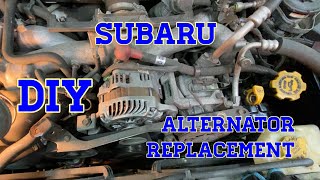
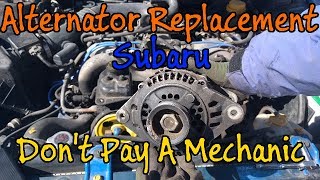
Replacing the alternator on these Subarus is a very feasible DIY job for those with basic mechanical skills. The alternator is located on the top front of the engine, making it easy to access.
- Disconnect the negative battery terminal.
- Remove the plastic accessory belt cover (typically two 10mm bolts).
- Loosen the accessory drive belt. On older models with manual tensioning, you'll loosen a 12mm lock bolt on the front of the alternator bracket, then turn the long 12mm tensioning bolt counter-clockwise to create slack. On newer models with an automatic tensioner, use a 14mm or 15mm wrench on the tensioner pulley bolt to rotate the entire assembly and slip the belt off.
- Unplug the main electrical connector and unbolt the main power wire (usually a 12mm nut under a rubber cap).
- Remove the main alternator mounting bolt and lift the alternator out.
- Installation is the reverse of removal. Ensure the belt is routed correctly and tensioned properly.
Pro Tip: While you have the belt off, it's the perfect time to replace it with a new one. Also, spin the belt tensioner and idler pulleys by hand. If they feel rough or make noise, replace them now to avoid a future failure.
Can I drive with a bad alternator?
No. The vehicle will run on battery power alone for a very short time—potentially only a few minutes—before the battery is completely drained. The engine will then stall, and you will lose power steering and power brakes, creating a serious safety hazard. If you suspect a bad alternator, do not drive the vehicle.
Is the whining noise always the alternator?
Not always, but it's a primary suspect. A whining noise that changes pitch with engine RPM can also be caused by a failing power steering pump, or a bad bearing in the belt tensioner or an idler pulley. A mechanic can use a stethoscope to pinpoint the source of the noise.
Why did my battery light come on if my battery is new?
The battery light indicates a problem with the charging system, not necessarily the battery itself. It means the alternator is not providing enough voltage to run the car and charge the battery. Even with a brand-new battery, a failed alternator will cause this light to come on and will quickly drain the new battery.
Do I need to replace the belt tensioner at the same time?
It is highly recommended, especially on 2014-2016 Foresters where it's part of a TSB fix for false misfire codes. The tensioner contains a bearing that wears out over time. Since you already have the belt off for the alternator replacement, replacing the tensioner is cheap insurance against having to do the job again soon.
Helpful Videos
Technical Specifications
OEM Part Numbers: A002TG0391 A002TL0091 A002TL0091A A2TG0391 A2TX3381 23700AA380 23700AA420 23700AA540 23700AA541 23700AA5418A 23700AA680 23700AB030
Amperage varies by application, typically 90A for older non-turbo models and 110A for turbo and newer non-turbo models. The voltage regulator is internal. Pulley has 5 grooves.
We Have This Part in Stock



The information in this article is provided for general reference and educational purposes only. Vehicle specifications, procedures, and part compatibility can vary by production date, trim level, and region. Always consult your vehicle's factory service manual and verify part numbers before purchasing or performing repairs. Safety-critical components such as airbags, seat belts, and braking systems should be installed by a qualified professional.
- Subaru Forester:
- Subaru Impreza:
- 🎬 Helpful Videos
- 🛍️ Shop This Part
- Critical Compatibility Warnings: Read This First!
- Symptoms of a Failing Subaru Alternator
- How to Diagnose a Bad Alternator in 5 Minutes
- Known Issues, TSBs, and Recalls
- TSB for False Misfire Codes (P0300) on 2014-2016 Forester
- Early Model Charging Cut-Out Issue (2006-2008 Forester)
- Widespread Battery Drain Complaints
- Buying a Used OEM Alternator: What to Look For
- Alternator Replacement Cost Comparison
- Key Steps for DIY Replacement
- 🎟️ Get 5% Off