

2009-2010 Hyundai Genesis Air Bag Module: Resetting Crash Data vs. Replacement
Learn why your airbag light is on and how a simple reset service can save you hundreds over a new dealer-installed module.
- If the airbag light is on, the entire safety system is disabled and will not function in a crash.
- After an accident, the module stores permanent 'crash data' and must be either replaced or have its memory reset by a specialist.
- The most cost-effective solution is to mail your original module to a reset service for about $60, which avoids the need for expensive dealer programming.
- Before replacing the module, investigate TSB 10-SS-002, as the airbag light could be caused by a simpler wiring issue near the passenger seat belt on early 2009 models.
Symptoms of a Failing Air Bag Control Module
The most common and immediate sign of a problem with the air bag system is a continuously illuminated airbag warning light on your instrument cluster. This light, often showing an icon of a person and an airbag, indicates that a fault has been detected within the Supplemental Restraint System (SRS).
Warning: When the airbag warning light is on, the entire airbag and seatbelt pre-tensioner system is deactivated. In the event of an accident, the airbags will not deploy, and the seatbelts will not tighten, significantly increasing the risk of serious injury.
A diagnostic scan is required to read the specific Diagnostic Trouble Codes (DTCs) that triggered the light. While many issues can cause the light to come on, codes pointing specifically to the module itself include:
- B1100 – Airbag Control Unit Fault
- B1101 – ACU (Airbag Control Unit) Configuration Error
- Codes indicating "Crash Event Stored" or "Deployment Commanded"
It is critical to have the system scanned professionally, as the fault could also lie with a less expensive component like a sensor, seat belt buckle, or the clockspring in the steering wheel.
The 'Crash Data' Problem: Reset vs. Replace
If your Genesis has been in an accident (even a minor one), the original airbag module will store what is known as "crash data" or "hard codes." This is a permanent record of the event written to the module's memory. Once this data is stored, the module is locked, and the airbag light will stay on permanently. Standard diagnostic scan tools cannot clear these hard codes.
You have two primary options to fix this:
- Replacement (The Dealer Method): A Hyundai dealership will not reset a module with crash data. Their only solution is to sell you a brand new module and program it to your vehicle, which can be very expensive.
- Reset Service (The Cost-Effective Method): You can remove your original module from the vehicle and mail it to a specialized reset service. These services use specific equipment to access the module's internal memory chip and completely erase the crash data, returning it to its original factory state. Because you are reinstalling your original module, it retains the correct VIN and programming for your car, so no additional dealer visit is required. This is by far the most affordable and common solution.
Known Issues & Technical Service Bulletins (TSBs)
Before assuming the module is bad, be aware of a known issue that can also trigger the airbag light on these vehicles.
TSB 10-SS-002 / Recall Campaign 094
For early production 2009 Genesis models (built before October 10, 2008), Hyundai issued a service campaign for an issue with the front passenger seat belt tension sensor wiring. The wiring harness could be routed incorrectly, causing it to chafe or get damaged, which illuminates the airbag light and stores DTCs B1489 or B1495. The fix involves rerouting the harness and adding a new fixing clip. This is a much simpler repair than replacing the module and should be investigated first if you have these specific codes.
Pro Tip: To avoid confusion, note that a recall for the 2010-2016 Genesis Coupe regarding the passenger seat sensor (OCS) does not apply to the 2009-2010 Genesis Sedan.
Buying a Used 2009-2010 Genesis Air Bag Module
Purchasing a used air bag control module is risky and generally not recommended unless you can follow a specific process.
- Verify the Part Number: You must exactly match the OEM part number. For the 2009-2010 Genesis with rear seat airbags, the correct part number is 95910-3M500.
- The Crash Data Risk: The biggest risk is buying a module from a vehicle that was in an accident. If it contains crash data, it is unusable without being sent to a reset service. Always ask the seller to guarantee the module is "crash-free" or has been professionally reset.
- The Best "Used" Option: The safest and most reliable approach is to have your vehicle's original module reset. This guarantees compatibility and avoids any programming headaches, as all the factory coding for your specific car remains intact.
- Physical Inspection: When inspecting a module, look for any signs of water damage, corrosion on the pins, or physical damage to the case. A module from a flood-damaged car should never be used.
Replacement Cost Comparison
The cost to resolve an airbag module issue varies dramatically depending on the solution you choose. Labor for removal and reinstallation typically costs between $150 and $300.
| Solution | Estimated Cost | Notes |
|---|---|---|
| New OEM Module | $650 - $940 (Part Only) | Requires programming (variant coding) by a dealer or specialized shop. |
| Mail-In Reset Service | $50 - $75 | Most cost-effective option. You mail in your original module. No programming needed after reset. |
| Used OEM Module (Crash-Free) | $100 - $250 | Risky. Must be from a non-crashed vehicle and an exact part number match. May still require coding. |
| Shop Labor (R&R) | $150 - $300 | Estimated 1.5-2.5 hours to remove and reinstall the center console and module. |
Frequently Asked Questions (FAQ)
Where is the airbag module located on a 2009-2010 Hyundai Genesis?
The airbag control module is located under the center console, between the two front seats, toward the front. Accessing it requires removing the center console trim panels.
Does a new or used airbag module need to be programmed?
Yes. A new module must be programmed with "variant coding" to match your car's specific options. A used module may also need this coding. The only way to avoid programming is to have your vehicle's original module reset and reinstall it.
Can I replace the airbag module myself?
Yes, if you are comfortable with removing interior trim pieces. The process involves disconnecting the battery, carefully disassembling the center console, unbolting the old module, and installing the new one. Always disconnect the negative battery terminal and wait at least 10-15 minutes before working on any SRS component to allow the system's backup power to discharge.
Will the car start or drive with a bad airbag module?
Yes, the vehicle will still start and drive normally. However, the entire SRS safety system will be inactive, meaning no airbags or seatbelt pre-tensioners will function in a crash. It is a critical safety failure that should be addressed immediately.
Technical Specifications
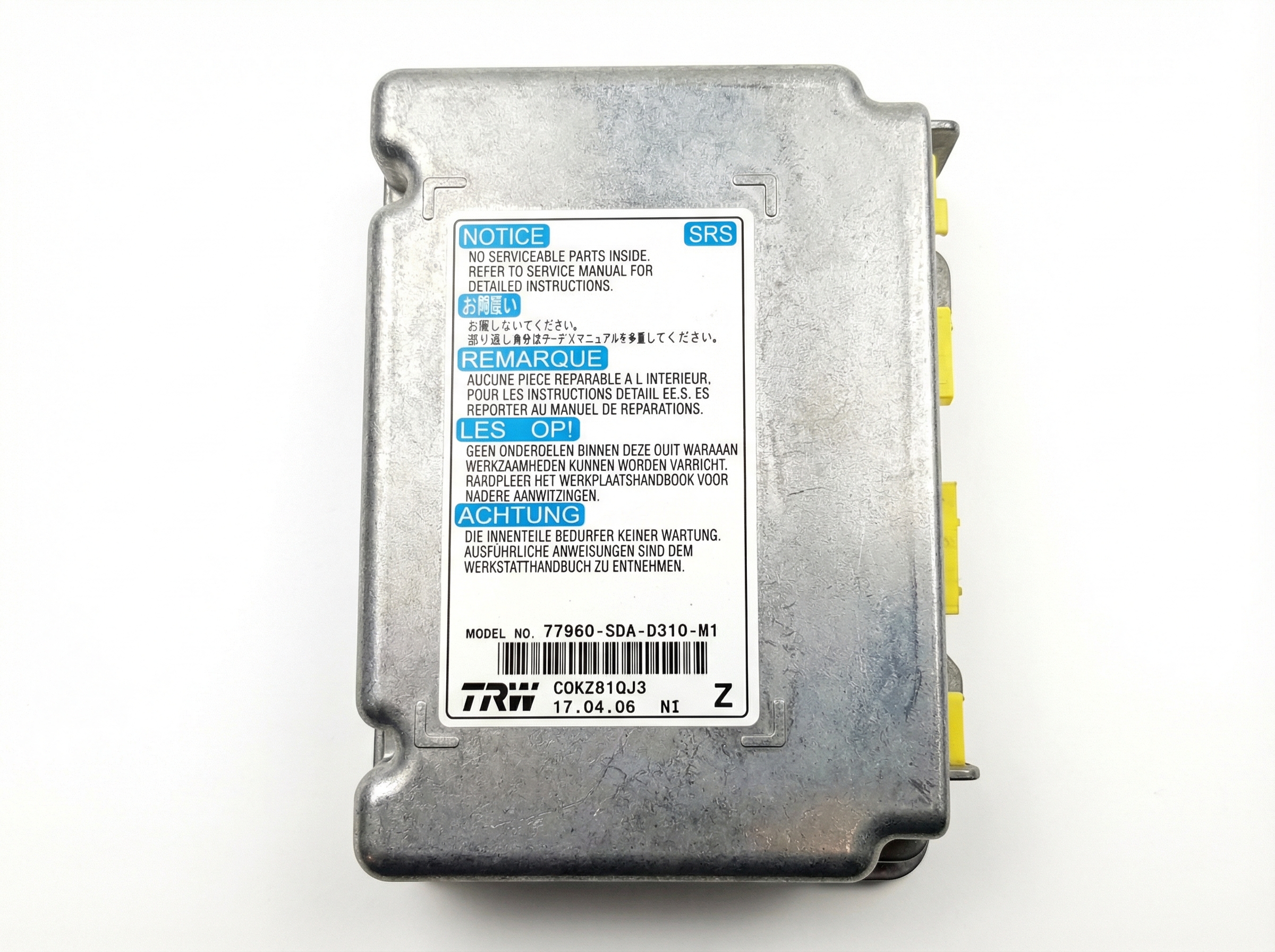
OEM Part Numbers: 95910-3M500 959103M500
Fits 2009-2010 Hyundai Genesis models equipped with rear seat airbags. Module is located under the center console.
We Have This Part in Stock



The information in this article is provided for general reference and educational purposes only. Vehicle specifications, procedures, and part compatibility can vary by production date, trim level, and region. Always consult your vehicle's factory service manual and verify part numbers before purchasing or performing repairs. Safety-critical components such as airbags, seat belts, and braking systems should be installed by a qualified professional.
- Hyundai Genesis:
- 🛍️ Shop This Part
- Symptoms of a Failing Air Bag Control Module
- The 'Crash Data' Problem: Reset vs. Replace
- Known Issues & Technical Service Bulletins (TSBs)
- TSB 10-SS-002 / Recall Campaign 094
- Buying a Used 2009-2010 Genesis Air Bag Module
- Replacement Cost Comparison
- Frequently Asked Questions (FAQ)
- 🎟️ Get 5% Off