

2012-2025 Evoque, E-Pace & Discovery Sport Accelerator Pedal: Fixing 'Restricted Performance'
This guide explains the common failure symptoms, diagnostic codes, and replacement costs for the accelerator pedal assembly shared by the Range Rover Evoque, Jaguar E-Pace, and Land Rover Discovery Sport.
- The most common failure symptom is the 'Restricted Performance' warning (limp mode), which is a safety feature that drastically cuts engine power.
- Replacement is very easy (1/5 difficulty) and can be done in under 30 minutes with basic tools, making it a great DIY repair.
- Always verify the OEM part number on your original pedal before buying a replacement, as many visually similar but incompatible versions exist.
- A used OEM pedal is often a more reliable and cost-effective choice than a new aftermarket part due to guaranteed compatibility and sensor calibration.
Symptoms of a Failing Accelerator Pedal Assembly
When the accelerator pedal assembly begins to fail, your vehicle's computer will quickly detect the problem and take protective measures. The symptoms are often sudden and can be alarming, but they are designed to ensure safety.
- 'Restricted Performance' Warning (Limp Mode): This is the most common and definitive symptom. A 'Restricted Performance' message will appear on the dashboard, and engine power will be severely limited. The vehicle may struggle to exceed 20-30 mph. 🎬 See these helpful tips for Jaguar Restricted Performance warnings This safety mode is triggered because the computer can no longer trust the signals from the pedal and limits power to prevent sudden or uncontrolled acceleration.
- No Throttle Response: You may press the accelerator pedal and get no reaction from the engine at all. In some cases, particularly noted by Land Rover Discovery Sport owners, this can happen intermittently while driving or from a complete stop, and may require restarting the vehicle to temporarily resolve.
- Check Engine Light: A fault in the pedal's sensors will trigger the check engine light and store specific Diagnostic Trouble Codes (DTCs) in the vehicle's computer.
- Hesitation and Inconsistent Acceleration: The vehicle might hesitate, stumble, or surge unexpectedly. You might press the pedal, feel a delay, and then a sudden burst of power as the sensor momentarily works correctly.
- Rough or High Idle: A faulty sensor can send incorrect position data even when your foot is off the pedal, causing the engine to idle roughly or at a higher RPM than normal.
Common Diagnostic Trouble Codes (DTCs)
If you're experiencing these symptoms, a scan tool will likely show one or more of the following codes. The most common code points to a disagreement between the pedal's internal sensors.
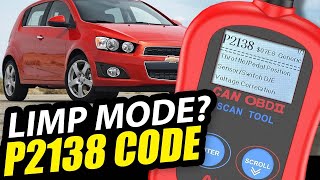
- P2138 - Throttle/Pedal Position Sensor/Switch 'D'/'E' Voltage Correlation: This is the most frequent code and directly indicates that the two internal pedal sensors are sending conflicting information to the computer.
- P2299 - Brake Pedal Position / Accelerator Pedal Position Incompatible: This code can be set if the computer sees signals from both the brake and accelerator at the same time, which can be caused by a faulty accelerator pedal sensor.
- P2122, P2123, P2127, P2128 - These codes point to circuit issues (low or high voltage) in one of the specific internal pedal sensors (Sensor 1/A or Sensor 2/B).
Pro Tip: While other issues like a dirty throttle body or vacuum leaks can cause acceleration problems, the combination of the 'Restricted Performance' warning and a P2138 code almost always points directly to a failed accelerator pedal assembly.
🎬 Watch: How to fix a P2138 code and limp modeBuying a Used Accelerator Pedal Assembly: What to Check
Given the high cost of a new OEM pedal and the simple, uncalibrated nature of the part, a used OEM assembly is an excellent, cost-effective solution. Here’s what to look for to ensure you get a good part.
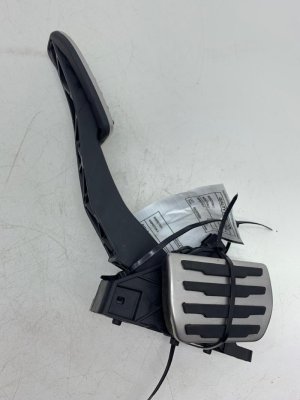
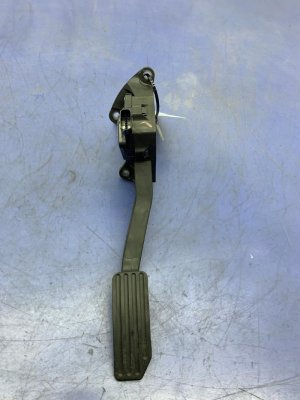
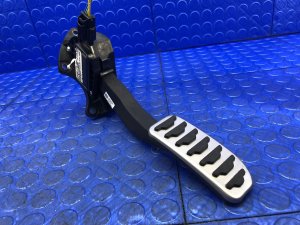
- Verify the Part Number: This is the most critical step. Jaguar Land Rover uses many visually similar pedals across different models and years. The only way to guarantee compatibility is to match the OEM part number from your original pedal to the replacement. The part number is typically on a sticker on the side of the plastic housing. Common part numbers include FK729F836AC, GK7M-9F836-BB, BJ32-9F836-AB, and LR159548.
- Inspect the Electrical Connector: Carefully examine the connector pins on the used assembly. They should be straight, clean, and free of any corrosion or damage. A bent or broken pin will render the part useless.
- Check the Pedal Pad: While not a perfect indicator, excessive wear on the pedal pad compared to the mileage of the donor vehicle might suggest a hard life. However, focus more on the part number and connector integrity.
- Why Used OEM is a Smart Choice: The original factory (OEM) pedals are built to JLR's exact electronic specifications. Many new aftermarket pedals are not available for these models, and those that are may not have the same precise sensor calibration, potentially causing performance issues. A tested, low-mileage used OEM part is often more reliable than a cheap, unproven aftermarket alternative.
Cost of Accelerator Pedal Assembly Replacement
Replacing the accelerator pedal is one of the more affordable repairs for these vehicles, especially if you do it yourself.
| Part or Service | Estimated Cost (USD) |
|---|---|
| New OEM Part | $240 - $300 |
| New Aftermarket Part | $70 - $150 (Limited availability) |
| Used OEM Part | $45 - $150 |
| Shop Labor | $100 - $165 |
Installation Guide (DIY)
Replacing the accelerator pedal assembly is a straightforward job that most DIY mechanics can complete in under 30 minutes with basic hand tools.
- Difficulty: 1 out of 5
- Estimated Time: 0.5 hours
- Tools Needed: Ratchet with extension, socket set (typically 10mm or 13mm), trim removal tool (optional).
Step-by-Step Replacement
- Safety First: Although not always required, it's good practice to disconnect the negative terminal of the battery.
- Access the Pedal: The pedal is located in the driver's footwell. You may need to remove a small plastic trim panel near the pedal to gain clear access to the mounting bolts.
- Disconnect the Electrical Connector: Press the release tab on the electrical connector at the top of the pedal assembly and pull it straight off.
- Remove the Mounting Bolts/Nuts: The assembly is typically held to the firewall by two or three nuts or bolts. Use a ratchet to remove them.
- Install the New Pedal: Position the new assembly and hand-tighten the nuts/bolts. Then, torque them to specification (if available, typically around 18 lb-ft or 25 Nm). Do not overtighten.
- Reconnect and Test: Plug the electrical connector back in until it clicks. If you disconnected the battery, reconnect it. Turn the ignition on and press the pedal to ensure the 'Restricted Performance' message is gone and throttle response has returned.
Note: While most JLR models do not require a calibration procedure for this part, some older or different models might. For the Evoque, E-Pace, and Discovery Sport covered here, it is generally a plug-and-play replacement.
Known Issues, Recalls & TSBs
There are no active recalls or widespread Technical Service Bulletins (TSBs) for the electronic failure of this specific accelerator pedal assembly on the 2012-2023 Range Rover Evoque, 2018-2020 Jaguar E-Pace, or 2020-2025 Land Rover Discovery Sport.
Jaguar Land Rover has issued past service actions for physical pedal placement on other models, such as incorrect spacing between the brake and accelerator pedals, but these do not relate to the electronic sensor failure discussed here.
Frequently Asked Questions (FAQ)
Can I just replace the sensor instead of the whole pedal assembly?
No, the accelerator pedal position sensors are built directly into the pedal housing and are not sold as a separate, replaceable component. The entire assembly must be replaced.
Will a bad accelerator pedal cause my car not to start?
It is very unlikely to cause a no-start condition. The engine will typically start and idle, but it will either have no throttle response or immediately enter 'Restricted Performance' mode when you press the pedal.
Is it safe to drive with a faulty accelerator pedal?
You can drive the vehicle, but only for a short distance to a safe location or a repair shop. The vehicle will be in a low-power 'Restricted Performance' mode, acceleration will be severely limited, and throttle response can be unpredictable. It is not safe for highway driving or merging into traffic.
Do I need to have the new pedal programmed by a dealer?
For these specific models, programming or calibration is generally not required. The replacement is considered a plug-and-play part. The system self-calibrates upon installation and ignition cycling.
Helpful Videos

Technical Specifications
OEM Part Numbers: FK729F836AC GK7M-9F836 GK7M-9F836-AB GK7M-9F836-BB GK7M-9F836-BC BJ32-9F836-AB LR027136 LR159548 LR105645 LR113940 LR113937
Electronic 'drive-by-wire' assembly with integrated, redundant Accelerator Pedal Position (APP) sensors. Typically has a 6-pin electrical connector.
We Have This Part in Stock



The information in this article is provided for general reference and educational purposes only. Vehicle specifications, procedures, and part compatibility can vary by production date, trim level, and region. Always consult your vehicle's factory service manual and verify part numbers before purchasing or performing repairs. Safety-critical components such as airbags, seat belts, and braking systems should be installed by a qualified professional.
- Land Rover Range Rover Evoque:
- Jaguar E-Pace:
- Land Rover Discovery Sport:
- 🎬 Helpful Videos
- 🛍️ Shop This Part
- Symptoms of a Failing Accelerator Pedal Assembly
- Common Diagnostic Trouble Codes (DTCs)
- Buying a Used Accelerator Pedal Assembly: What to Check
- Cost of Accelerator Pedal Assembly Replacement
- Installation Guide (DIY)
- Step-by-Step Replacement
- Known Issues, Recalls & TSBs
- Frequently Asked Questions (FAQ)
- 🎟️ Get 5% Off