

Subaru Legacy & Baja AC Condenser (2000-2006): Fitment Traps, Leaks, and Replacement Guide
This guide clarifies the confusing engine compatibility for the 2000-2004 Legacy and 2003-2006 Baja AC condenser, and covers symptoms, inspection, and replacement costs.
- Crucially, this condenser fits 2.5L Legacy models ONLY, but fits both 2.5L and 3.0L Outback models from 2000-2004.
- It fits all 2003-2006 Subaru Baja models (naturally aspirated and turbo).
- The most common failure is due to road debris impact causing leaks. Inspect any used part for oily residue and crushed fins.
- DIY replacement is possible, but professional equipment is required by law to evacuate and recharge the refrigerant.
AC Condenser Compatibility for Legacy & Baja (2000-2006)


Compatibility Warning: There is significant confusion regarding which engines this AC condenser fits, with many parts listings being unclear or incorrect. The same condenser part number is used across these vehicles, but only for specific engine configurations. Refer to the table below before ordering.
| Vehicle | Years | Compatible Engines | Notes |
|---|---|---|---|
| Subaru Legacy | 2000-2004 | 2.5L H4 Only | Does NOT fit 3.0L H6 models. The condenser for the 6-cylinder is a different part. |
| Subaru Outback | 2000-2004 | 2.5L H4 & 3.0L H6 | The same condenser fits both 4-cylinder and 6-cylinder Outback models of this generation. |
| Subaru Baja | 2003-2006 | 2.5L H4 (All) | Fits both naturally aspirated and Turbo models. |
Common Symptoms of a Failing AC Condenser
A bad AC condenser will quickly make itself known, especially on a hot day. Here are the most common signs of failure:
- Warm or Weak Airflow: This is the most immediate and obvious symptom. The air from your vents may be lukewarm or only slightly cool, even with the AC on its highest setting. This happens because the damaged condenser can't properly cool the refrigerant.
- Gradual Loss of Cooling: A small pinhole leak might not cause an immediate failure. Instead, you may notice the AC system getting progressively weaker over several days or weeks as refrigerant slowly escapes.
- Visible Leaks or Oily Residue: The refrigerant in your AC system is mixed with a special oil to lubricate the compressor. If the condenser is leaking, this oil will escape along with the refrigerant, leaving a greasy, oily film on the condenser fins or on the ground beneath the front of the car.
- AC System Shuts Off: If the condenser is severely clogged with dirt or debris, it can cause a dangerous buildup of pressure in the AC system. Modern vehicles have a high-pressure switch that will automatically shut down the AC compressor to prevent catastrophic failure.
- Overheating at Idle: Since the condenser sits in front of the radiator, a badly clogged condenser can restrict airflow to the radiator. This may cause the engine to run hotter than normal or even overheat, particularly when the vehicle is stationary.
Known Issues, Recalls, and TSBs
For the 2000-2004 Subaru Legacy and 2003-2006 Subaru Baja, there are no specific recalls or Technical Service Bulletins (TSBs) issued by Subaru or the NHTSA for the AC condenser itself. However, these vehicles were subject to the widespread Takata airbag recalls, which owners should ensure have been addressed.
The most common known issue is not a manufacturing defect, but rather the condenser's vulnerability to damage. Its position at the very front of the vehicle makes it highly susceptible to impacts from rocks and road debris kicked up by other cars. These impacts can easily bend the delicate cooling fins or puncture the tubes, causing a refrigerant leak.
While not specific to the condenser, some Subaru models of this era are known for developing refrigerant leaks from dried-out O-rings at the compressor hose connections. If you are diagnosing a leak, it's wise to inspect these connections as well.
Pro Tip: When replacing the condenser, it is highly recommended to also replace the receiver/drier (also called an accumulator). This component absorbs moisture from the refrigerant. Opening the system to replace the condenser exposes the drier to atmospheric moisture, compromising its effectiveness. A new drier is inexpensive and ensures the longevity of your new parts.
Buying a Used AC Condenser: What to Check
A used OEM condenser can be a cost-effective alternative to an expensive new dealer part, often providing better fit and quality than cheap aftermarket options. However, careful inspection is crucial before you buy.
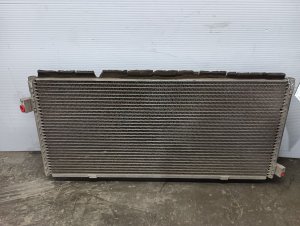
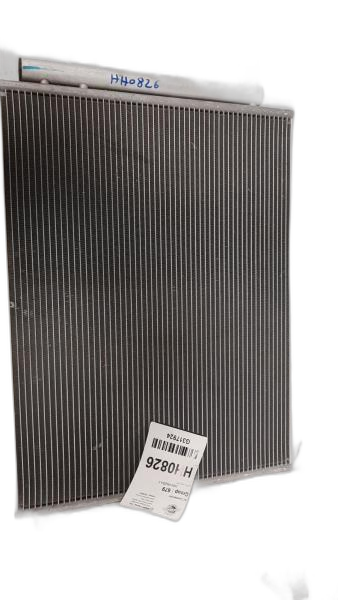
- Inspect the Fins: Look down the rows of cooling fins. A few slightly bent fins are acceptable and can be carefully straightened with a fin comb, but avoid condensers with large areas of crushed or flattened fins. This damage severely restricts airflow and reduces cooling performance.
- Check for Corrosion: Examine the entire unit, especially where the aluminum tubes connect to the main body and at the inlet/outlet fittings. Look for white, chalky powder or significant flaking. Heavy corrosion can lead to pinhole leaks.
- Look for Leaks: Check for dark, oily stains or a greasy film on the surface. This is a clear sign of a past or present refrigerant leak. A condenser with any sign of an oil leak should be rejected.
- Examine the Fittings: Ensure the threaded block fittings where the AC lines attach are clean, undamaged, and not stripped. Damaged threads will prevent a proper seal.
- Verify Part Numbers: If possible, match the OEM part number. The most common numbers for this application are 73210AE02A and its replacement, 73210AE040.
Replacement Overview & Cost
Replacing the AC condenser is a moderately difficult job that most experienced DIY mechanics can handle, but it requires special tools for handling the refrigerant.
- Difficulty: 3 out of 5
- DIY Feasible: Yes, but with a major caveat. The law requires that any existing refrigerant be recovered by a certified technician with a special machine before you begin work. Likewise, after installation, the system must be vacuum-tested for leaks and recharged by a professional.
- General Steps:
- Have the AC system professionally evacuated.
- Remove the front grille for access.
- Disconnect the AC lines from the condenser. Be prepared for a small amount of residual oil to drip out.
- Unbolt the condenser mounting brackets and remove the condenser from the vehicle.
- Transfer any necessary brackets to the new condenser.
- Install the new condenser, ensuring the rubber mounting bushings are in good condition.
- Replace the O-rings on the AC line fittings with new, correct-sized ones lubricated with PAG oil.
- Reconnect the AC lines and tighten to the proper torque specification.
- Reinstall the front grille.
- Take the vehicle back to a shop to have the system vacuum-tested and recharged with the correct amount of R-134a refrigerant and PAG oil.
Cost Comparison
| Part/Service | Estimated Cost |
|---|---|
| New OEM Condenser | $420 - $450 |
| New Aftermarket Condenser | $60 - $180 |
| Used OEM Condenser | $50 - $120 |
| Shop Labor (Replacement) | $200 - $300 |
| Shop Labor (Evacuate & Recharge) | $100 - $200 |
Frequently Asked Questions (FAQ)
Can I just add more refrigerant if my AC is blowing warm?
If your system is blowing warm, it's because the refrigerant has leaked out. Simply adding more is a temporary fix at best, as it will just leak out again. The leak, most commonly in the condenser or O-rings, must be found and repaired first.
Is the condenser for the 2.5L Legacy the same as the 3.0L Outback?
Yes, for the 2000-2004 generation, the 2.5L Legacy, 2.5L Outback, and 3.0L Outback all share the same AC condenser. However, the 3.0L Legacy uses a different part.
Why is my AC condenser covered in oil?
An oily, greasy film on the condenser is a sure sign of a refrigerant leak. The system's refrigerant contains PAG oil to lubricate the compressor. When the refrigerant leaks out as a gas, it leaves this oily residue behind. The condenser will need to be replaced.
Do I have to replace the receiver/drier when I replace the condenser?
It is very strongly recommended. The receiver/drier contains a desiccant material that absorbs moisture from inside the AC system. When you open the system to replace a part, this material becomes saturated with moisture from the air. Failing to replace it can lead to corrosion and premature failure of your new compressor or condenser.
Technical Specifications
OEM Part Numbers: 73210AE02A 73210AE040 73210AE05A
Core Type: Parallel Flow. Inlet/Outlet: Block Fitting. Material: Aluminum.
We Have This Part in Stock

The information in this article is provided for general reference and educational purposes only. Vehicle specifications, procedures, and part compatibility can vary by production date, trim level, and region. Always consult your vehicle's factory service manual and verify part numbers before purchasing or performing repairs. Safety-critical components such as airbags, seat belts, and braking systems should be installed by a qualified professional.
- Subaru Legacy:
- Subaru Baja: