

2009-2015 Toyota Corolla ABS Module: Decoding VSC, Brake Types, and Calibration
This guide covers the critical compatibility differences, known issues, and mandatory calibration steps for replacing the ABS module on your 2009-2015 Toyota Corolla.
- Compatibility is critical and complex. You must match the part number and ensure the replacement module is for your car's specific configuration: with or without Vehicle Stability Control (VSC) and, for 2014-2015 models, rear disc or rear drum brakes.
- Programming is not optional. Any replacement ABS module (new or used) requires a 'Zero Point Calibration' using a professional scan tool to make the VSC and TRAC systems work.
- A scan tool is also required for proper brake bleeding. Air gets trapped in the new module, and the scan tool is needed to cycle the internal pump and solenoids to purge it completely.
- Check for simple fixes first. The common C1241 fault code often points to a bad battery, alternator, or poor electrical connection, not a failed ABS module. Diagnose the charging system before replacing expensive parts.
Symptoms of a Failing ABS Module

A failing ABS module can present several distinct symptoms. While some issues can also be caused by a faulty wheel speed sensor or wiring, a combination of these signs often points to the module itself.
- ABS Warning Light: The most common symptom is an illuminated ABS warning light on your dashboard. This light indicates the system has detected a fault and has likely disabled the anti-lock function.
- Traction Control and VSC Lights: If your Corolla is equipped with Vehicle Stability Control (VSC), the VSC and traction control (TRAC) warning lights will typically illuminate along with the ABS light.
- Unresponsive or Stiff Brake Pedal: In some failure modes, the brake pedal may become very hard to press or feel unresponsive, requiring significantly more effort to stop the vehicle.
- Wheels Locking Up: The primary purpose of ABS is to prevent your wheels from locking and skidding during hard braking. If your wheels lock up easily on slippery surfaces or during a hard stop, the ABS system is not functioning.
- Brakes Activating Erratically: The module may fail in a way that causes the ABS pump to activate at the wrong times, such as under light braking or when driving normally. This can feel like a pulsing pedal or a grinding/buzzing noise from the engine bay.
Common Diagnostic Trouble Codes (DTCs)
A professional scan tool can read codes from the ABS module. While many codes exist, some are more common for these issues:
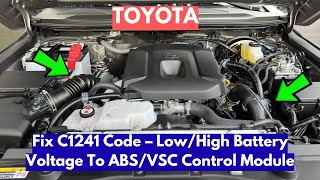
- C1241 - Low or High Battery Positive Voltage: This is a very common code for Toyota vehicles. It indicates the module is not receiving the correct voltage. Before condemning the module, it is critical to test the battery, alternator, 🎬 Watch: How to fix the C1241 low voltage code and check for corroded terminals or poor ground connections.
- C1466 - Actuator/Pump Malfunction: This code often points to an internal failure of the ABS pump motor or the electronic controller itself.
- C1336 - Zero Point Calibration of G Sensor Undone: This code appears when the Zero Point Calibration has not been performed or was done incorrectly after a part replacement. It means the stability control system doesn't know the vehicle's baseline orientation.
- Other codes may point to specific wheel speed sensor failures, which should be diagnosed before replacing the entire module.
Known Issues, Recalls, and Technical Service Bulletins (TSBs)

While there are no widespread recalls specifically for ABS module failure on this generation of Corolla, there are related service campaigns and bulletins to be aware of.
- Safety Recall 90H (2009-2010 models): This recall addresses an issue where moisture from the PCV system could freeze inside the intake manifold's brake vacuum port in extremely cold climates. This could lead to a loss of power brake assist, resulting in a hard pedal and increased stopping distance. The fix involves installing a newly designed intake air connector. This is not a failure of the ABS module itself but affects braking performance.
- TSB-0235-12 (2009-2013 models): This TSB was released to address customer complaints of a slight increase in brake pedal travel over time on models with rear drum brakes. The solution was an improved rear drum brake adjuster.
- Takata Airbag Recalls: Many 2009-2012 Corollas were part of the massive Takata airbag inflator recalls. While unrelated to the braking system, it's important to verify if this safety recall has been performed on any vehicle.
Pro Tip: Always check for a simple cause first. A low battery, bad alternator, or a blown fuse can trigger ABS warning lights and codes like C1241. Fully diagnose the charging and electrical system before assuming the expensive ABS module has failed.
Buying a Used 2009-2015 Corolla ABS Module: What to Know

Buying a used OEM ABS module is an excellent way to save money, as new units can be very expensive. However, compatibility is absolutely critical. Installing the wrong module will result in warning lights and a non-functional ABS/VSC system. Here’s what you must verify.
1. Match Your Vehicle's Options Exactly
The ABS module is programmed differently based on your car's factory options. You cannot swap them. The two most important distinctions are:
- Vehicle Stability Control (VSC): Modules for cars with VSC are different from those without it. A non-VSC module will not work in a car that has VSC, and vice-versa. To check if you have VSC, look for a "VSC OFF" switch on your dashboard, typically to the left of the steering wheel.
- Rear Brake Type (2014-2015 models): For the 2014-2015 model years, Toyota used different ABS modules for cars with rear drum brakes versus those with rear disc brakes. You must match your car's specific brake setup.
2. Match the Part Number
The surest way to guarantee compatibility is to match the OEM part number from your original module to the replacement part. The module is located in the engine bay, and the part number is usually on a white sticker on the electronic portion. Do not rely on visual similarity alone.
3. Physical Inspection
When you receive the used module, inspect it carefully before installation:
- Connectors: Check the electrical connector pins for any signs of corrosion, bending, or damage.
- Housing: Look for cracks in the plastic electronic housing or the metal hydraulic block.
- Brake Line Ports: Ensure the ports where the brake lines attach are clean and the threads are not damaged.
Programming and Calibration Requirements

Warning: A replacement ABS module, whether new or used, MUST be calibrated to the vehicle after installation. This is not an optional step.
After the new or used module is installed, it must undergo a procedure called Zero Point Calibration. This procedure teaches the module's sensors the vehicle's "zero" position—meaning it's stationary on a level surface with the steering wheel pointed straight. This is essential for the VSC and traction control systems to function correctly.
There are two primary ways to perform this calibration:
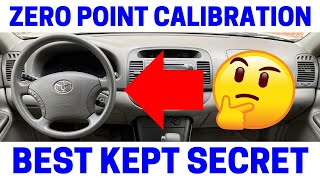
- Using a Scan Tool: A professional scan tool like Toyota's Techstream software can initiate the calibration through the vehicle's diagnostic port. 🎬 Watch: How to perform a Zero Point Calibration The tool will guide the technician through the steps. This is the most reliable method and is required for the brake bleeding process.
- Manual Procedure: On some Toyota models, a manual calibration can be performed by using a wire or paperclip to short specific pins (typically pins 4 and 13 or Ts and CG) in the OBD-II port in a specific sequence. While this can work for the calibration itself, it does not help with the necessary step of bleeding the brakes with a scan tool.
Because a scan tool is also required to properly bleed air from the ABS hydraulic unit, this job is best left to a professional technician or an experienced DIYer with the right equipment. An independent shop with a high-end scan tool can perform this service; a dealer visit is not always required.
Cost to Replace a 2009-2015 Corolla ABS Module
The cost can vary significantly depending on the part source and labor rates. The ABS module and pump are typically replaced as a single assembly.
🎬 See this walkthrough on replacing the ABS hydraulic pump unit| Item | Estimated Cost |
|---|---|
| New OEM (Dealer) | $700 - $1,200 |
| New Aftermarket | $400 - $700 |
| Used OEM | $150 - $350 |
| Remanufactured / Repair Service | $250 - $400 |
| Shop Labor (including bleeding & calibration) | $150 - $300 |
Frequently Asked Questions (FAQ)
Can I drive my Corolla with a bad ABS module?
Yes, but with significant risks. Your standard hydraulic brakes will still work, but you will not have anti-lock brakes, traction control, or stability control. This means your wheels can lock up during a panic stop, increasing stopping distances and causing a loss of steering control, especially on wet or slippery roads. It is highly recommended to get the issue repaired as soon as possible.
Do I have to program a used ABS module?
Yes, a Zero Point Calibration is mandatory after installing a used ABS module. This procedure syncs the module with your car's steering and stability sensors. Without it, the ABS and VSC lights will remain on, and the systems will not work.
How do I know if my Corolla has VSC (Vehicle Stability Control)?
The easiest way to check is to look for a button labeled "VSC OFF" on the dashboard, usually on the lower left side near your knee. If you have this button, your car is equipped with VSC, and you must buy an ABS module that is compatible with VSC.
What's the difference between the ABS module and the ABS pump?
On the 2009-2015 Corolla, these two components are integrated into a single unit often called the ABS actuator or modulator. The pump is the hydraulic part with the motor that modulates brake pressure, while the module is the attached electronic controller. They are removed and replaced as one assembly.
Could my problem just be a wheel speed sensor?
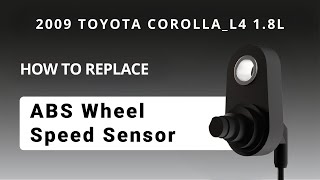
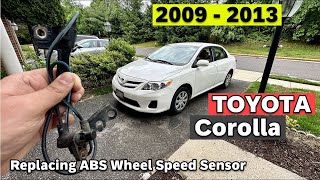
Yes. A single faulty wheel speed sensor can illuminate the ABS and VSC lights. However, a scan tool will typically show a specific code pointing to that sensor (e.g., "Right Front Wheel Speed Sensor Circuit Malfunction"). If the codes are for internal module failure (like C1466) or power supply issues (like C1241), the problem is more likely with the module or the vehicle's electrical system.
Helpful Videos
Technical Specifications
OEM Part Numbers: 4405002260 4405002440 4405002690 4405002691 4405002700 4405002701 4405012620 4451002170 4454002200 4454002410 4454002411 8954112550 8954112700
The unit is a combined electronic control module and hydraulic pump/actuator assembly. It operates on the vehicle's 12V electrical system.
We Have This Part in Stock



The information in this article is provided for general reference and educational purposes only. Vehicle specifications, procedures, and part compatibility can vary by production date, trim level, and region. Always consult your vehicle's factory service manual and verify part numbers before purchasing or performing repairs. Safety-critical components such as airbags, seat belts, and braking systems should be installed by a qualified professional.
- Toyota Corolla:
- 🎬 Helpful Videos
- 🛍️ Shop This Part
- Symptoms of a Failing ABS Module
- Common Diagnostic Trouble Codes (DTCs)
- Known Issues, Recalls, and Technical Service Bulletins (TSBs)
- Buying a Used 2009-2015 Corolla ABS Module: What to Know
- 1. Match Your Vehicle's Options Exactly
- 2. Match the Part Number
- 3. Physical Inspection
- Programming and Calibration Requirements
- Cost to Replace a 2009-2015 Corolla ABS Module
- Frequently Asked Questions (FAQ)
- 🎟️ Get 5% Off