

2013-2020 Fusion & MKZ ABS Module: Decoding Recalls, Part Numbers, and Programming
This guide clarifies the common failures, critical recalls, and mandatory programming requirements for the anti-lock brake system in the 2013-2020 Ford Fusion and Lincoln MKZ.
- Programming is mandatory. A replacement ABS module, whether new or used, must be professionally programmed to your car's VIN to function.
- Part numbers must be matched exactly. Due to numerous variations, the only way to ensure compatibility is to match the OEM part number from your original module.
- Check for recalls first. Your issue might be related to a known recall for the HCU (19S54) or master cylinder (20V-332), which could be repaired for free.
- A used module is a viable option. Despite what some dealers may say, a used module can be successfully reprogrammed by a knowledgeable independent shop, offering significant cost savings.
Known Issues, Recalls, and Technical Service Bulletins (TSBs)

Before replacing your ABS module, check if your vehicle is affected by any of these known issues. A repair could be covered by the manufacturer.
Recall 19S54: HCU Valve Malfunction
Some 2013-2018 Ford Fusion and Lincoln MKZ models were recalled because a valve inside the Hydraulic Control Unit (HCU) could get stuck in the open position. This can lead to a longer brake pedal travel, making the pedal feel soft or requiring you to press it further to stop. While it doesn't cause a complete loss of braking, it can be alarming. Dealers will inspect the HCU and perform necessary repairs free of charge.
Pro Tip: Even if you are outside the recall period, if you experience a sudden increase in brake pedal travel, mention this specific recall to your technician as it points to a known HCU issue, not necessarily an electronic module failure.
Recall 20V-332 (Ford 20S31): Master Cylinder Leak
A significant recall was issued for 2014-2016 Ford Fusion and Lincoln MKZ models where the brake master cylinder could leak fluid into the brake booster. This will trigger a red brake warning light, an audible chime, and a change in brake pedal feel. While this is not a failure of the ABS module itself, the symptoms can be confused with an ABS fault. The fix involves replacing the master cylinder and, if it has leaked, the brake booster as well.
TSB 13-5-22: Cold Weather ABS Light
For early 2013 Fusion and MKZ models (built on or before April 9, 2013), a technical service bulletin was issued to address an issue where the ABS and stability control lights would illuminate in cold weather, typically right after starting the car. The issue would often clear after restarting the vehicle. This is caused by a software glitch, and the fix is to reprogram the ABS module with updated software, not replace it.
Symptoms of a Failing ABS Module

When the ABS module fails, it can cause a variety of symptoms, from warning lights to changes in how the brake pedal feels.
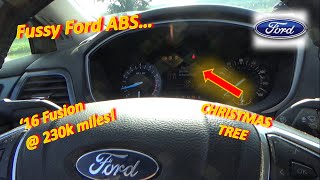
- ABS Warning Light: The most common symptom is the ABS warning light illuminating and staying on. This indicates the system has detected a fault and has likely disabled the anti-lock function.
- Traction and Stability Control Lights: Because the traction control (TCS) and electronic stability control (ESC) systems rely on the ABS module and its sensors, these lights will often come on as well, indicating those safety features are also disabled.
- Wheels Locking Up: During a hard stop, you may notice one or more wheels lock up and skid. This means the anti-lock function is not working, and your vehicle has reverted to conventional braking.
- Unresponsive or Hard Brake Pedal: The brake pedal may feel unusually hard to press or spongy, as the hydraulic unit controlled by the module may not be functioning correctly.
- ABS Pump Runs Constantly: You might hear the ABS pump motor running continuously, even when you are not braking. This can indicate an internal electronic failure in the module.
Common Diagnostic Trouble Codes (DTCs)
A professional OBD-II scanner that can read ABS codes is necessary for proper diagnosis. Here are some common codes associated with these systems:
| Code | Description | Common Cause |
|---|---|---|
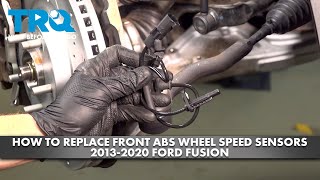
| C0035 - C0050 | Wheel Speed Sensor Circuit Faults | Often a faulty wheel speed sensor or wiring, not the module itself. Always check these first. | 🎬 Watch: How to replace front ABS wheel speed sensors
| U0415 | Invalid Data Received From ABS Control Module | Indicates a communication problem. Can be the module, but also check wiring and connectors. |
| C0121 / U3000 | Control Module Performance / Internal Control Module Malfunction | These codes strongly suggest the ABS module itself has failed internally. |
| C0110 | ABS Pump Motor Circuit Fault | Points to an issue with the hydraulic pump motor or its electrical circuit. |
Buying a Used ABS Control Module

Purchasing a used OEM ABS module is a cost-effective way to repair your Ford Fusion or Lincoln MKZ, but careful attention to detail is required to ensure compatibility.
Warning: You MUST match the OEM part number from your original module exactly. These vehicles use many different ABS modules depending on the model year, engine (Hybrid vs. non-Hybrid), drivetrain (FWD vs. AWD), and specific features like Adaptive Cruise Control. There is no 'one-size-fits-all' module. Visually comparing modules is not enough.
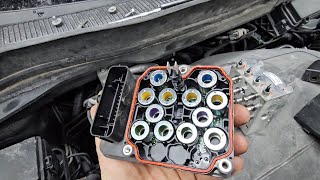
To find the correct part number, you will need to locate and inspect your current ABS module. The number is printed on a sticker on the electronic portion of the unit. When purchasing a used module, provide the seller with this number to guarantee you receive an identical part. Inspect the electrical connector pins on the used module for any signs of corrosion or damage before installation.
Programming and Installation Requirements

Once installed, the replacement ABS module must be professionally programmed to your vehicle's Vehicle Identification Number (VIN).
Warning: This step is not optional. A non-programmed module will not function correctly, will keep warning lights on, and may compromise the safety of your braking system. Claims of 'pre-programmed' or 'plug-and-play' used modules are misleading, as programming must be done while the module is installed in the vehicle.
The programming process, often called a Programmable Module Installation (PMI), copies your vehicle's specific configuration (As-Built data) and VIN into the new module. This ensures it communicates correctly with the engine computer, transmission, and other systems.
- Dealer: A Ford or Lincoln dealership can perform the programming using their proprietary IDS software.
- Independent Shop: Many independent repair shops with professional-grade diagnostic tools (like high-end Autel or Snap-on scanners) can also perform the PMI procedure.
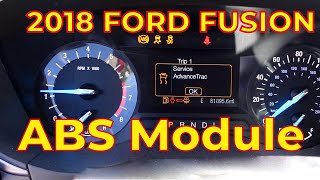
- DIY (Advanced): Technicians and advanced DIYers with a subscription to Ford's software and a J2534 pass-thru device, or using software like FORScan (with an extended license), may be able to perform the programming and subsequent calibration procedures 🎬 See a walkthrough of the ABS module programming process like IVD (Interactive Vehicle Dynamics) initialization.
After programming, a full brake fluid bleed and flush is required. This often requires a scan tool to cycle the ABS pump to remove all air from the hydraulic unit.
🎬 Watch: Proper brake bleeding procedure after an ABS replacementReplacement Cost Comparison
The cost to replace the ABS module can vary significantly based on the source of the part and labor rates.
| Item | Estimated Cost | Notes |
|---|---|---|
| New OEM Module | $650 - $1100+ | Highest cost, sourced from a Ford or Lincoln dealer. |
| Remanufactured Module | $300 - $600 | A rebuilt original part, often with a warranty. A good balance of cost and reliability. |
| Used OEM Module | $75 - $250 | Most affordable option. Price depends on condition and seller. Must match part number exactly. |
| Shop Labor (Installation & Programming) | $200 - $450 | Includes physical installation, programming the module, and bleeding the brake system. |
Frequently Asked Questions (FAQ)
Can I still drive my car with a bad ABS module?
Yes, but with extreme caution. Your normal power braking will still function, but you will not have anti-lock brakes, traction control, or stability control. This means your wheels can lock up during a panic stop, increasing the risk of skidding and extending your stopping distance, especially on wet or slippery surfaces. It is highly recommended to have the system repaired as soon as possible.
My dealer said a used ABS module cannot be programmed. Is this true?
This is incorrect. A used ABS module can be programmed to a new vehicle. However, some dealerships have policies against installing customer-supplied used parts or may be unfamiliar with the procedure for reprogramming a used module. An independent shop that specializes in diagnostics or works with used parts is often a better choice for this job.
Do I need to bleed the brakes after replacing the ABS module?
Yes. Any time the hydraulic lines are disconnected from the ABS unit, a full brake system bleed is mandatory to remove air from the lines. This often requires a 'scan tool bleed' or 'ABS bleed' procedure, where the diagnostic tool electronically cycles the valves in the HCU to purge all trapped air, which cannot be removed with a traditional manual bleed.
What is the difference between the ABS module and the HCU?
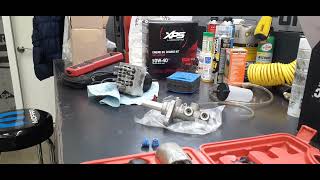
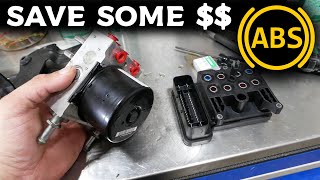
The ABS module is the electronic computer (the 'brain'), while the HCU (Hydraulic Control Unit) is the mechanical pump and valve body assembly (the 'muscle'). They are typically bolted together and replaced as a single assembly. The module contains the circuit board that fails electronically, while the HCU contains the mechanical parts that can fail or leak.
Helpful Videos
Technical Specifications
OEM Part Numbers: DG982C555AE DG982C555AF DG982C555AG DG982C555AH DG982C555AJ DG982C555AL DG982C555AM DG9C2C219AH DG9C2C405AE DG9C2C405AF DG9C2C405AG DG9C2C405AH DG9C2C405BE DG9C2C405BF DG9C2C405BG EG9C2C405AG
Varies by vehicle configuration (Hybrid/Non-Hybrid, FWD/AWD, engine type). Module requires programming with vehicle-specific As-Built data via Ford's Integrated Diagnostic System (IDS) or equivalent professional scan tool.
We Have This Part in Stock



The information in this article is provided for general reference and educational purposes only. Vehicle specifications, procedures, and part compatibility can vary by production date, trim level, and region. Always consult your vehicle's factory service manual and verify part numbers before purchasing or performing repairs. Safety-critical components such as airbags, seat belts, and braking systems should be installed by a qualified professional.
- Ford Fusion:
- Lincoln MKZ:
- 🎬 Helpful Videos
- 🛍️ Shop This Part
- Known Issues, Recalls, and Technical Service Bulletins (TSBs)
- Recall 19S54: HCU Valve Malfunction
- Recall 20V-332 (Ford 20S31): Master Cylinder Leak
- TSB 13-5-22: Cold Weather ABS Light
- Symptoms of a Failing ABS Module
- Common Diagnostic Trouble Codes (DTCs)
- Buying a Used ABS Control Module
- Programming and Installation Requirements
- Replacement Cost Comparison
- Frequently Asked Questions (FAQ)
- 🎟️ Get 5% Off