

2011-2017 Volt & 2016-2017 Malibu Hybrid ABS Module: Programming, Recalls, and Replacement
This guide covers the specific ABS control module used in the Chevrolet Volt and Malibu Hybrid, focusing on mandatory programming and vehicle-specific issues.
- This ABS module MUST be programmed to the vehicle's VIN after installation using dealer-level software (GM Techline Connect SPS2). It is not a plug-and-play part.
- For the 2016 Malibu, this part ONLY fits the Hybrid 'New Style' body (4th VIN digit 'Z'), not the 'Limited' model.
- New aftermarket or remanufactured options are generally not available, making used OEM parts the primary budget-friendly alternative to new OEM.
- If multiple wheel speed sensor codes appear at once, the ABS module is the most likely culprit, not the individual sensors.
Symptoms of a Failing ABS Control Module

When the ABS control module begins to fail, the vehicle will typically alert the driver through multiple warnings on the instrument cluster. Because the module is the central computer for several safety systems, its failure will disable them.
- Warning Lights: The most common symptom is the illumination of the ABS, Traction Control (TCS), and/or Stabilitrak/Electronic Stability Control (ESC) warning lights on your dashboard.
- Driver Information Center (DIC) Messages: You may see messages such as "Service ABS System," "Service Traction Control," or "Service Stabilitrak."
- Loss of ABS and Traction Control: During hard braking, especially on slippery surfaces, the wheels may lock up and skid since the anti-lock function is disabled. Similarly, the traction control will not function to prevent wheel spin during acceleration.
- Unusual Brake Pedal Feel: In some cases, the brake pedal may feel different, or you might hear the ABS pump running at odd times.
Common Diagnostic Trouble Codes (DTCs)
A professional scan tool that can read chassis codes (starting with 'C') is required to diagnose the issue properly. While many codes can indicate a problem, here are some common ones associated with this system:
- C0035: Left Front Wheel Speed Sensor Circuit
- C0040: Right Front Wheel Speed Sensor Circuit
- C0045: Left Rear Wheel Speed Sensor
- C0050: Right Rear Wheel Speed Sensor
- P25A2: Brake System Control Module 1 Requested MIL Illumination
- C056D: Electronic Control Unit Hardware/Internal Fault
Pro Tip: If your vehicle shows fault codes for multiple wheel speed sensors at the same time, it is highly unlikely that all sensors failed simultaneously. This scenario strongly points to a failure of the central ABS control module itself.
Known Issues, Recalls, and Technical Service Bulletins (TSBs)

There are several documented issues and recalls specific to each vehicle that uses this module.
2011-2017 Chevrolet Volt
- Recall 12V-266000 (NHTSA #12110): Affecting a small number of 2012 Volts, a problem with the brake pressure modulator valve could prevent the front brakes from releasing during an ABS, ESC, or traction control event, potentially causing the wheels to lock up.
- Recall 18V-670000 (GM #18279): Affecting 2018-2019 Volts (outside the primary year range of this guide, but relevant), rear brake caliper pistons could have an insufficient coating, leading to gas pockets in the brake fluid and reduced rear brake performance. The fix is to have the dealer bleed the brake system.
- TSB 19-NA-103: For 2016-2019 Volts, an intermittent clicking noise from the front of the vehicle accompanied by ABS/TCS lights may be caused by a fractured front axle anti-click washer, which can damage the wheel speed sensor.
2016-2017 Chevrolet Malibu Hybrid
- Recall 16V-272000 (GM #39440): A small batch of 2016 Malibu vehicles manufactured in March 2016 were recalled because the memory chip in the Electronic Brake Control Module (EBCM) could fail. This failure would disable ABS and ESC systems, increasing crash risk. The remedy was a complete replacement of the module by a dealer.
- Recall 18V-670000 (GM #18279): This recall for insufficient coating on rear brake caliper pistons also affected some 2018 Malibu models.
Buying a Used ABS Control Module: What You Must Know

Since new aftermarket and remanufactured versions of this specific module are not readily available, your main options are a new OEM part from a dealer or a used OEM part from a recycler. Given the high cost of a new module, a used part is often the most practical choice.
Warning: This is NOT a plug-and-play part. A replacement module, whether new or used, MUST be programmed to your vehicle's Vehicle Identification Number (VIN) to function.
Compatibility Checks
- Match Part Numbers: The most important step is to match the OEM part number from your original module to the one you are buying. Known part numbers include 20864952, 20918875, 22840013, 23170879, 84088525, and 85132072. The number 84088525 is a common service replacement for several earlier numbers.
- Chevrolet Malibu Specifics: This module is ONLY for the 2016-2017 Malibu Hybrid. For 2016 models, it must be the 'New Style' body, which can be identified by the 4th digit of the VIN being 'Z'. It will not work on the 2016 Malibu 'Limited', which was a carryover of the previous generation.
- Chevrolet Volt Specifics: This module is designed to work with the Volt's unique regenerative braking system. Using a module from a different GM vehicle, even if it looks identical, will not work.
Inspection and Red Flags
When inspecting a used module, look for:
- Physical Damage: Check the plastic housing and connectors for any cracks, corrosion, or broken tabs.
- Intact Solenoids: Ensure the solenoid posts on the bottom of the module (which connect to the hydraulic pump) are clean and straight.
- Clean Connectors: The electrical connector pins should be clean and free of any green or white corrosion, which indicates water intrusion.
Because the part's functionality can't be verified visually, it is essential to buy from a reputable seller with a good return policy.
Programming and Calibration Requirements

This is the most critical part of the replacement process. Failure to program the module will result in it not working and continued warning lights.
- Dealer or Specialized Shop Required: The programming must be done using General Motors' official software, called Techline Connect (which includes the Service Programming System, or SPS2). This requires an online subscription and a compatible J2534 Pass-Thru device. Most DIY mechanics do not have this equipment.
- Procedure for Used Modules: When programming a used module, the technician MUST select the "Replace and Reprogram" option within the GM software. Simply selecting "Program" may not work correctly.
- Post-Programming Steps: After programming, additional procedures like calibrating the steering angle sensor and brake pedal position sensor may be required. The scan tool will guide the technician through these steps.
Replacement Procedure Overview

Physically replacing the module has a moderate to high difficulty level, primarily due to the mandatory programming and the potential need to open the hydraulic brake system.
Difficulty: 4/5 (DIY is only feasible for experienced mechanics with access to programming tools)
Estimated Time: 1.5 - 3 hours
There are two main approaches to the replacement:
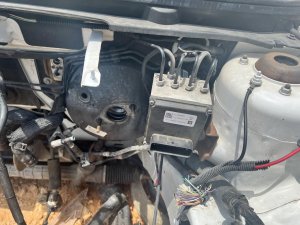
- Module Only Replacement (No Brake Bleeding): Some technicians can carefully unbolt the electronic module from the hydraulic pump (Brake Pressure Modulator Valve or BPMV) while it's still in the car. This is a delicate operation that avoids opening the brake lines, saving significant time and the hassle of bleeding the brakes. This is the preferred method for a skilled DIYer but carries risk of damaging components.
- Full Assembly Replacement (Brake Bleeding Required): This involves disconnecting the battery, removing the brake lines from the hydraulic block (use flare nut wrenches to avoid stripping), disconnecting the electrical harness, and unbolting the entire assembly. The new or used assembly is then installed, and the entire brake system must be thoroughly bled. An advanced scan tool is often required to cycle the ABS pump during the bleeding process to remove all trapped air.
On the Chevrolet Malibu, the module is located under the hood on the passenger side, beneath the coolant reservoir. On the Volt, access is also in the engine bay but can be more constrained, sometimes requiring other components to be moved for access.
Warning: Brake fluid is corrosive and will damage paint. Place rags around the master cylinder and brake lines to catch any drips. Always use fresh, sealed DOT 3 or DOT 4 brake fluid as specified for your vehicle.
Cost Comparison
The cost to fix a failed ABS module can vary significantly depending on the parts and labor source.
| Item | Estimated Cost | Notes |
|---|---|---|
| New OEM Module | $310 - $500 | Part only. Prices vary by dealer. |
| Used OEM Module | $100 - $250 | Part only, from an automotive recycler. Price depends on condition and availability. |
| New Aftermarket / Remanufactured | Not Available | No direct-fit aftermarket or remanufactured options were found during research as of early 2026. |
| Shop Labor (Replacement & Programming) | $275 - $840 | Wide range depends on the vehicle (Volt labor is typically higher) and whether the full hydraulic unit is replaced. |
| Total Dealer Repair (New OEM) | $900 - $1,600+ | Includes new OEM part, labor, programming, and brake fluid if needed. |
| Total Independent Shop (Used OEM) | $400 - $1,100+ | Includes used part and labor/programming. Assumes shop is willing to install a customer-supplied or sourced used part. |
Frequently Asked Questions (FAQ)
Can I install a used ABS module myself and have the dealer program it?
Maybe. While you can physically install the part, some dealerships refuse to program customer-supplied used electronic parts due to liability concerns. Always call your local dealer or independent shop and ask about their policy before buying and installing a used module.
Is it safe to drive with a bad ABS module?
Your vehicle's primary braking system will still work, meaning the car will stop when you press the brake pedal. However, you will NOT have anti-lock brakes, traction control, or stability control. This significantly increases the risk of skidding and losing control in an emergency stop or on slippery roads. It is strongly recommended to have the module repaired as soon as possible.
Why can't I find a cheaper aftermarket or remanufactured module?
This specific ABS module is complex, tied into hybrid and regenerative braking systems, and was used on a relatively limited number of vehicles. The low production volume and high complexity make it unprofitable for most aftermarket companies to reverse-engineer and manufacture a replacement.
Will replacing a wheel speed sensor fix my ABS light?
It might, but only if the diagnostic code points to a single, specific wheel speed sensor failure. If you have codes for multiple sensors, or a code specifically for the module's internal performance (like C056D), the module itself is the likely cause, not the sensors.
Technical Specifications
OEM Part Numbers: 20864952 20918875 22840013 23170879 84088525 85132072
Manages ABS, Traction Control, Stability Control, and integrates with the hybrid regenerative braking system. Requires programming via GM Techline Connect (SPS2).
We Have This Part in Stock





The information in this article is provided for general reference and educational purposes only. Vehicle specifications, procedures, and part compatibility can vary by production date, trim level, and region. Always consult your vehicle's factory service manual and verify part numbers before purchasing or performing repairs. Safety-critical components such as airbags, seat belts, and braking systems should be installed by a qualified professional.
- Chevrolet Volt:
- Chevrolet Malibu:
- 🛍️ Shop This Part
- Symptoms of a Failing ABS Control Module
- Common Diagnostic Trouble Codes (DTCs)
- Known Issues, Recalls, and Technical Service Bulletins (TSBs)
- 2011-2017 Chevrolet Volt
- 2016-2017 Chevrolet Malibu Hybrid
- Buying a Used ABS Control Module: What You Must Know
- Compatibility Checks
- Inspection and Red Flags
- Programming and Calibration Requirements
- Replacement Procedure Overview
- Cost Comparison
- Frequently Asked Questions (FAQ)
- 🎟️ Get 5% Off