

2015-2025 Expedition & Navigator A/C Compressor: Noises, TSBs, and Evaporator Issues
Diagnosing A/C problems in these SUVs is complex; what seems like a bad compressor could be a faulty sensor, a recalled blower motor, or a known refrigerant issue.
- Poor A/C performance may not be the compressor. A known issue with a faulty evaporator temperature sensor causes the system to freeze up (TSB 22-2089).
- A burning smell or smoke from the vents on 2015-2017 models is likely the blower motor, which is under a fire-risk recall (22S56), not the compressor.
- You MUST verify if your vehicle uses R134a or R1234yf refrigerant via the under-hood sticker before buying parts or servicing the system.
- A grinding noise on 4WD models could be the common IWE (Integrated Wheel End) issue, not the A/C compressor. If the noise stops in 4WD, it's likely the IWEs.
Symptoms of a Failing A/C Compressor

A failing A/C compressor in a Ford Expedition or Lincoln Navigator will make itself known through several distinct symptoms. Paying attention to these signs can help you diagnose the problem before it causes a complete system failure.
A/C Blows Warm or Merely Cool Air
This is the most common symptom. If the compressor is weak or has failed, it cannot adequately pressurize the refrigerant to start the cooling process. The air from your vents may be slightly cooler than the outside air but will not be cold. This can also be a sign of low refrigerant, which could be caused by a leak in the compressor or elsewhere in the system.
Loud Grinding, Whining, or Squealing Noises
Unusual noises from the engine bay when the A/C is turned on are a major red flag. A grinding or rattling sound often indicates failing internal bearings. A loud squeal can point to a slipping serpentine belt, which may be caused by a compressor that is beginning to seize. If the compressor's internal components fail, they can send metal debris throughout the entire A/C system, leading to a much more expensive repair.
Pro Tip: On 4WD models, a grinding noise during acceleration can also be caused by the Integrated Wheel End (IWE) system. If the noise goes away when you switch to 4WD, the issue is likely the IWEs, not the A/C compressor. Ford has issued multiple Technical Service Bulletins (TSBs) for this common issue.
A/C Compressor Clutch Does Not Engage
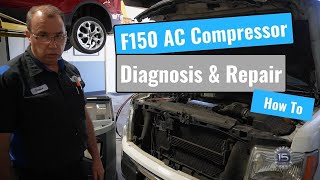
🎬 Watch: How to diagnose and repair a Ford A/C compressorThe compressor has a clutch on its pulley that engages and disengages to cycle the compressor on and off. You should hear a distinct 'click' when you turn on the A/C, and you can visually see the outer plate of the pulley start spinning with the belt. If the clutch does not engage, it could be due to a failed clutch coil, a blown fuse, low refrigerant pressure (which prevents engagement as a safety measure), or a faulty compressor.
Visible Refrigerant Leak
The compressor has several seals that can fail over time, leading to leaks. A/C refrigerant contains a special oil to lubricate the compressor. If you see a greasy, oily residue on the body of the compressor, it's a sign of a leak. Technicians often add a UV dye to the system to make finding these leaks easier with a blacklight.
Known Issues, TSBs, and Recalls

For the 2015-2025 Ford Expedition and Lincoln Navigator, several known issues can be mistaken for a faulty A/C compressor. Always check for these possibilities before replacing the compressor itself.
TSB: A/C Evaporator Freezing Up (Poor Cooling/Low Airflow)
🎬 Watch: Why your airflow suddenly stops and TSB 22-2089 explainedMany owners of 2018-2020 Expedition and Navigator models (among other Fords) have experienced poor A/C performance or a sudden loss of airflow, especially on hot days. This is often caused by the A/C evaporator core freezing into a block of ice. The root cause is frequently a faulty evaporator temperature sensor that gives incorrect readings. Ford issued TSB 21-2250 and the updated TSB 22-2089 to address this. The fix involves replacing the sensor, which is a labor-intensive job as it is located deep within the dashboard.
Recall: Front Blower Motor Fire Risk (2015-2017 Models)
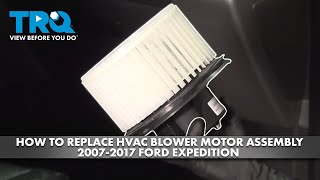
🎬 See this walkthrough on replacing the front HVAC blower motorRecall Notice: Ford issued recall 22S56 for 2015-2017 Ford Expedition and Lincoln Navigator SUVs due to a faulty front blower motor. This motor, located behind the glove box, can fail, overheat, and potentially cause an interior fire. Symptoms include a burning smell, smoke from the vents, or the fan stopping completely. This is NOT a compressor issue, but it is a critical safety-related A/C system failure.
Customer Program: Contaminated Refrigerant (2018 Models)
A specific batch of 2018 Expedition and Navigator vehicles built between January and early February 2018 were subject to Customer Satisfaction Program 20N08 (also referenced as 18N01). These vehicles may have been filled with contaminated R-1234yf refrigerant from the factory. This could cause a lack of A/C cooling. The program extended the warranty on A/C components and required dealers to use special equipment to evacuate the system and replace the compressor and other parts if contamination was found.
TSB: Water Leaking into Passenger Footwell (2018-2020 Models)
TSB 20-2170 addresses an issue where the A/C evaporator drain tube could allow condensation to leak into the right front passenger floor area. While not a direct compressor failure, this water leak has been theorized by Ford to be a contributing factor in another recall (24S06) for inadvertent seat belt pretensioner deployment due to potential corrosion. The fix involves installing a simple elbow on the drain tube.
The Critical Refrigerant Question: R134a vs. R1234yf

During this vehicle's production run, manufacturers transitioned from R134a refrigerant to the more environmentally friendly but more expensive R1234yf. The 2018 model year appears to be the primary transition point for the Expedition and Navigator.
Warning: These two refrigerants are NOT interchangeable. The service ports are different to prevent cross-contamination, and the systems are designed for the specific properties of each refrigerant. Using the wrong type can damage A/C components and lead to poor performance.
Before purchasing a compressor or servicing the system, you MUST verify which refrigerant your vehicle uses. This information is found on a sticker under the hood, typically on the radiator support or a strut tower.
Buying a Used A/C Compressor
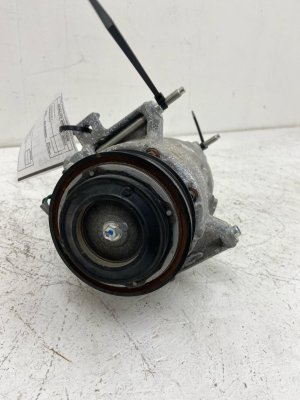
A used OEM compressor can be a cost-effective and reliable alternative to expensive new parts, especially when compared to cheap, new aftermarket units which can have questionable quality. When buying used, careful inspection is key.
- Verify Part Numbers: Match the part number from your old compressor to the used one. The provided OEM part numbers are a good starting point, but physical confirmation is best.
- Check the Pulley and Clutch: The pulley should spin freely and smoothly by hand with no grinding or roughness. The clutch plate on the front should be intact and not show signs of extreme heat or scoring.
- Inspect for Leaks: Look for oily residue around the seals and where the two halves of the compressor body meet. A clean, dry compressor is a good sign.
- Ensure Ports are Capped: A reputable seller will cap the inlet and outlet ports to prevent moisture and debris from entering the compressor during storage and shipping. A compressor that has been left open to the elements is likely contaminated and should be avoided.
- Confirm Refrigerant Type: Ensure the donor vehicle used the same type of refrigerant (R134a or R1234yf) as your vehicle.
Replacement Overview & Difficulty

Replacing the A/C compressor is a difficult job best left to professionals or experienced DIY mechanics. The primary challenge is the need for specialized equipment to safely and legally recover the refrigerant from the system before starting work and to properly vacuum and recharge the system afterward.
- Difficulty: 4 out of 5
- Key Steps: Refrigerant recovery, serpentine belt removal, disconnecting electrical connectors and refrigerant lines, unbolting the old compressor, installing the new one, and then vacuuming and recharging the system.
- Required System Flush: If the old compressor failed internally, the entire system must be flushed to remove metal debris. You must also replace the receiver/drier (or accumulator) and the orifice tube (or expansion valve) to ensure the new compressor isn't damaged and to validate its warranty.
Cost Comparison
| Part Type | Estimated Cost |
|---|---|
| New OEM | $420 - $700 |
| New Aftermarket | $250 - $500 |
| Used OEM | $80 - $150 |
| Remanufactured | $175 - $300 |
| Shop Labor | $250 - $550 |
Note: Labor costs do not include the price of refrigerant or other necessary parts like a receiver/drier or system flush.
Frequently Asked Questions (FAQ)
My A/C isn't blowing cold. Is it definitely the compressor?
Not necessarily. For these vehicles, the problem could be a simple refrigerant leak, a faulty pressure switch, or the known issue of the evaporator freezing due to a bad temperature sensor (TSB 22-2089). A proper diagnosis with manifold gauges is needed to check system pressures before condemning the compressor.
Can I replace the A/C compressor myself?
While mechanically possible, it is not recommended for beginners. Federal law requires the use of special equipment to recover refrigerant; releasing it into the atmosphere is illegal. The system must also be put under a deep vacuum to remove moisture before recharging. Failure to do this will cause the new compressor to fail quickly.
Do I need to replace any other parts with the compressor?
Yes. Any time you replace the compressor, you must also replace the A/C receiver/drier (or accumulator) and the orifice tube/expansion valve. If the old compressor failed internally, the entire system must be flushed to remove debris. Skipping these steps will void the warranty on the new compressor and lead to premature failure.
How do I know if my Expedition or Navigator uses R134a or R1234yf refrigerant?
Check the information label under the hood. It is typically a silver or white sticker located on the core support above the radiator or on one of the strut towers. It will explicitly state which refrigerant type the system contains and the correct charge amount.
Helpful Videos
Technical Specifications
OEM Part Numbers: FL1419D629AA FL1419D629AB FL14AA FL1Z19703A FL1Z19703B JL1419D629AB JL1419D629AC JL1Z19703AB KL1419D629BA KL1Z19703A L1MZ19V649EB NL1H-19D629-AB NL1H-19D629-BA NL1H19D629 NL1H19D629AA
Fits vehicles with the 3.5L V6 turbocharged engine. System refrigerant type is either R134a or R1234yf depending on model year; this must be verified by the under-hood sticker.
We Have This Part in Stock



The information in this article is provided for general reference and educational purposes only. Vehicle specifications, procedures, and part compatibility can vary by production date, trim level, and region. Always consult your vehicle's factory service manual and verify part numbers before purchasing or performing repairs. Safety-critical components such as airbags, seat belts, and braking systems should be installed by a qualified professional.
- Ford Expedition:
- Lincoln Navigator:
- 🎬 Helpful Videos
- 🛍️ Shop This Part
- Symptoms of a Failing A/C Compressor
- A/C Blows Warm or Merely Cool Air
- Loud Grinding, Whining, or Squealing Noises
- A/C Compressor Clutch Does Not Engage
- Visible Refrigerant Leak
- Known Issues, TSBs, and Recalls
- TSB: A/C Evaporator Freezing Up (Poor Cooling/Low Airflow)
- Recall: Front Blower Motor Fire Risk (2015-2017 Models)
- Customer Program: Contaminated Refrigerant (2018 Models)
- TSB: Water Leaking into Passenger Footwell (2018-2020 Models)
- The Critical Refrigerant Question: R134a vs. R1234yf
- Buying a Used A/C Compressor
- Replacement Overview & Difficulty
- Cost Comparison
- Frequently Asked Questions (FAQ)
- 🎟️ Get 5% Off