

2017-2019 Honda CR-V A/C Control Module: Programming, TSBs, and Replacement Guide
A deep dive into the automatic temperature control module for the fifth-generation Honda CR-V, covering critical programming requirements and known issues.
- This module is NOT plug-and-play. Replacement requires a software update by a Honda dealer or a shop with an i-HDS tool per TSB 19-032.
- The module was replaced as part of a fix for engine misfire issues (DTCs P0300-P0304) on 2017-2018 models.
- If your only symptom is weak or no A/C cooling, first investigate the common compressor shaft seal leak (TSB A23-040), which has a 10-year extended warranty.
- Ensure your vehicle has automatic climate control (with an 'AUTO' button) before buying; this part does not fit manual A/C systems.
Symptoms of a Failing A/C Control Module

When the A/C control module in a 2017-2019 Honda CR-V begins to fail, it can cause a range of confusing symptoms. Because the module controls the entire HVAC system, a fault can mimic other problems, like a bad blower motor or blend door actuator. Here are the most common signs that point to the module itself:
- Incorrect Temperature Output: The most frequent complaint is air that is the wrong temperature—for example, hot air blowing when the A/C is on, or cold air when the heat is on.
- Unresponsive Controls: Buttons or knobs on the climate control panel may stop working or only work intermittently.
- Blower Fan Issues: The fan may be stuck on one speed, not work at all, or run continuously even when turned off.
- Incorrect Airflow Direction: The system may be stuck on one setting (like defrost or floor vents) and won't switch to other vents when you press the button.
- System is Completely Dead: In some cases, the entire climate control panel may go dark and become completely unresponsive.
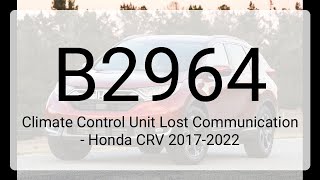
A professional scan tool that can read Honda-specific Body (B-series) Diagnostic Trouble Codes (DTCs) is essential for accurate diagnosis. A code like B2964 indicates a communication loss between the climate control unit and the front panel, pointing directly to a module or wiring issue.
🎬 Watch: Diagnosing DTC B2964 communication lossWarning: Many of these symptoms can also be caused by less expensive parts like a failed blend door actuator, a bad blower motor resistor, or a simple refrigerant leak. Always perform a full system diagnosis before replacing the control module.
Known Issues, TSBs, and Recalls

While there are no direct recalls for the A/C control module itself, it is a key part of a significant issue covered by Honda Technical Service Bulletins (TSBs) for 2017-2018 CR-V models.
TSB 19-032: Software Update with A/C Control Unit Replacement
This is the most critical piece of information for this part. Honda identified an issue where certain 2017-2018 CR-Vs could experience engine driveability problems, setting engine misfire codes (P0300-P0304) or a "fuel system too rich" code (P0172). Honda's official fix involves multiple steps, including replacing the A/C control unit, changing the engine oil, and updating the software for the PGM-FI (engine computer) and TCM (transmission computer).
This TSB is crucial because it confirms that replacing the A/C control unit requires a subsequent software update using a dealer-level tool (the Honda i-HDS). This is not a simple plug-and-play part.
Warranty Extension for A/C Compressor Shaft Seal (TSB A23-040)
Many CR-V owners experience A/C systems that stop blowing cold. The most common cause for this on 2017-2022 models is not the control module, but a leaking A/C compressor shaft seal. This problem is so widespread that Honda extended the warranty on the A/C compressor shaft seal to 10 years with unlimited mileage. If your only symptom is a lack of cold air, investigate this TSB before suspecting the control module.
🎬 Watch: Understanding the CR-V compressor warranty extensionBuying a Used A/C Automatic Temperature Control Module

Buying a used OEM module can be a great way to save money, but it comes with significant considerations due to the programming requirements.
- Verify Compatibility: First and foremost, ensure your CR-V has automatic temperature control. This system has an "AUTO" button and allows you to set a specific temperature. It is different from the manual system with simple blue-to-red dials. This module will not work in a vehicle with manual A/C.
- Part Numbers: The primary OEM part number is 79600-TLA-A63. This number supersedes older versions 79600-TLA-A61 and 79600-TLA-A62. When buying used, aim for the newest revision (A63) if possible, though any of these numbers are functionally correct for the specified years.
- Physical Inspection: Carefully inspect the used module for any signs of physical damage, especially to the connectors and pins. Check for any discoloration that might indicate water intrusion or electrical shorts.
- The Programming Problem: This is the biggest hurdle. As confirmed by TSB 19-032, replacing the module requires software updates with a Honda i-HDS tool. You cannot simply swap the part and expect it to work correctly. You MUST factor in the cost and logistics of a visit to a Honda dealer or a well-equipped independent shop that has this specific software.
- Why Used OEM is Still a Good Choice: Despite the programming, a used OEM module is often superior to new aftermarket options. Aftermarket modules can have quality control issues and may not integrate as seamlessly with the vehicle's complex communication network (B-CAN system). A genuine Honda part, even used, is designed to meet the original specifications.
Pro Tip: Before purchasing a used module, call your local Honda dealer and independent shops. Ask for a quote to "install customer-supplied A/C control module and perform software updates per TSB 19-032." Knowing this cost upfront will help you determine the total cost of the repair.
Replacement and Programming Procedure

Replacing the module is a straightforward mechanical task, but the final software steps are critical.
- Access the Module: The A/C control unit is located behind the glove box on the passenger side.
- Removal: You will need to remove the passenger's dashboard side panel, the undercover, and the glove box assembly to gain access.
- Installation: Disconnect the electrical connectors from the old unit, unbolt it, and install the new unit in its place. Reconnect the electrical connectors.
- Reassembly: Install the glove box and trim panels in the reverse order of removal.
- CRITICAL - Diagnostics and Software Update: This step must be performed by a technician with a Honda i-HDS tool.
- Connect the i-HDS and run the self-diagnostics procedure to ensure the new module is communicating correctly.
- Clear any new DTCs that may have appeared during the swap.
- Update the PGM-FI and TCM software to the latest version, as specified in the TSB.
Cost Comparison
| Part or Service | Estimated Cost |
|---|---|
| New OEM Module (Part # 79600-TLA-A63) | $85 - $125 |
| New Aftermarket Module (e.g., Dorman) | $120 - $470 |
| Used OEM Module | $50 - $100 |
| Shop Labor (Module R&R) | $98 - $143 |
| Dealer Programming/Software Update | $100 - $200 (approx. 1 hour labor) |
Frequently Asked Questions (FAQ)
Does the A/C control module for a 2017-2019 CR-V need to be programmed?
Yes, absolutely. Honda TSB 19-032 confirms that after replacing the A/C control unit, the vehicle's engine and transmission computers (PGM-FI and TCM) must be updated using a dealer-level Honda i-HDS scan tool. This is not a plug-and-play part. Failure to perform the software update can result in unresolved issues.
Can I replace this module myself?
The physical replacement is a relatively easy DIY task for someone with basic tools. The module is located behind the glove box. However, you will still need to take the vehicle to a dealer or qualified independent shop to have the required software updates performed.
My A/C only blows warm air. Is the control module bad?
While possible, it's more likely to be another issue. The most common cause of warm air on these CR-Vs is a refrigerant leak from the A/C compressor shaft seal, which is covered under an extended 10-year warranty (TSB A23-040). Other causes include low refrigerant, a bad compressor, or a clogged condenser. Always diagnose the simple things first.
What's the difference between the automatic and manual climate control unit?
The automatic climate control system, which this module is for, has an "AUTO" button and allows you to set a specific cabin temperature (e.g., 72°F). The manual system has simpler rotary knobs with blue and red markings for temperature and does not use this electronic control module. The parts are not interchangeable.
Helpful Videos
Technical Specifications
OEM Part Numbers: 79600-TLA-A63 79600-TLA-A62 79600-TLA-A61
Module for vehicles with Dual-Zone Automatic Climate Control. Communicates on the vehicle's B-CAN network.
We Have This Part in Stock


The information in this article is provided for general reference and educational purposes only. Vehicle specifications, procedures, and part compatibility can vary by production date, trim level, and region. Always consult your vehicle's factory service manual and verify part numbers before purchasing or performing repairs. Safety-critical components such as airbags, seat belts, and braking systems should be installed by a qualified professional.
- Honda CR-V:
- 🎬 Helpful Videos
- 🛍️ Shop This Part
- Symptoms of a Failing A/C Control Module
- Known Issues, TSBs, and Recalls
- TSB 19-032: Software Update with A/C Control Unit Replacement
- Warranty Extension for A/C Compressor Shaft Seal (TSB A23-040)
- Buying a Used A/C Automatic Temperature Control Module
- Replacement and Programming Procedure
- Cost Comparison
- Frequently Asked Questions (FAQ)
- 🎟️ Get 5% Off